Valea Viilor Fortified Church
Valea Viilor, Sibiu County · Transylvania

About Valea Viilor Fortified Church
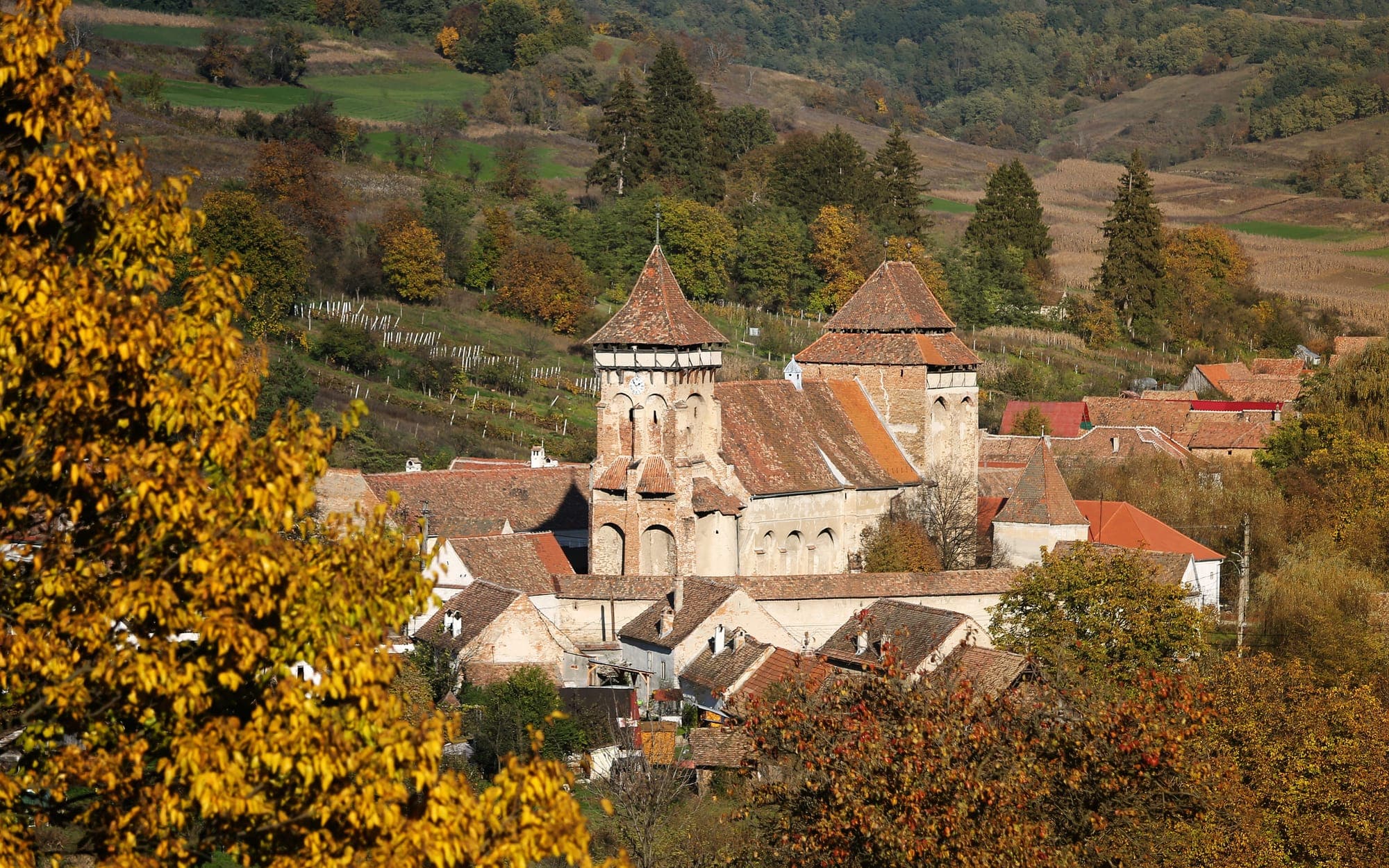
Valea Viilor, known to the Saxons as Wurmloch, appears in documents as early as 1263, and in the middle of the village stands one of the best-preserved fortified churches in Transylvania. The Gothic hall church was built in the 14th century on the site of an older Romanesque basilica and rebuilt in the following century; sources disagree on the exact date. Around 1500 the community turned it into a stronghold, and the ensemble has come down to us almost unchanged.
Precisely because its defences survive almost in full, the church was added in 1999 to the UNESCO site "Villages with Fortified Churches in Transylvania". The last restoration work dates from 1996–1997, and since 2022 the National Heritage Institute has been preparing the project for a new one.
What you can see
From outside, the most striking part is the choir: it was raised like a tower, with three brick defence levels and walls one and a half metres thick, and above them a fourth level, with a timber-framed parapet, projects on arches resting on the buttresses. Another defence level sits above the nave, with loopholes and murder holes. At the entrance bearing the date 1525 the portcullis survives, the sliding grille of iron-reinforced timber that was lowered during a siege, a feature rarely preserved in fortified churches.
The church is ringed by an oval wall 6–7 m high, with a covered wall-walk on brick arcades, bastions and a gate tower. Inside, beneath the net vault, you can see the choir stalls of 1528, from the transition between Gothic and Renaissance, the sacrament niche of 1504 with a relief of Christ as the Man of Sorrows, the Baroque altarpiece of 1779 with the Crucifixion, painted by Stephan Folbarth of Sighișoara, and the organ built by Melchior Achxs in 1807–1808.
Good to know
The church is opened by the custodian who lives in the village; outside opening hours or in winter, phone ahead.
- The choir raised like a tower, with four defence levels, the top one projecting on arches between the buttresses.
- The portcullis at the entrance dated 1525, the iron-reinforced timber grille lowered during a siege.
- The covered wall-walk of the oval enclosure, resting on brick arcades.
- The choir stalls of 1528 and the sacrament niche of 1504, with a relief of Christ as the Man of Sorrows.
- The Baroque altarpiece of 1779, painted by Stephan Folbarth of Sighișoara, with the Crucifixion at its centre.
Good to know before you go
- Getting there
By car: from the DN14, between Mediaș and Copșa Mică, turn south onto the DJ142G, then ~5 km more to the village centre. Mediaș is ~15 km away (~20 minutes), Sibiu ~50 km (~1 hour) and Sighișoara ~52 km (~1 hour).
Public transport: the nearest railway station is Copșa Mică, ~8 km away, from where you continue by taxi. The UNESCO Bus blue line (Sibiu–Sighișoara) stops in Valea Viilor all year round on certain days of the week, by online reservation only, made in advance.
- Where to park
The county tourism website lists parking for cars and coaches next to the church, in the village centre. Charges are not published.
- Fees & discounts
A ticket costs 8 lei per person, according to the Mediaș Lutheran Deanery. Entry is free with the Kirchenburgenpass (Transilvania Card). Guided tours in German on request.
- Facilities
small museum of Saxon culture at the entrance · souvenir shop · toilets · viewpoint
Reviews
Other attractions nearby
The closest attractions to Valea Viilor Fortified Church, sorted by distance.
 17 km from Valea Viilor Fortified Church
 Top 10026 km from Valea Viilor Fortified Church
 27 km from Valea Viilor Fortified Church