Făgăraș Citadel
Făgăraș, Brașov County · Transylvania

About Făgăraș Citadel
Făgăraș Citadel is first documented as a stone fortress in 1455, on the site of an earth-and-timber stronghold probably destroyed during the Tatar invasion of 1241. Standing halfway between Brașov and Sibiu, close to Wallachia, it was for centuries the centre of one of the largest estates in Transylvania. Michael the Brave held it in 1599 and gave it to his wife, Lady Stanca.
Its present form is the work of its 16th- and 17th-century owners: Ștefan Mailat turned the military fortress into a fortified castle, Gaspar Békés dug the moat, and Prince Gabriel Bethlen added the bastions and an Italian Renaissance loggia. Under Michael I Apafi it became a princely residence, and between 1670 and 1691 the Transylvanian Diet met here 11 times — more often than in Alba Iulia over the same period.
Its later history is darker: after 1696 it served as an Austrian barracks and prison, and from 1948 to 1960 it was a communist prison for political detainees. Restored in 1965–1977 and again after 2020, the citadel now houses the Făgăraș Land Museum "Valer Literat".
What you can see
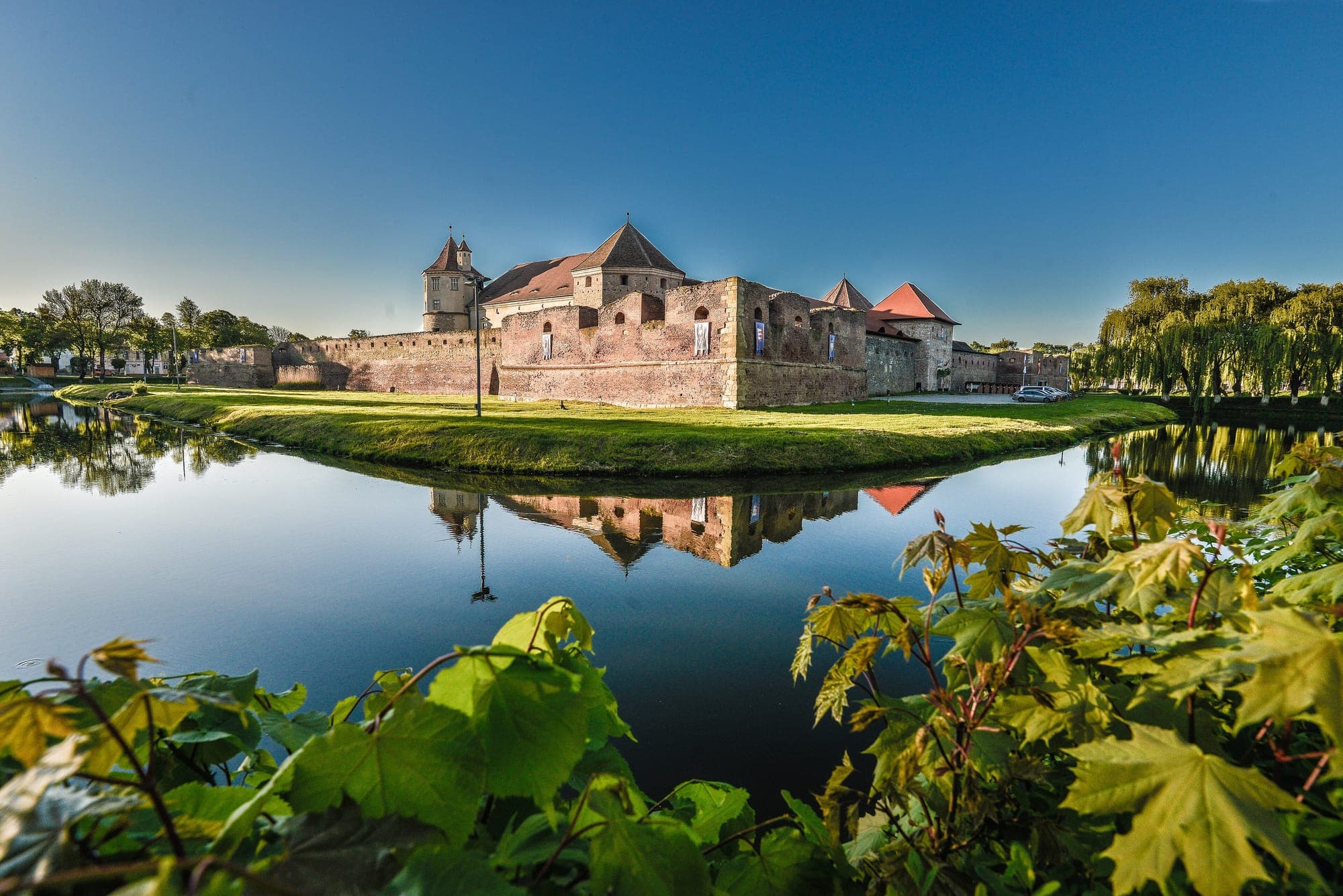
You enter over a timber bridge rebuilt on the model of the 17th-century ones, across a wide water-filled moat where swans usually swim. The outer enclosure, with thick walls and corner bastions, surrounds the castle itself, with its paved inner courtyard and the arcaded loggia on the south side.
The museum fills the castle's halls on two levels and has three sections: the history of the Făgăraș Land (from the Bronze Age to 1918), local ethnography (pottery, textiles, folk costume, icons painted on glass) and fine and decorative art. Temporary exhibitions are held alongside them.
Good to know
The citadel is currently being restored: the works that began in 2025 cover bastions, the guardhouses, the gate tower and the castle, so some areas may be closed or under scaffolding.
- The timber bridge with its drawbridge mechanism, rebuilt on the 17th-century model.
- The arcaded loggia on the south side of the inner courtyard, built by Gabriel Bethlen.
- The corner bastions of the outer enclosure, including the Bethlen Bastion, the only wedge-shaped one.
- The museum's ethnography section, with folk costume, pottery and icons painted on glass from the Făgăraș Land.
- A full walk along the moat, with the citadel reflected in the water.
Good to know before you go
- Getting there
By car: the citadel is in the centre of Făgăraș, just off the DN1, ~65 km from Brașov and ~75 km from Sibiu (~1 hour 15 minutes from either).
Public transport: train on the Brașov–Sibiu line to Făgăraș station, then ~20 minutes on foot to the citadel.
- Where to park
Free parking, with plenty of spaces around the citadel, including for coaches. The entrance is on Strada Mihai Viteazul.
- Fees & discounts
Adults 30 lei, pupils and students 10 lei, seniors 15 lei. Free for children under 7, people with disabilities and their companions. The ticket covers both the citadel and the museum and is sold only at the entrance ticket office; there are no group discounts. Organised groups of at least 15 people get a free guided tour. Local residents (with a Făgăraș ID card) enter free on Tuesdays at 13:00 and Wednesdays at 16:00.
- Rules
Disposable overshoes are worn in the museum, and tickets are checked on both levels of the tour. Photography and filming are allowed for personal use only; tripods are not permitted. Food and drink are not allowed inside the citadel, nor bicycles in the museum.
- Facilities
Information desk · toilets · free Wi-Fi · free parking
Reviews
Other attractions nearby
The closest attractions to Făgăraș Citadel, sorted by distance.
 Top 10032 km from Făgăraș Citadel
 Top 10037 km from Făgăraș Citadel