About Costinești
Costinești is a village on the Black Sea shore that turns into a resort every summer and has called itself "the youth resort" for seven decades. The place has gone by many names: the Greek trading post of Parthenopolis, Mangeapunar under the Ottomans, and between 1897 and 1940 Büffelbrunnen, "the buffalo well", while it was a village of Dobrujan Germans. The present name comes from Emil Costinescu, the landowner and politician who bought the land by the shore in the late nineteenth century.
The resort was born in 1949 with the first pioneers' camp and took shape ten years later, when several hundred blue tents went up along the bluff for the international students' camp. The 1960s brought canteens, bungalows and a campsite for a thousand people, the summer theatre and the central club were finished in 1971, and by the early 1990s Costinești could take more than 60,000 young people in a single summer.
Two landmarks survive from all that, both visible from the sand: the wreck of the Greek cargo ship Evangelia, driven aground here in October 1968, and the Obelisk, a white concrete work by the sculptor Wilhelm Demeter that is actually titled "Camp Signal".
What you can see
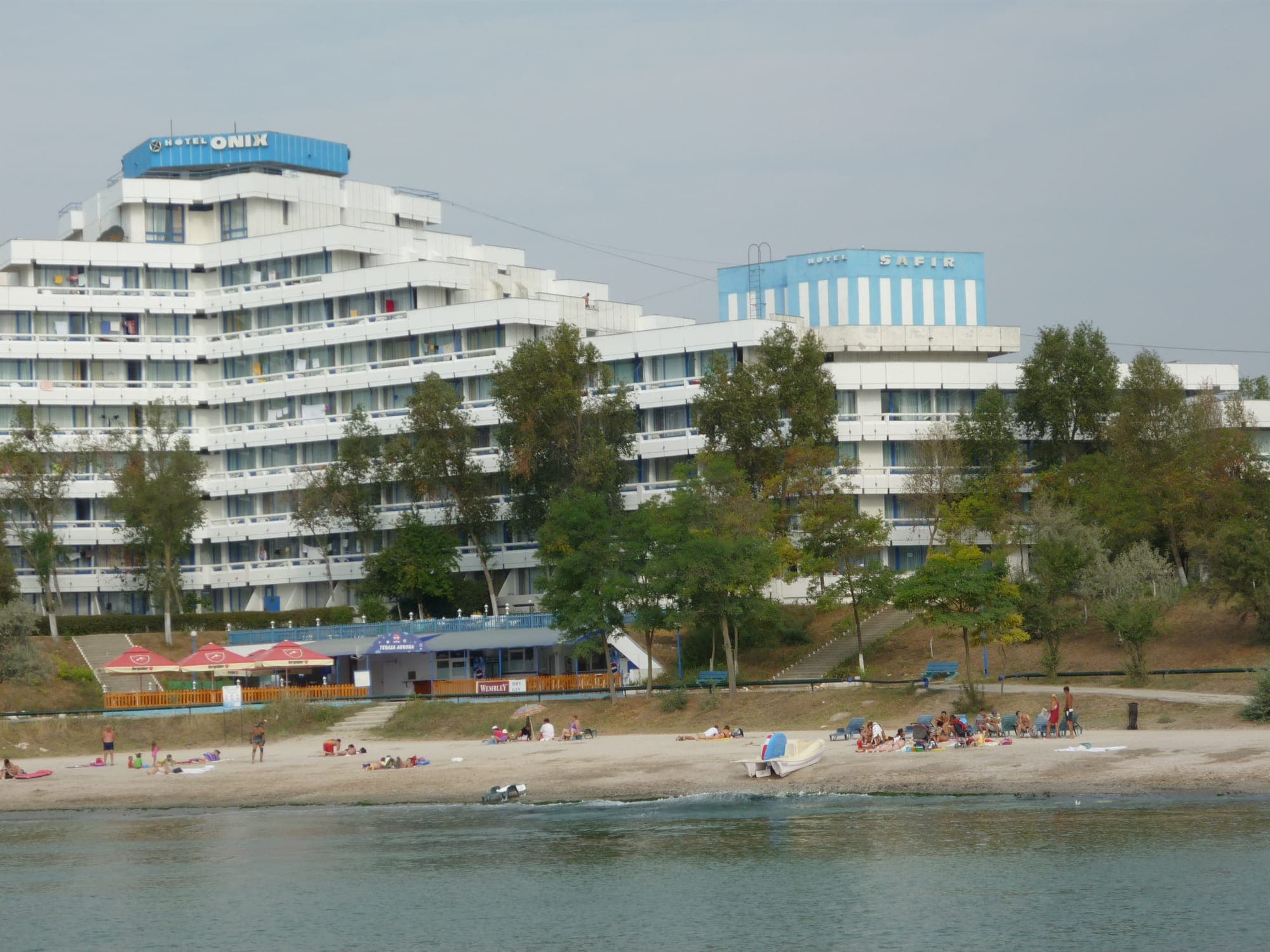
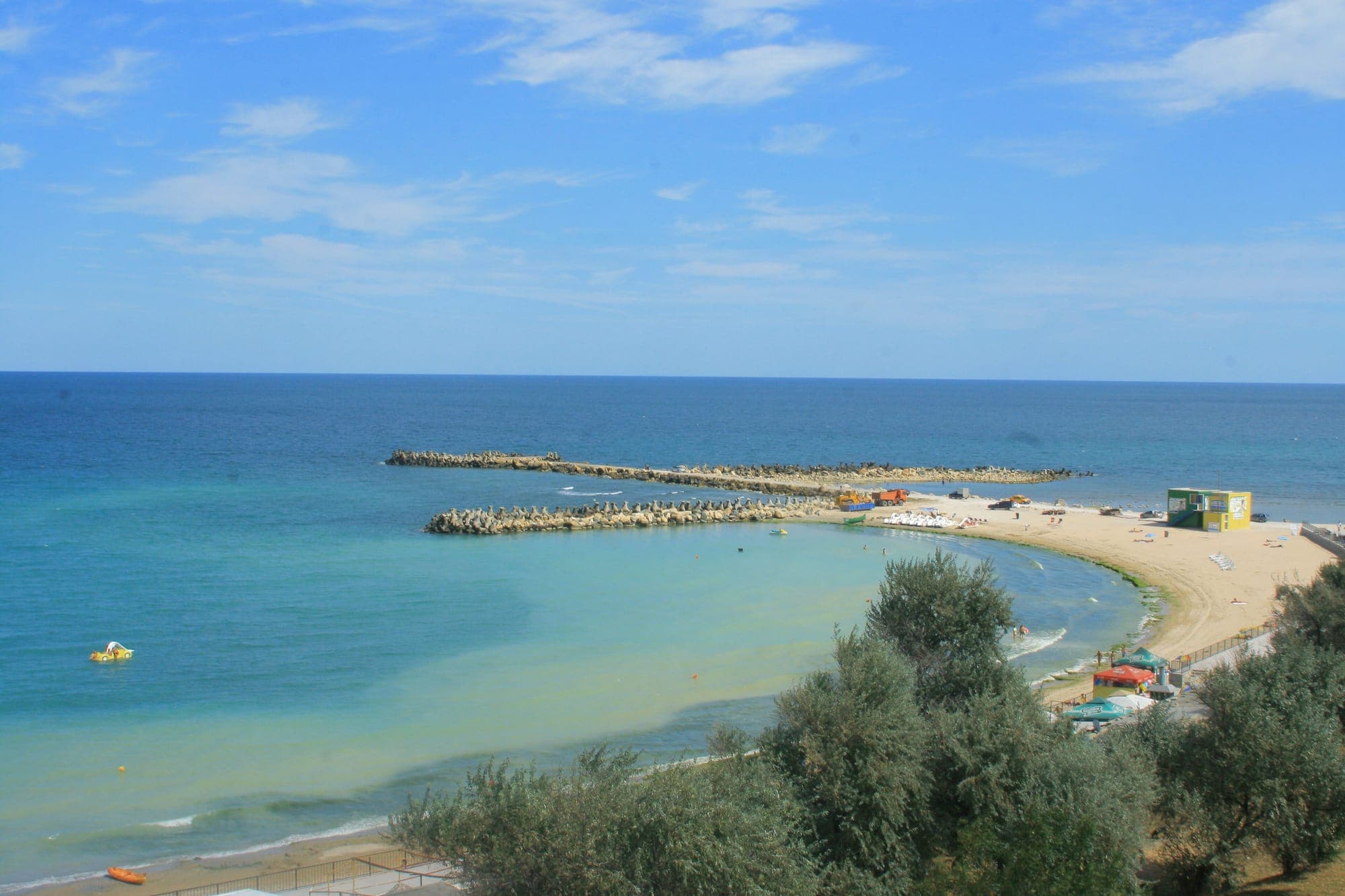
The beach runs for about a kilometre around a wide bay, sheltered by Cape Tuzla, and faces east, so it catches the sun from early morning. In front of the Obelisk it is at its widest and its busiest; to the north it narrows beneath a low clay bluff, and the sand carries on as far as the French Bay. There, out in the water, lies the wreck: a rusted hull broken in two, with the white letters painted by students still legible on its side. Behind the beach is Lake Costinești, seven hectares of it, the only lake on the coast with no underground supply; its salinity has left a layer of mud on the bottom that is used for rheumatic complaints.
Good to know
Since 2025 the shore has been a building site: five breakwaters and a major sand replenishment are meant to bring the beach to 100 metres wide over 2.7 kilometres, with one of the breakwaters passing some 60 metres from the wreck. Work stops for the summer season and starts again in autumn. The wreck is decaying fast — the stern has collapsed and loose sheets of metal drift in the water — so the lifeguards let nobody climb on it.
- The wreck of the Greek cargo ship Evangelia, driven aground in October 1968 and rusting ever since at the northern end of the beach.
- Wilhelm Demeter's Obelisk, 18.5 metres of white concrete raised again in 2006, the resort's classic meeting point.
- The newly built breakwater out by the wreck, from which the ship is some 60 metres away.
- Lake Costinești, just behind the beach, whose salty mud is used for treatments.
- Sunrise watched straight from the sand, in a bay that opens to the east.
Good to know before you go
- Getting there
By car: Costinești is 31 km south of Constanța and ~255 km from Bucharest (the A2 to Constanța, then the DN39/E87 towards Mangalia). The resort is not quite on the main road: you turn off the DN39 and drive a further two kilometres towards the sea. On July and August weekends the entrance to the resort jams up.
Public transport: the resort has its own halt, Costinești Tabără, on the Constanța–Mangalia line, about a kilometre from the beach; it was modernised in 2025–2026 and the line has been closed several times for the works, so it is worth checking the timetable before you set off. Dozens of minibuses also run daily between Constanța and Costinești, from Constanța railway station and the Autogara Sud coach station, a 30–45 minute ride; the first leave around 05:00 and the last towards evening.
- Where to park
Parking in the resort is paid, run by the town hall, and split into two zones. In zone 1, the centre and the streets by the beach, an hour costs 3 lei, three hours 7 lei and 24 hours 25 lei; a weekly pass is 120 lei. In zone 2 the rates are 2 lei an hour, 5 lei for three hours and 15 lei for the whole day. Coaches pay 20 lei an hour and 200 lei a day. In 2026 charging began on 1 July; at the height of the season the spaces near the beach fill up in the morning.
- Fees & discounts
Access to the beach is free along its whole length, including the equipped sections; you pay only for the furniture and for parking. In the summer of 2026 the Romanian press reported rates at Costinești of around 80 lei for a set of two sunbeds with an umbrella, among the lowest on the coast, with a rise of 10–15% from 1 July. Rates differ from one sector operator to the next and are displayed at the entrance to each sector.
- Rules
Climbing on the wreck is forbidden by the lifeguards: the rusted plate cuts deep and loose pieces of the ship drift in the water, so every summer tourists are pulled out of the sea with gashes. Since 2026, anyone who refuses to leave the water when a lifeguard calls them out risks a fine of between 1,000 and 3,000 lei. No cars or quad bikes on the sand, no camping and no street trading, and pets are admitted only with the sector operator's agreement. Watch the flags at the lifeguard posts: red over yellow means the beach is supervised, red means bathing is forbidden and yellow that swimming is not advised.
- Facilities
A water rescue base, two first aid points and 16 observation posts in season · sections with sunbeds and umbrellas, alongside stretches of free beach · beach bars, restaurants and watersports operators on the sand itself · open-air discos in the middle of the resort · diving on the wreck and at the Rapanelor Cave, with the local centres · the sand is hard going with a pushchair or a wheelchair
Reviews
Other attractions nearby
The closest attractions to Costinești, sorted by distance.
 6 km from Costinești
 10 km from Costinești
 13 km from Costinești