
About Sfântu Gheorghe Beach
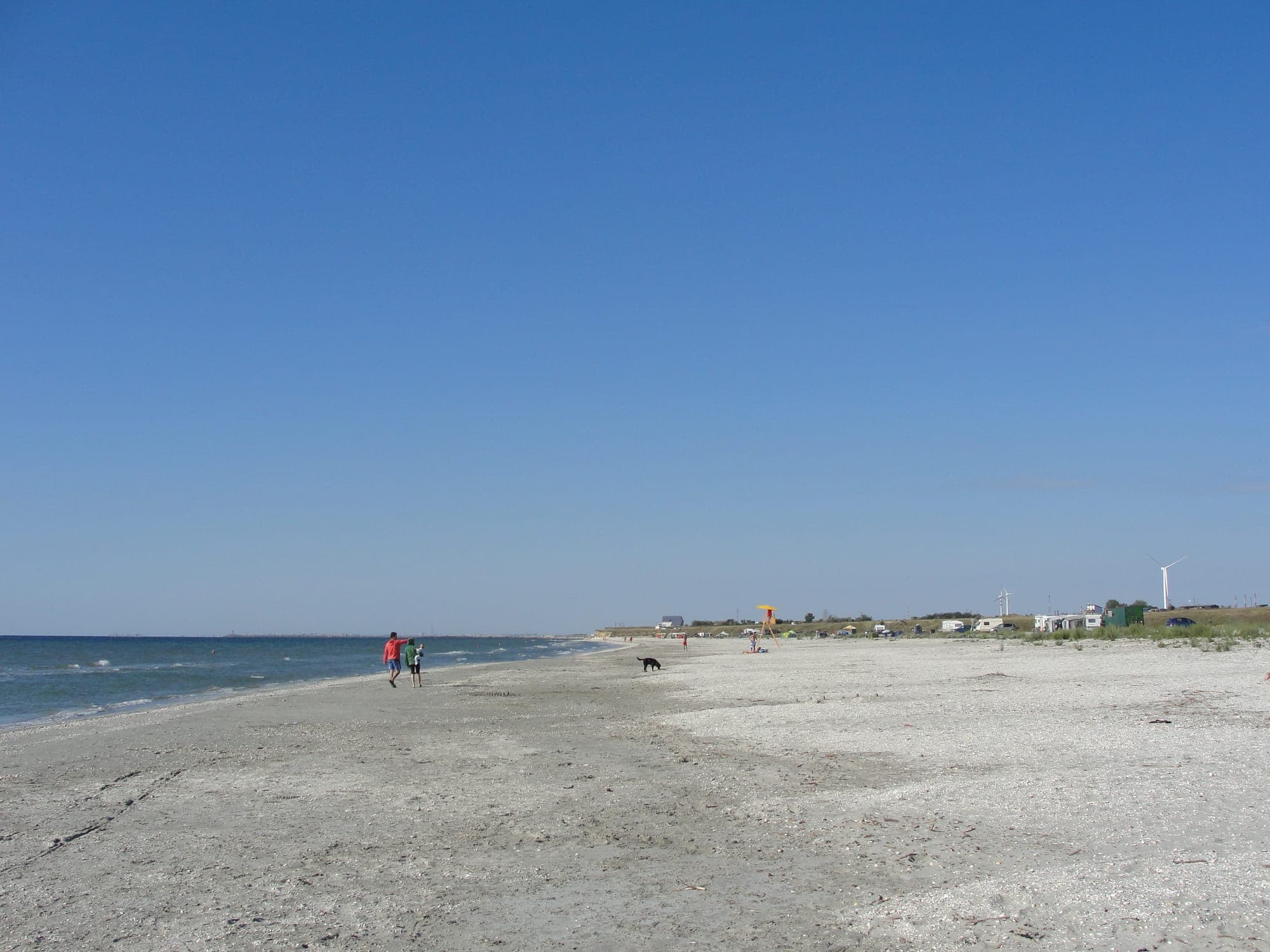
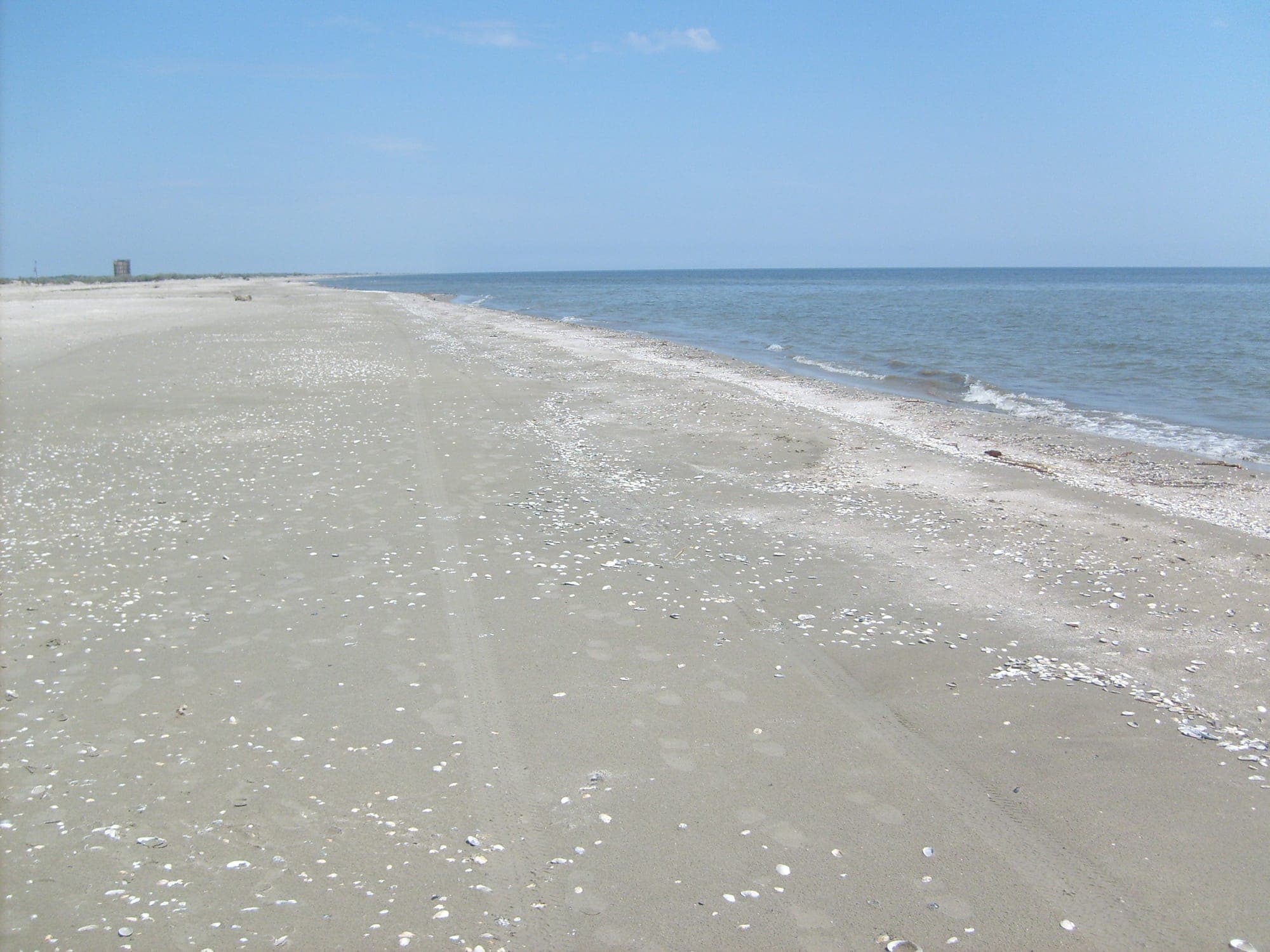
Where the southernmost branch of the Danube runs out into the Black Sea lies the widest beach on the Romanian coast. The commune's town hall puts it at 30 kilometres long and one to two kilometres wide, and along the whole of it nothing has been built: no promenade, no hotels on the sand, only low dunes, scrub and a waterline strewn with broken shells. The Danube pours its fresh water out alongside, so the sea here is less salty than further south and clouds over quickly after a storm.
The beach belongs to Sfântu Gheorghe, a fishing village some 123 kilometres from Tulcea that no road reaches: you come only by water. The settlement appears as San-Giorgio on a Genoese map of 1318 and is documented from the 14th century; the Turks called it Katârlez, the Greeks Aios Iorgos. The old fish-processing station, built between 1950 and 1953 and the largest in the Delta in its day, now stands derelict at the edge of the village.
From the village to the sea is about two kilometres eastwards. You walk it in 20–30 minutes, or take the trocarici, a tractor-drawn trailer with benches and a canopy that carries people to the beach for a few lei. All of this lies inside the Danube Delta Biosphere Reserve, so you need the access permit issued by the reserve administration.
What you can see
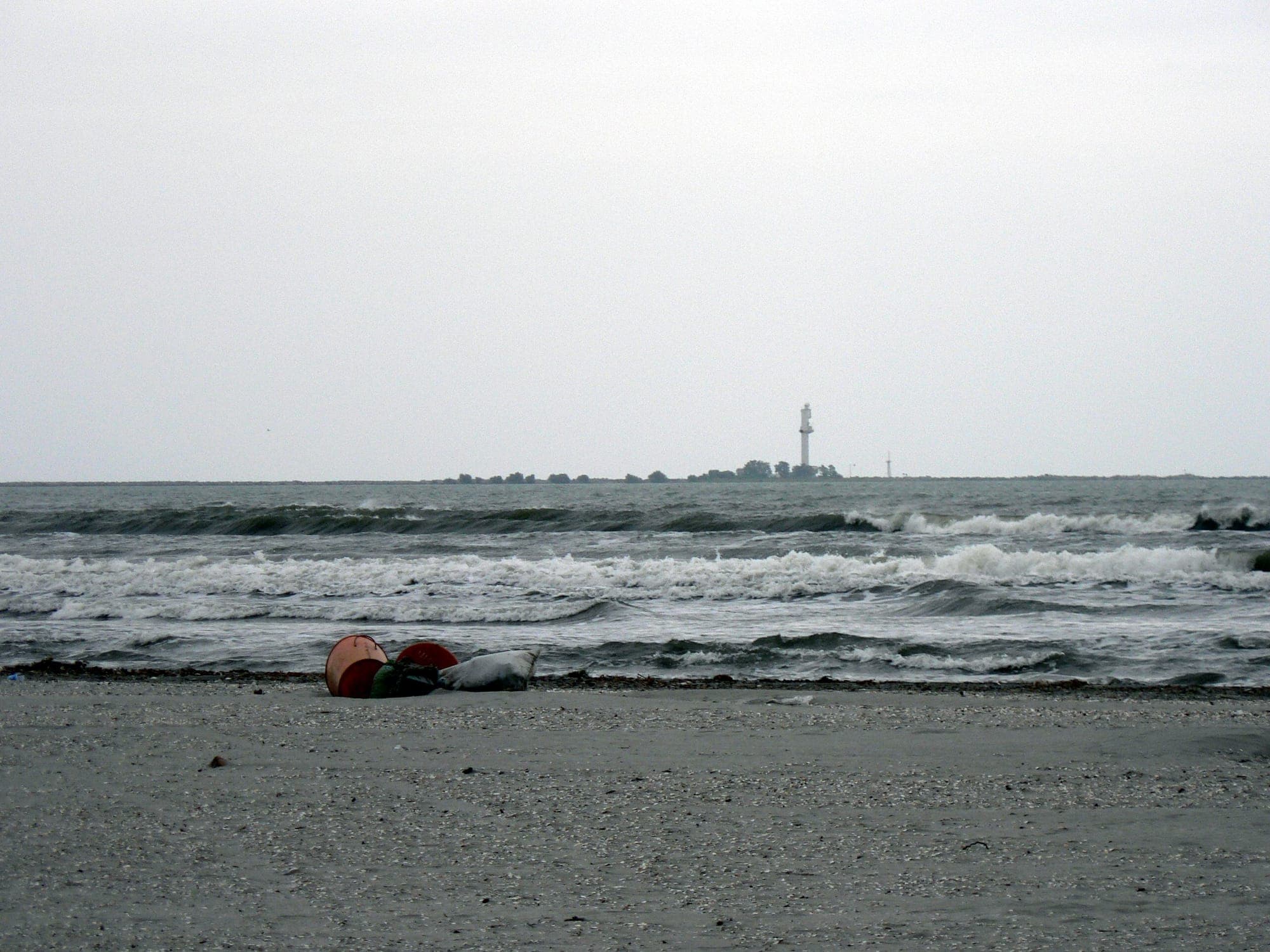
The broad strip of sand running away to the north, emptier the further you walk from the end of the road, and the line of the waves, where small shells and whole rapa whelks gather. To the south, at the mouth of the branch, fresh water visibly mixes with the sea, and beyond it lie Sacalinul Mare and Sacalinul Mic, two recently formed sand islands that cannot be landed on. The lighthouse of 1967, 57 metres tall and built of iron and glass, is the landmark you see both from the sand and from the water. In summer a few drinks terraces work at the beach entrance; otherwise, nothing.
Good to know
There is no lifeguard: the reserve administration classes the beaches at Sfântu Gheorghe and Sulina as wild, unmanaged beaches, and trading is banned within 150 metres of the waterline. Tents and caravans are forbidden inside the reserve outside authorised campsites. The Navrom ships leave Tulcea once a day, at 13:30, and return in the morning at 7:00, so a day on the beach almost certainly means at least one night in the village. In August the village fills up for the Anonimul film festival, held here since 2004.
- The mouth of the Sfântu Gheorghe branch, where the fresh water of the Danube mixes with the sea, at the southern end of the beach.
- The empty strip of sand a few hundred metres beyond the entrance, where you meet nobody at all.
- The two-kilometre journey from the village to the sea, on foot or on the tractor-drawn trocarici trailer.
- The 57-metre lighthouse, built in 1967 of iron and glass, the landmark seen from the sand and from the water.
- The islands of Sacalinul Mare and Sacalinul Mic, watched from a distance, from the beach or from a boat.
Good to know before you go
- Getting there
By car: you cannot get here. The village has no road link to the rest of the county, so the car stays either in Tulcea or in Murighiol. Murighiol is about 330 km from Bucharest, on the A2 leaving at Drajna and then through Slobozia, Țăndărei, Hârșova and Tulcea, or about 360 km through Fetești, Cernavodă, Babadag and Tulcea. From Tulcea to Murighiol is roughly 40 km, by way of Mahmudia.
Public transport: the Navrom Delta ships leave the port of Tulcea at 13:30 and run up the Sfântu Gheorghe branch, calling at Bălteni de Jos and Mahmudia; the return sailing leaves Sfântu Gheorghe at 7:00. Faster are the speedboats from Murighiol, from the landing stage in the car park of the Star 2000 petrol station: the transfer run by the village resort takes around 60 minutes and departs according to bookings. From the village harbour it is about 2 km east to the beach, 20–30 minutes on foot along an unsurfaced track, or by trocarici, the bench-lined trailer pulled by a tractor.
- Where to park
There is no car park at the beach, and nothing to park: the car stays on the mainland. In Murighiol you leave it in the car park at the Star 2000 petrol station, where the speedboats go from, at 25 lei a day per vehicle; the other option is to leave it in Tulcea, where the ship departs. Very few cars move around the village, and driving onto the sand and the dunes is forbidden. The reserve's vehicle permit, 10 lei a day or 100 lei until the end of the year, is valid only on public roads inside the reserve, and parking near natural banks and reed beds is not allowed.
- Fees & discounts
The beach has no ticket; what you pay for is the journey by water and the reserve access permit. The Navrom Tulcea–Sfântu Gheorghe crossing costs 70 lei per person each way on the classic boat and 80 lei on the semi-rapid, and tickets bought online at navromdelta.ro are charged at the classic fare whichever boat you take. Residents of the Delta and of the town of Tulcea pay a subsidised fare, 19 lei on the classic boat and 28 lei on the semi-rapid. Children under 7 and school pupils travel free, pensioners get 50% off, and people with severe or accentuated disabilities travel free; those tickets are issued at the ticket office or on board, on production of documents. The visitor access permit for the Danube Delta Biosphere Reserve costs 5 lei for one day, 15 lei for seven days and 30 lei until the end of the year, and is free for pupils, students, pensioners, war veterans, former political prisoners, people with disabilities and anyone living inside the reserve or in the neighbouring communes. It is bought online at ddbra.ro, by SMS to 7494, at SelfPay terminals or, in cash, at the information centres in Sulina, Crișan and Murighiol — the one in Sfântu Gheorghe is temporarily closed. The recreational fishing permit is free but is issued separately; a boat permit costs 20 lei for seven days. Commercial photography costs 100 lei, filming for educational purposes 50 lei, and flying a drone under 500 g 50 lei. The trocarici to the beach costs a few lei per person each way.
- Rules
The beach lies inside the Danube Delta Biosphere Reserve, so you need an access permit, children included — theirs is free, but it still has to be obtained. Tents and caravans are banned throughout the reserve outside authorised campsites. Driving and parking cars or ATVs on the sand and the dunes is not allowed. The reserve administration classes this as a wild beach and provides no lifeguards, so you swim at your own risk; trading is banned within 150 metres of the waterline. The Sacalin islands and the strictly protected Sacalin-Zătoane complex are closed to visitors, and unauthorised entry is fined. Fishing needs the recreational fishing permit, with a limit of 5 kg of fish a day and no more than 10 kg per angler or 15 kg per family carried out of the reserve; pike, zander, catfish and carp must be released at once, apart from a single specimen a day. Drones and commercial photography need separate permits.
- Facilities
No lifeguard · a few drinks terraces at the beach entrance, in summer only · bins placed by the town hall along the track and on the beach · no natural shade · no surfaced road to the sand · trocarici transport from the village in season · accommodation, shops, the village museum and the cultural centre in the village, 2 km away · the reserve's information centre in the village is temporarily closed
Reviews
Other attractions nearby
The closest attractions to Sfântu Gheorghe Beach, sorted by distance.
 37 km from Sfântu Gheorghe Beach
 70 km from Sfântu Gheorghe Beach
 78 km from Sfântu Gheorghe Beach