The Bucegi Sphinx
Moroeni, Dâmbovița County · Muntenia

About The Bucegi Sphinx
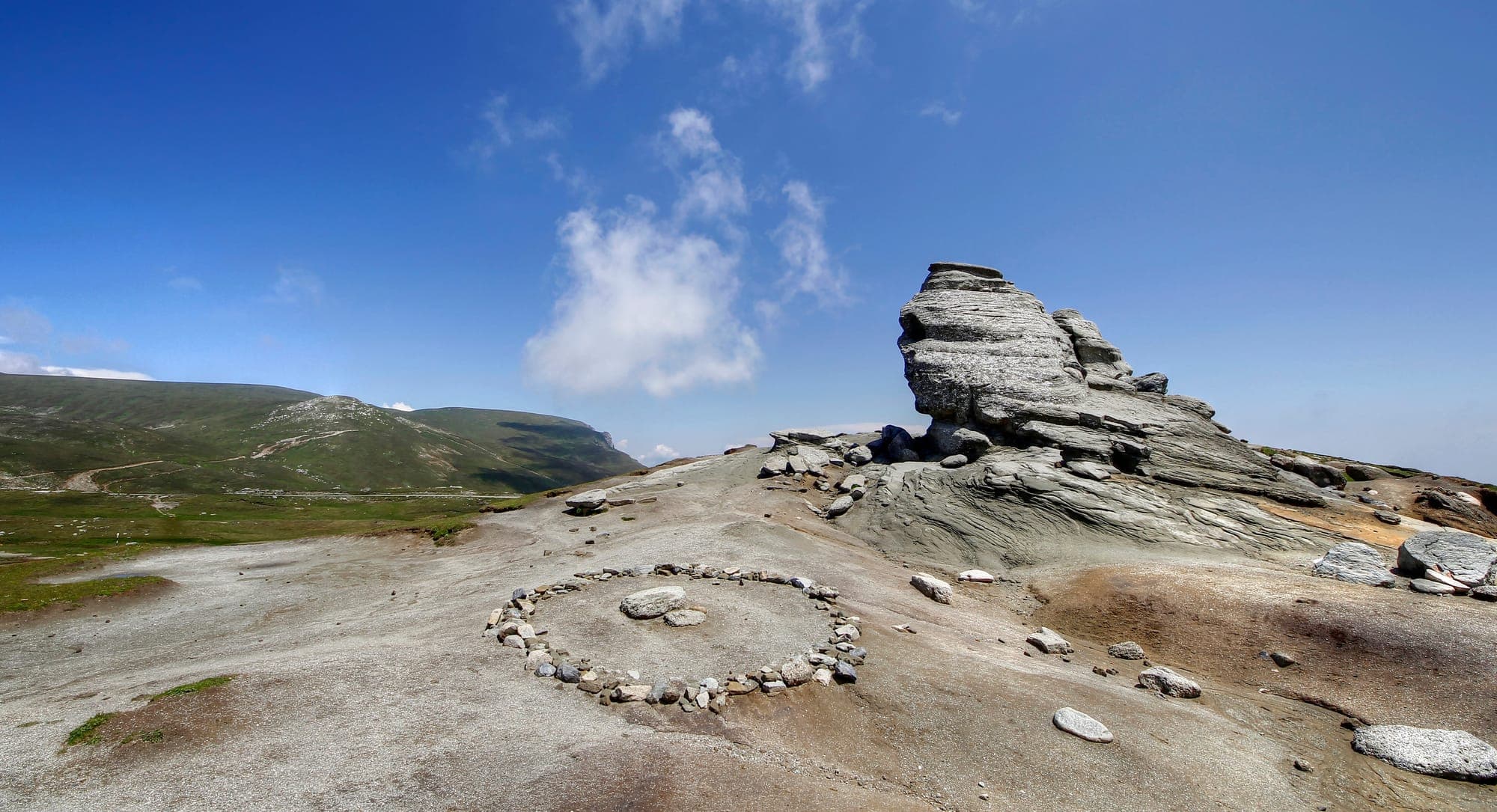
The Sphinx is a natural megalith on the plateau of the Bucegi Mountains, a block of conglomerate and sandstone about 8 m high and 11–12 m wide. Nobody carved it: the harder and softer layers of the rock wore away at different rates under water, wind and repeated freezing, until what was left was a profile that, seen from the side, recalls a human face, and to some the Sphinx of Giza.
The oldest known photograph of the rock dates from around 1900 and presented it as part of the "Babele of Caraiman". The name Sphinx appears in mountaineering publications in the 1930s, and since then the rock has become one of the symbols of the Bucegi: it featured in historical films such as "The Dacians" (1967) and on the back of the 50,000 lei banknote issued in 2000. Besides the geology, the place gathers plenty of legends about the Dacians and mysterious energies, which you can listen to without taking them seriously.
Administratively, the Sphinx and Babele belong to the commune of Moroeni, in Dâmbovița county, although they are easiest to reach from Bușteni, in Prahova; the dispute between the two counties lasted more than 25 years and was settled for good in 2026. The rock is protected within Bucegi Natural Park.
What you can see
The famous profile only shows from the side, from the marked spots around the rock where nearly every visitor stops; from the front or the back the rock looks like a plain mound of layered stone. It is worth walking around the Sphinx to see the horizontal layers, the hollows and the "eye" deepened by erosion. Around it lies the bare plateau, with smaller rocks shaped in the same way, and a few minutes to the south are Babele, the stone mushrooms by the cable car station. On a clear day you can see the Leaota ridges to the west, beyond the Ialomița valley, while to the north-east rises Caraiman Peak, with the Heroes' Cross on the edge of the escarpment.
Good to know
You are above 2,200 m: the weather changes quickly, fog can cover the plateau within minutes, and the wind is cold even in summer. The cable car stops in storms and strong wind, and the trails from Bușteni up the steep valleys close in winter.
- The Sphinx's "human head" profile, seen from the side, from the marked spots around the rock.
- A walk around the rock, with its horizontal layers of conglomerate and the hollows carved by wind and frost.
- Babele, the stone mushrooms by the cable car station, a few minutes' walk across the plateau.
- The cable car ride up from Bușteni, with the Caraiman escarpment and the Prahova Valley below you.
- The hike across the plateau to the Heroes' Cross on Caraiman, if you have time for a longer outing.
Good to know before you go
- Getting there
By cable car: the easiest way up is the Bușteni–Babele cable car, which leaves from Bușteni and climbs 4.35 km, with a height difference of more than 1,200 m, in about a quarter of an hour. From the top station the Sphinx is about 500 m to the north, around 10 minutes on foot across the plateau, past Babele and the closed chalet. You can also carry on with the Babele–Peștera cable car, towards Hotel Peștera and the Ialomița Cave.
By car: Bușteni is ~135 km from Bucharest, on the DN1 via Ploiești and Sinaia, and ~45 km from Brașov, via Predeal. On the plateau, the nearest you can get by car is the Transbucegi (DJ713), from the DN71 near Sinaia to the barrier near Piatra Arsă; from there it is ~3.5 km along the forest road closed to cars (yellow stripe waymark), about an hour on foot to Babele and a few more minutes to the Sphinx. The upper section of the Transbucegi is closed in winter.
On foot from Bușteni: the blue cross trail climbs the Jepii Mici valley to the Caraiman chalet and on to Babele in about 4–5 hours; it is steep, with exposed stretches and chains, recommended only for experienced hikers and closed in winter. A longer option, waymarked with a blue triangle, climbs the Urlători road and past the Jepi hut to the Piatra Arsă chalet, from where you continue along the yellow stripe to Babele.
Public transport: Bucharest–Brașov trains stop at Bușteni station; from there it is ~2 km to the lower cable car station.
- Where to park
You cannot drive to the Sphinx. If you take the cable car, park in Bușteni around the lower station, where there are several car parks, some of them paid; on summer weekends they fill up early, and so does the queue for the cable car. If you come via the Transbucegi, leave the car at the end of the tarmac, by the barrier at Piatra Arsă, or at the Piatra Arsă chalet.
- Fees & discounts
There is no entry ticket for the Sphinx. Visiting Bucegi Natural Park costs 10 lei per person (from age 14), with a ticket valid for 3 months, bought online or in cash from the rangers; it is not included in the cable car ticket. Bușteni–Babele cable car (2026 fares): single ascent or descent 105 lei, return 199 lei; children aged 5–12 pay 49 lei each way and 85 lei return; children under 5 travel free. Bușteni–Babele–Peștera return: 249 lei (children 109 lei).
- Rules
You are in Bucegi Natural Park: leave no litter, do not light fires, do not camp outside the signposted sites and do not write on or scratch the rocks. On the plateau stick to the waymarked paths; in fog it is easy to get lost, so do not leave Babele without a map or GPS. Bring warm and waterproof clothing even in summer; for the trails from Bușteni you need hiking boots and an early start. Mountain rescue: 0SALVAMONT (0725 826 668) or 112.
- Facilities
no facilities at the Sphinx · bar at the top cable car station · Babele chalet closed for several years · chalets at Piatra Arsă and Caraiman · patchy mobile signal on the plateau
Reviews
Other attractions nearby
The closest attractions to The Bucegi Sphinx, sorted by distance.
 Top 1000 km from The Bucegi Sphinx
 2 km from The Bucegi Sphinx
 Top 1003 km from The Bucegi Sphinx