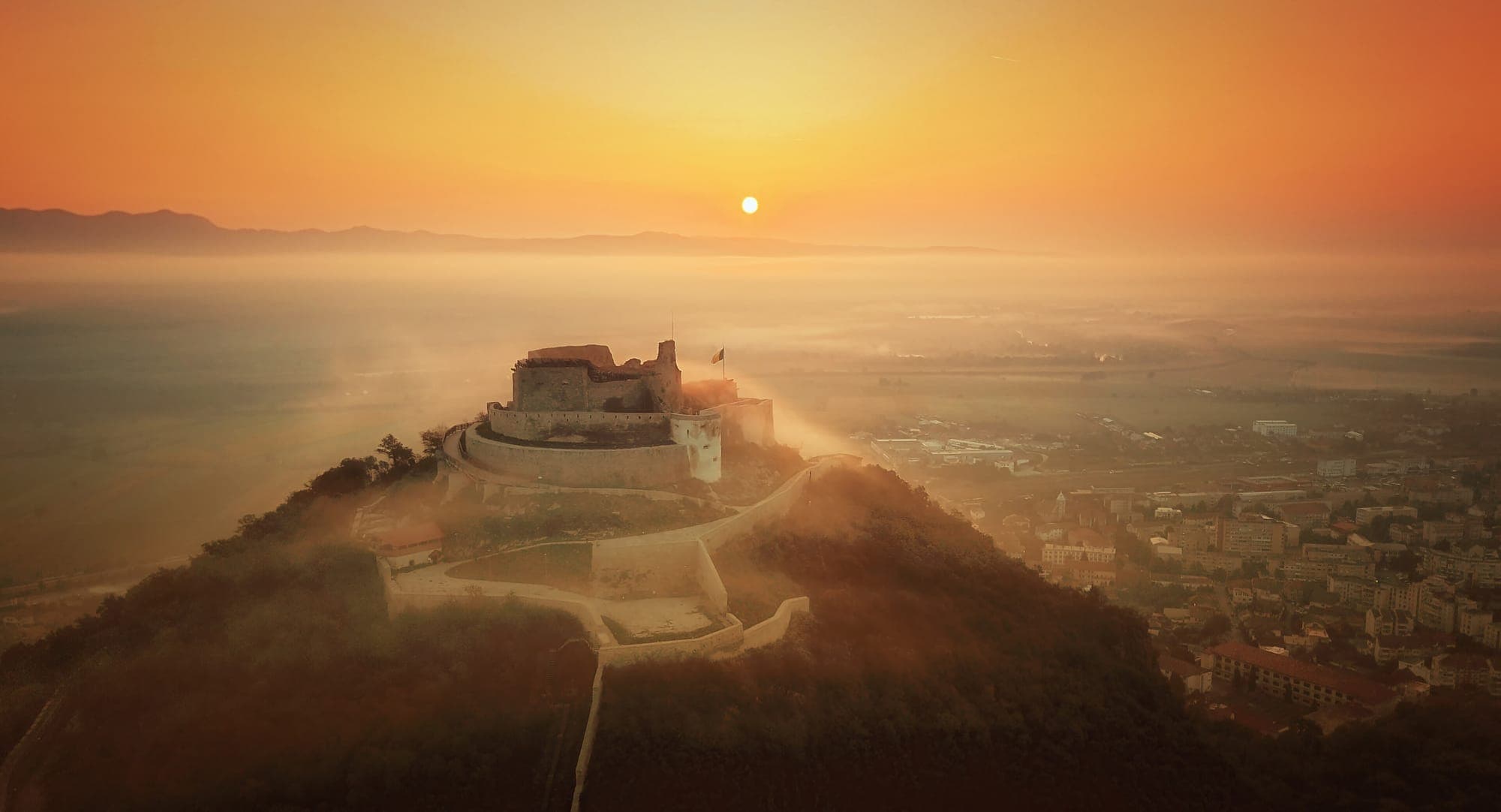
Oradea Fortress
Oradea, Bihor County · Crișana

About Oradea Fortress
Oradea Fortress is a bastion fortification shaped as a regular pentagon: five bastions at the corners, joined by curtain walls, and in the middle a princely palace that repeats the same shape around a paved courtyard. Italian military architects designed it in the second half of the 16th century, when the Italian bastion system — the ancestor of Vauban's fortifications — was the last word in defence. Giulio Cesare Baldigara built the first bastion, the Crăișorul, in 1569–1570, the rest followed under Prince Stephen Báthory, and Gabriel Bethlen closed the ring with the bastion that bears his name, in 1618, and began the palace, finished around 1650 by the architect Giacomo Resti.
The site is far older than the walls. King Ladislaus I founded a fortified monastery here around 1085, with a cathedral in which he was buried, and in the 15th century, around the bishopric, Oradea became one of the centres of humanism in Central Europe. The fortress was destroyed by the Mongols in 1241, held out for 46 days against the Ottoman siege of 1598, fell nonetheless in 1660 and was retaken by the Austrians in 1692. They rebuilt it between 1775 and 1777, to the plans of Lodovico Marini, giving it the look it has today.
The moat around it was fed with thermal water from the Peța stream, so it never froze in winter and could not be crossed on ice — a detail that kept the fortress standing longer than the thickness of its walls did.
What you can see
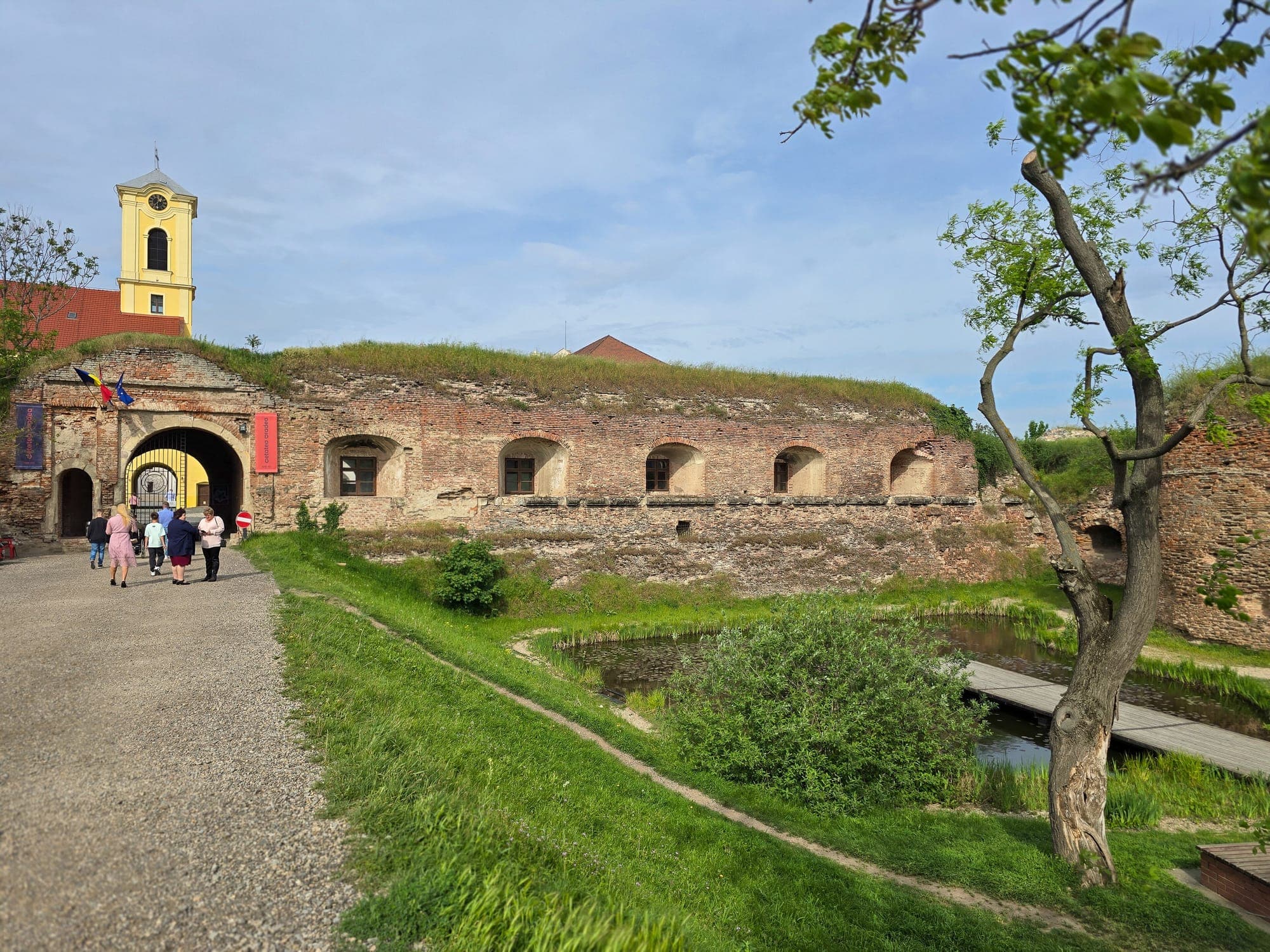
You go in through the West Gate, of 1573, over the timber bridge across the moat, or through the East Gate, opened by the Austrians in 1777. Inside, the sixteen ranges of buildings enclose the paved courtyard, with the fortress church and its yellow clock tower in the middle of the north side.
The Oradea City Museum fills the wings of the princely palace, with displays on the city's history, early Oradea photography, its religious denominations, the First World War and the nightlife of the 1970s and '80s, plus the Hall of the Griffins. The other ranges hold art galleries, craft workshops, restaurants, a coworking space, the Faculty of Visual Arts and the Centre for Culinary Culture and Civilisation. Outside, a path makes a full circuit of the walls, past the Ciunt, Bethlen (now an open-air amphitheatre), Red, Golden and Crăișorul bastions.
Good to know
The courtyards, the paths and the moat area are free to walk; you pay only for the museum and for some exhibitions and events. The Crăișorul bastion, dug out from under some 10,500 tonnes of earth, reopened on 1 September 2026, with its two casemates and the wall-walk along the top. The Golden bastion, the Red bastion and three curtain walls are still to be restored, and the moat area on the Strada Clujului side is a building site. The museum is closed on Mondays.
- The Crăișorul bastion, the oldest of the five, reopened in September 2026 after being dug out from under some 10,500 tonnes of earth.
- The two casemates and the wall-walk of the Crăișorul, with original walls, arches, buttresses and firing positions.
- The paved inner courtyard of the princely palace, with the fortress church and its yellow clock tower.
- The Hall of the Griffins and the permanent display of the Oradea City Museum, in the palace wings.
- The full circuit on the path outside the walls, past the loopholed curtains and all five bastions.
Good to know before you go
- Getting there
By car: the fortress is ~1 km east of Piața Unirii, in the centre of Oradea, entered from Piața Emanuil Gojdu. Oradea is ~150 km from Cluj-Napoca (DN1/E60, ~2h30), ~120 km from Arad (DN79, ~2 hours), ~135 km from Satu Mare (~2 hours) and ~15 km from the Borș border crossing, on the motorway to Hungary.
Public transport: Oradea railway station is ~2.5 km from the fortress; OTL trams and buses link the station with the centre, and from Piața Unirii it is a ~15-minute walk east. The bus station is next to the railway station, and the airport ~6 km west of the centre.
- Where to park
You park outside the walls, on Piața Emanuil Gojdu and the streets around the fortress, in paid public parking — the municipal hourly rate, paid at the meter (cash or card) or by text message to 7401; check the markings and the sign, as the rate differs by zone. The spaces by the west gate fill up at weekends and during events.
- Fees & discounts
Access to the courtyards and the paths around the walls is free. Oradea City Museum, permanent display: adults 20 lei, children over 4, pupils, students and pensioners 10 lei; the "Medieval Inventions. Leonardo da Vinci" exhibition 10 lei per person. Guided tour for groups of at least 15 people: +10 lei per adult, +5 lei per pupil or pensioner. Free for children under 4, war veterans and people with disabilities. Some temporary exhibitions and the events held in the fortress are ticketed separately.
- Rules
The fortress is a public space: no climbing on the walls or bastions, and the moat paths close while work is going on. Photography in the museum is allowed for personal use, without flash; commercial filming and drones need separate approval. Dogs on a lead, outdoors only. The bastions, casemates and wall-walks have steps, thresholds and gravel — wear comfortable shoes.
- Facilities
Museum, art galleries and craft workshops in the fortress ranges · restaurants, cafés and the Centre for Culinary Culture and Civilisation · toilets · conference room and coworking space · the paved inner courtyard is pushchair- and wheelchair-accessible, but the bastions and casemates have steps · good mobile signal
Reviews
Other attractions nearby
The closest attractions to Oradea Fortress, sorted by distance.
 Top 1009 km from Oradea Fortress
 62 km from Oradea Fortress
 67 km from Oradea Fortress