Oradea Fortress
Oradea, BH
A pentagonal bastion fortress built by the princes of Transylvania in the 16th–17th centuries: five bastions, a princely palace housing the Oradea City Museum, and courtyards you can walk into freely.
12 results
A pentagonal bastion fortress built by the princes of Transylvania in the 16th–17th centuries: five bastions, a princely palace housing the Oradea City Museum, and courtyards you can walk into freely.

The Roman Catholic bishops' residence, built in 1762–1777 by Franz Anton Hillebrandt, is Romania's largest Baroque palace; today it hosts church art exhibitions, and the garden is open daily.

A synagogue of 1877–1878 on the bank of the Crișul Repede, with a broad dome and a Moorish-style painted interior; restored and reopened in 2015, it is now a cultural venue.

An eclectic palace of 1902–1903 on Piața Unirii, home to the city hall, with a tower of almost 50 m: its clock plays Iancu's March, and the top gives a view over the rooftops of the centre.

The Cathedral of the Assumption, built between 1752 and 1780: the largest Baroque church in Romania, with an organ given by Maria Theresa and an interior of marble, frescoes and gilding.

Oradea's zoological garden, open since 1962 on the grounds of a noble park with a chapel, rebuilt between 2010 and 2013 and now covering 7.5 hectares, with tigers, wolves, bears, zebras and dozens of other species.

The Oradea State Theatre building, designed by the Viennese firm Fellner & Helmer and opened in 1900: an Ionic portico on Piața Ferdinand and an auditorium with boxes and a balcony, still in use every week.

A Secession building from 1907–1908 on Piața Unirii in Oradea, with a glass-roofed passage and a stained-glass window of a black eagle, from which it takes its name.

The Orthodox church of the Dormition of the Mother of God in Piața Unirii, built in 1784–1790 and known for the globe in its tower that shows the phases of the Moon, in a mechanism of 1793.

Bihor's county museum, housed since its move in the former Royal Cadet School of 1898: archaeology, history, art, ethnography, natural sciences and a vivarium under one roof.

The Secession villa of the industrialist Imre Darvas, designed by the Vágó brothers in 1909–1912, now houses Romania's first Art Nouveau museum, with period interiors and a garden.
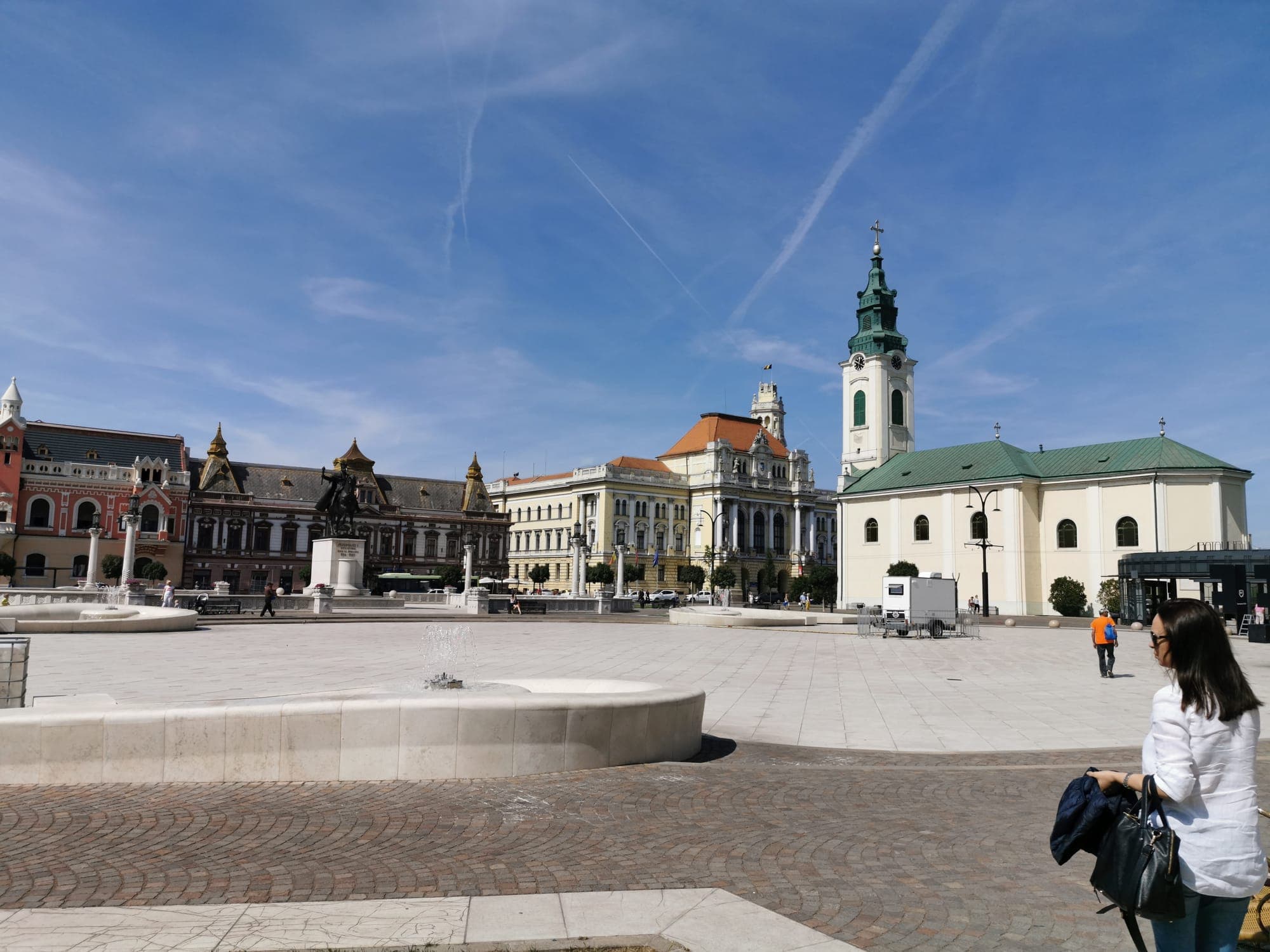
The central, pedestrianised square of Oradea, with the Town Hall Palace, the Black Eagle Palace, the Moon Church and the equestrian statue of King Ferdinand; in winter it hosts the Christmas market.
Food, wine and sightseeing tour of Oradea

Oradea walking tour with plăcintă and pálinka
From Oradea: hike with views over the Crișul Repede gorges
Not in Oradea itself, but in the surrounding area — sorted by distance from Oradea.