Sighet Memorial
Sighetu Marmației, Maramureș County · Maramureș

About Sighet Memorial
Sighetu Marmației prison was built in 1897, under Austria-Hungary, for common criminals. In May 1950 the communist regime brought here, in a single night, over a hundred former ministers, generals, academicians and bishops of interwar Romania, to the most isolated prison in the country, two kilometres from the Soviet border. By 1955, at least 53 of them had died in the "prison of the ministers" of hunger, cold and neglect, among them Iuliu Maniu, Gheorghe I. Brătianu, Constantin Argetoianu and the Greek Catholic bishops; they were buried at night, without crosses, in the Paupers' Cemetery on the edge of town.
After 1977 the building was abandoned. In 1993 the poet Ana Blandiana and the writer Romulus Rusan proposed to the Council of Europe that the ruin be turned into a memorial; the Civic Academy Foundation took over the building, and in 1997 Parliament declared it an "ensemble of national interest". The first rooms opened that same year, and the Council of Europe named the Sighet Memorial, alongside the Auschwitz Memorial and the Normandy Peace Memorial, among the main sites of memory on the continent. In 2018 it received the European Heritage Label, the first in Romania.
What you can see
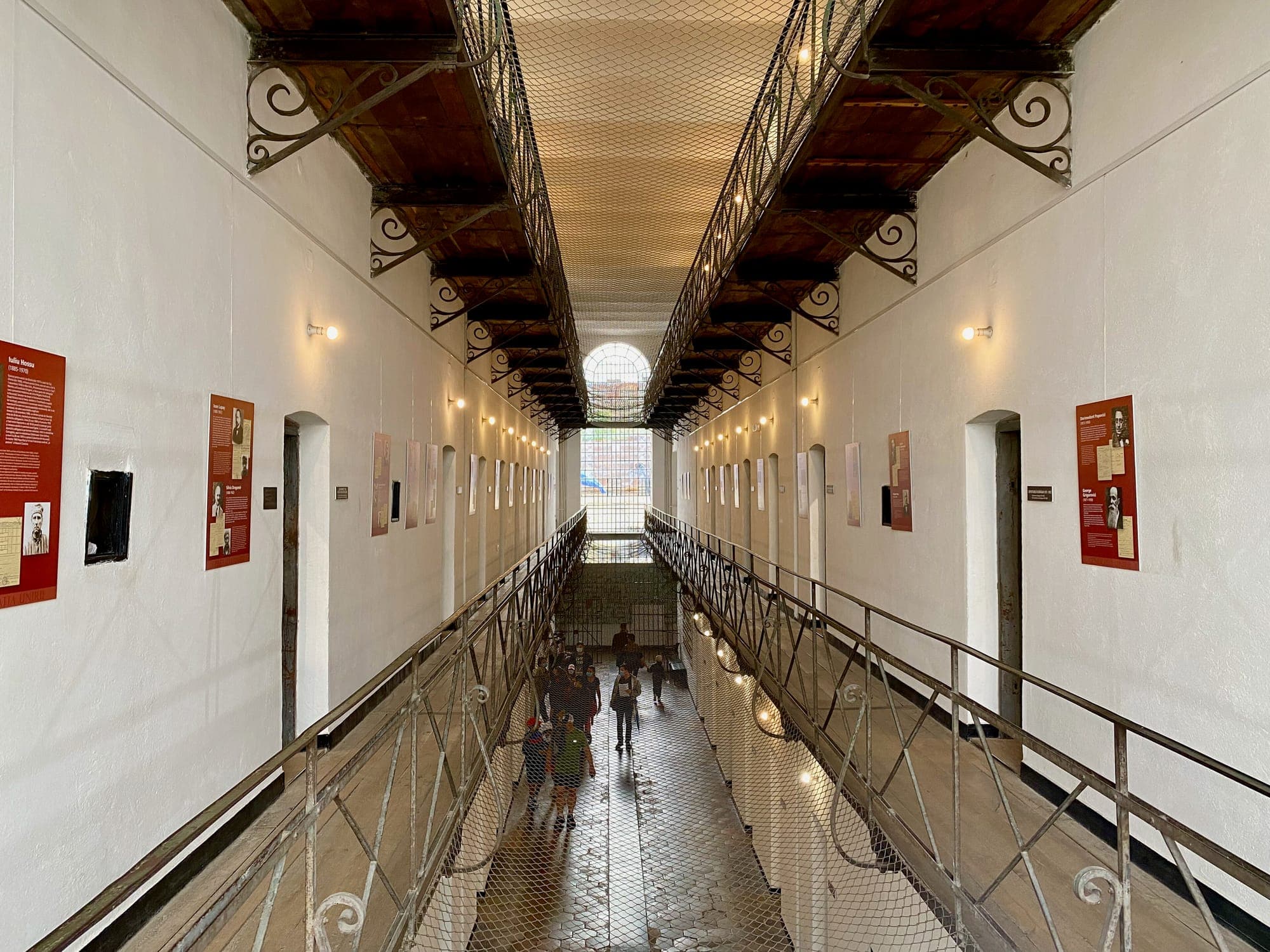
The museum keeps the layout of the prison, with three tiers of cells around a central hall crossed by iron walkways. Each cell has become a room on one chapter of Romanian and Eastern European communism: the rigged elections of 1946, collectivisation, the deportations to the Bărăgan, the Danube–Black Sea Canal, the armed resistance in the mountains, the demolitions of the 1980s, but also everyday life, propaganda and childhood under communism. The cell in which Iuliu Maniu died, that of Gheorghe Brătianu and the "Black" cell, the lightless punishment cell, are preserved as they were; the walls of the hall carry thousands of photographs of political prisoners.
In the inner courtyard, Aurel Vlad's "Procession of the Sacrificed", 18 bronze figures walking towards the wall, is the memorial's defining image. Beneath the courtyard, the Space of Recollection and Prayer, designed by Radu Mihăilescu, spirals down into a round chamber with an oculus in the ceiling, its walls engraved with nearly 8,000 names of those who died in prisons and camps. 2.5 km away, towards Satu Mare, the Paupers' Cemetery has been laid out as a park of remembrance, with a map of Romania planted in conifers and an altar-cenotaph.
Good to know
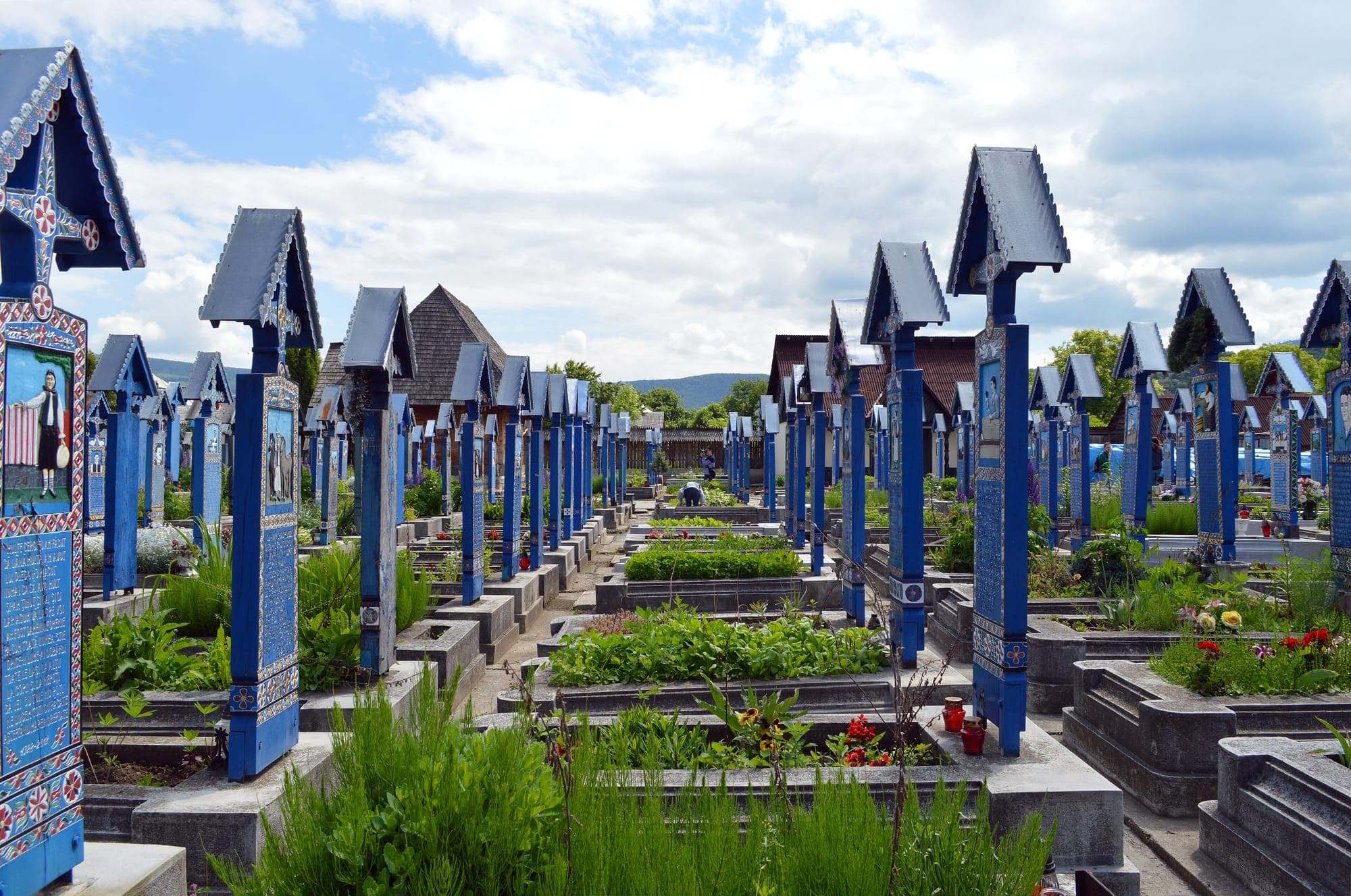
This is a museum you read: the rooms are dense with documents and text, and a serious visit takes two to three hours. The content is hard for young children; it makes sense from the teenage years. In winter it is closed on Mondays; in the warm season it is open daily. Combine it with the nearby Elie Wiesel memorial house and with the Merry Cemetery at Săpânța, 18 km away.
- The central hall of the prison, with its three tiers of cells, the iron walkways and the thousands of photographs of prisoners.
- The cell in which Iuliu Maniu died in 1953, preserved as it was, and the "Black" cell, the lightless punishment cell.
- Aurel Vlad's "Procession of the Sacrificed", the 18 bronze figures in the inner courtyard.
- The Space of Recollection and Prayer beneath the courtyard, with nearly 8,000 names engraved on its walls and the oculus in the ceiling.
- The Paupers' Cemetery, 2.5 km away, with the map of Romania planted in conifers over the prisoners' mass graves.
Good to know before you go
- Getting there
By car: Sighetu Marmației is ~65 km from Baia Mare on the DN18 over the Gutâi Pass, via Vadu Izei (~1h30); ~100 km from Satu Mare on the DN19 via Negrești-Oaș and Săpânța (~2 hours); ~180 km from Cluj-Napoca (~3h30). The memorial is in the centre, on Strada Corneliu Coposu, two streets from Piața Libertății; follow Bogdan Vodă and Gheorghe Șincai, and the car park is behind the building. The Paupers' Cemetery is 2 km away, on the way out towards Satu Mare (DN19).
Public transport: Sighetu Marmației railway station (trains from Cluj, Timișoara and Satu Mare, changing at Salva or Satu Mare) is ~1 km away, a 15-minute walk along Strada Iuliu Maniu; the bus station is next to it, with frequent minibuses from Baia Mare (~1h30) and Satu Mare.
- Where to park
The museum points to the free parking on Strada Gheorghe Șincai, at right angles to Corneliu Coposu, right behind the building. In the centre, on the surrounding streets, parking is paid on weekdays, by SMS or at the meter; in summer, around midday, spaces go quickly.
- Fees & discounts
Ticket (official website, 2026): adults 25 lei; pensioners 15 lei; pupils and students 10 lei; free for former political prisoners and deportees, people with disabilities and journalists. An audio guide is available once you have your ticket; groups can ask for a guided tour at the entrance. The Paupers' Cemetery is free to visit. The 8-theme virtual tour is free on the website.
- Rules
This is a place of memory: quiet and respect, especially in the preserved cells and in the Space of Recollection. Photography without flash is allowed in the rooms; in the prayer space do not talk loudly or use your phone. Do not touch the exhibits or the prison's original fittings. Young children are the parents' responsibility; some rooms (torture instruments, the cells) can be upsetting. Large bags are left at the entrance.
- Facilities
Audio guide · guided tours for groups · toilets on site · bookshop with the Civic Academy Foundation's publications at the entrance · the upper walkways and cells are reached by stairs, no lift; the ground floor is accessible · cafés and restaurants on the pedestrian street in the centre, a minute away · the memorial's multifunctional centre, with exhibitions and conferences, at Strada Gheorghe Șincai 19 · Elie Wiesel memorial house 10 minutes' walk away
Reviews
Other attractions nearby
The closest attractions to Sighet Memorial, sorted by distance.
 Top 2020 km from Sighet Memorial
 22 km from Sighet Memorial
 34 km from Sighet Memorial