
About Turda Salt Mine
Salt has been dug out of the ground at Turda since Roman times, when the town was called Potaissa, and the salt works here are mentioned in documents as early as 1075 and 1271. The mines you visit today are those cut in the last three centuries: Terezia, opened in 1690, then Iosif, Rudolf and Ghizela, linked to the town by the Franz Josef Gallery, a 917 m tunnel dug in the second half of the 19th century so that the salt no longer had to be hauled out by cart. Mining stopped in 1932, too costly compared with modern mines; during the Second World War the galleries served as an air-raid shelter and then, until 1992, as a cheese store.
The mine opened to visitors in 1992, but its fame came with the 2008–2010 modernisation, financed with EU funds: in the huge voids left by the miners appeared a panoramic lift, a 20 m Ferris wheel, an amphitheatre, sports courts, minigolf and bowling, and rowing boats on the lake in the Terezia mine. The international press has since called it "the most beautiful underground place in the world", and with over half a million visitors a year it is among Romania's most visited attractions. The air here, at a constant 11–12 °C and free of allergens, is also used to treat respiratory conditions.
What you can see
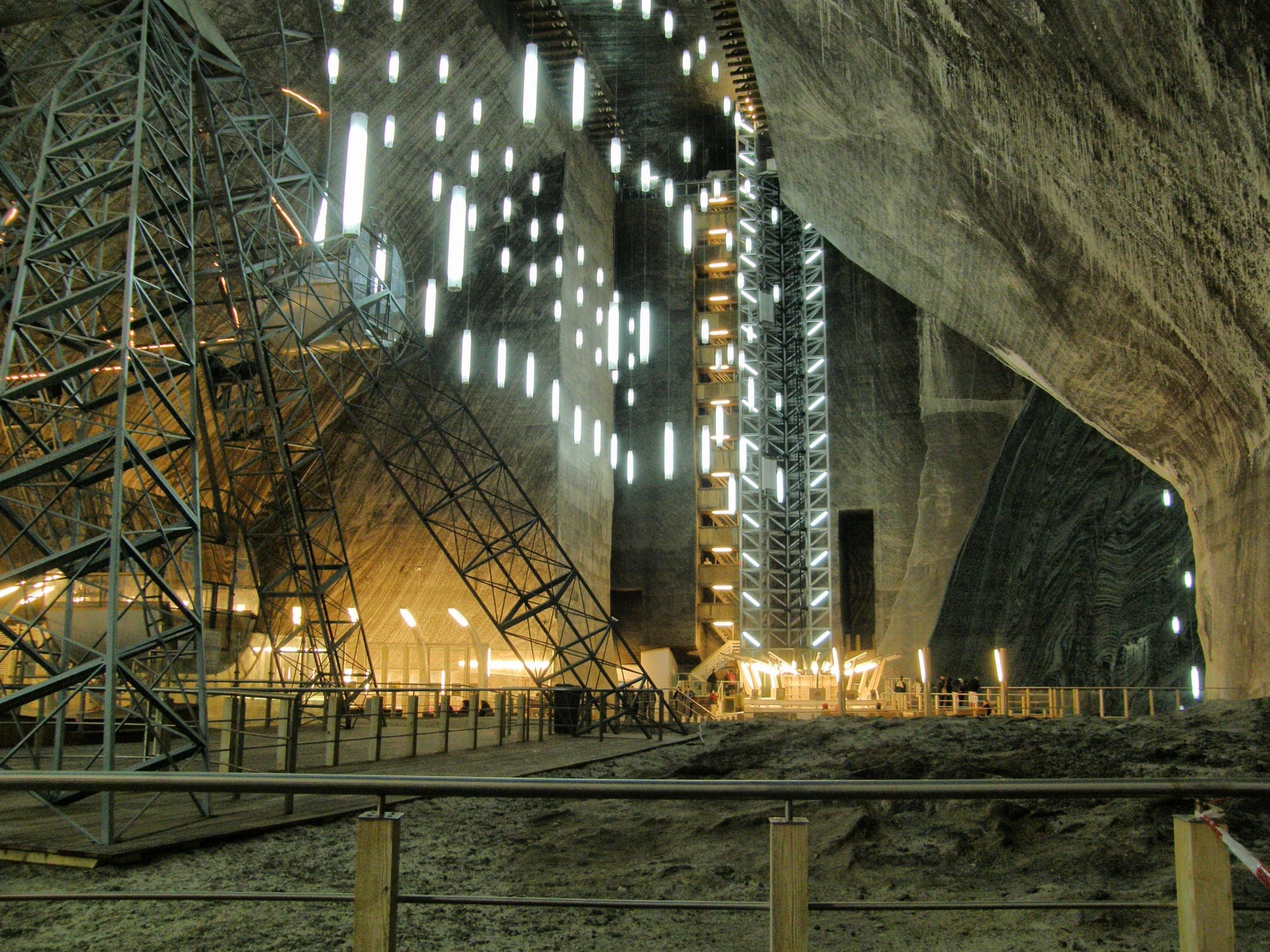
From the new entrance at Durgău you go down by lift or stairs to the Franz Josef Gallery and walk underground past the Crivac Hall, with the horse-driven extraction machine of 1881, and the Iosif mine, the "hall of echoes", where a word comes back up to 20 times. Then you find yourself on the balcony of the Rudolf mine: a salt hall 42 m high, 50 m wide and 80 m long, its walls streaked with bands of salt and hung with stalactites that grow 2 cm a year; 172 steps or the panoramic lift take you to its floor, among the Ferris wheel and the amphitheatre.
Below Rudolf, in the bell-shaped Terezia mine, 112 m deep, lies a salt lake up to 6 m deep, with an island in the middle on which a small leisure park has been built; by boat you row along the lit salt walls. For an extra fee you can also visit the Ghizela mine, now used for treatment.
Good to know
Underground it is 11–12 °C all year, with high humidity: bring a jacket and shoes with good grip, even in August. Children under 3 go in free, but bear the cold in mind. Weekends and school holidays are very crowded, with queues for the lift; come at opening time or after lunch and buy your ticket online.
- The balcony of the Rudolf mine, where you take in the whole 42 m-high salt hall, with the lifts, the wheel and the amphitheatre on its floor.
- A boat trip on the salt lake in the Terezia mine, 112 m down, along the lit salt walls.
- The hall of echoes in the Iosif mine, where a shout comes back up to 20 times.
- The 1881 crivac, the horse-driven extraction winch, preserved in its original chamber.
- The salt stalactites and the banded walls of Rudolf, best seen from the panoramic lift.
Good to know before you go
- Getting there
By car: Turda is 30 km south of Cluj-Napoca, on the A3 motorway (Turda exit) or the DN1 (~35 minutes); the mine is in the Durgău district, north-east of the centre, signposted "Salina Turda – intrarea nouă" towards Aleea Durgăului. From Alba Iulia it is ~65 km (A10, ~45 minutes), from Târgu Mureș ~70 km (A3, ~50 minutes), from Bucharest ~420 km (~5h30). In the sat-nav look for "Salina Turda Durgău", not the old entrance.
Public transport: frequent minibuses Cluj-Napoca – Turda (from the Beta bus station / Piața Mihai Viteazu area, ~45 minutes), then local bus 17 to the mine or a taxi (~3 km from Turda's centre). The old entrance on Strada Salinelor is ~20 minutes' walk from the town centre, through the Franz Josef Gallery.
- Where to park
The car park at the new (Durgău) entrance costs 10 lei an hour, paid at the machine or the ticket desk; at weekends and in the holidays it is full by midday and people park on the surrounding streets. At the old entrance on Strada Salinelor there are only a few roadside spaces. A new, larger car park at Durgău is planned for 2026.
- Fees & discounts
Official prices (September 2026): adults 75 lei Monday–Friday and 90 lei at weekends and on public holidays; seniors over 65 50/60 lei; children aged 3–18 48/59 lei; under 3 free; passes for at least 7 days at 65/37/37 lei a day. People with disabilities and their carer enter free with documents. Inside the mine: Ferris wheel 35 lei (8 minutes), boat on Lake Terezia 56 lei per boat (20 minutes, up to 3 people), minigolf 35 lei, table tennis 35 lei, billiards 2.5 lei a minute, Ghizela mine 32 lei, guide on request 205 lei. Tickets online on the official website; underground, the activities are often cash only.
- Rules
Underground it is 11–12 °C with humidity above 75%: dress warmly and wear shoes with grip, the floors are damp. Do not touch or break off the salt walls and stalactites, and do not eat or smoke inside. No animals, except muzzled guide dogs. The mine's regulations require the company's consent for filming, photography and live streaming on the premises; professional or commercial filming needs a contract. People with serious heart conditions or claustrophobia should bear in mind the depth and the lift; the stairs down have 172 steps, and the climb back is tiring, so take the lift.
- Facilities
Panoramic lift and a lift from the Durgău entrance, pushchair- and wheelchair-accessible on the main level · toilets at the surface and underground · café and souvenir shop in the Rudolf mine · boats, Ferris wheel, minigolf, bowling, billiards, table tennis, playground · amphitheatre seating 180 · cash machine only at the surface · Hotel Potaissa with a spa centre next to the new entrance · weak mobile signal underground
Reviews
Other attractions nearby
The closest attractions to Turda Salt Mine, sorted by distance.
 0 km from Turda Salt Mine
 3 km from Turda Salt Mine
 24 km from Turda Salt Mine