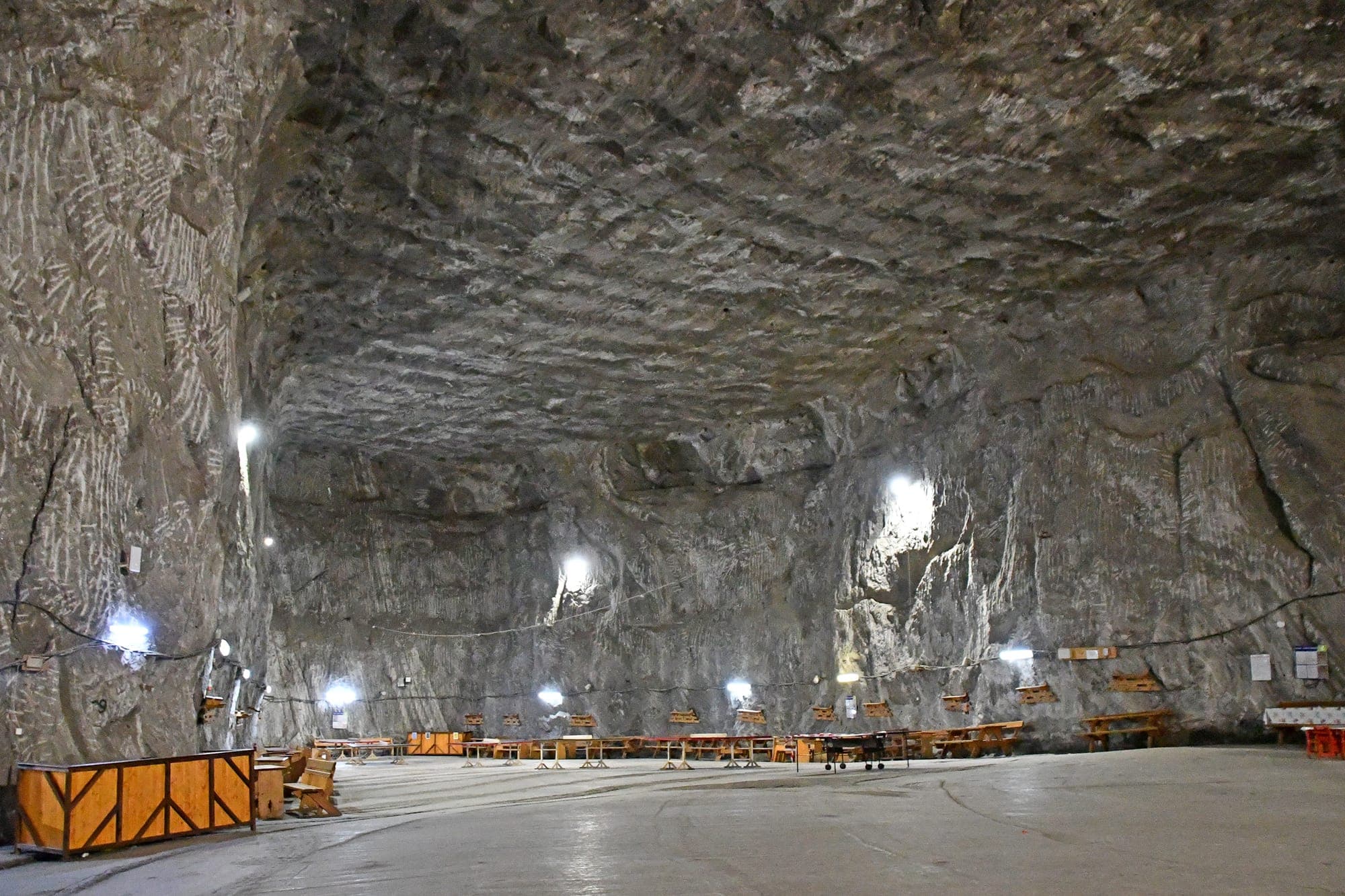

About Praid Salt Mine
Beneath the Salt Hill at Praid lies one of the largest rock-salt bodies in Europe: an elliptical block roughly 1.2 by 1.4 km that reaches 2.6–2.8 km deep. Salt was taken from here as early as Roman times, from surface pits, and a letter of King Andrew III from 1291 already mentions the Praid salt works. Underground mining began in 1762 with the bell-shaped Iosif mine, from which the salt was hauled up in buffalo-hide sacks by a horse-driven winch. Then came the Parallel mine in 1864, the Gh. Doja mines, the new levels opened after 1978 and the Telegdy sector, worked until 2025.
In the old galleries, on "Level 50", 120 m down, a leisure and treatment centre for respiratory conditions was set up: halls several hundred metres long, with salty air and a constant temperature, which drew hundreds of thousands of visitors a year. Praid was Romania's most visited salt mine.
Between 27 and 30 May 2025, after torrential rain, the waters of the Corund stream drained through a sinkhole that opened under its bed straight into the mine and filled every level, including the visitor area. Salrom halted all activity; as of September 2026 the mine is still temporarily closed, with no announced reopening date. Praid commune remains under a state of alert extended month by month, and in July 2026 micro-tremors in the salt body led to an orange alert. Access to the affected mining area and to the Salt Canyon is prohibited.
What could be visited
The mine's buses took visitors 1,250 m along the access gallery, under the dome of the salt body, then 247 steps led down to the seven visitor halls, dug between 1957 and 1978, 20 m wide and 12–14 m high, their walls streaked with bands of salt. They held playgrounds, sports courts, a café and restaurant, a small salt-mining museum and the ecumenical chapel consecrated in 1993 by Orthodox, Roman Catholic and Reformed priests, with its altar and statue of St John of Nepomuk carved in salt.
Good to know
The mine cannot be visited and no tickets are sold. Salrom's salt-water lido next to the mine was not affected and opens in summer; check the official website before travelling for any reopening announcement.
Good to know before you go
- Getting there
By car: Praid is on the DN13A, between Sovata (~7 km) and Corund (~12 km); it is ~70 km from Târgu Mureș via Sovata (~1h15), ~40 km from Odorheiu Secuiesc via Corund (~45 minutes) and ~170 km from Cluj-Napoca (A3 to Târgu Mureș, ~2h45). To the north, the DN13B climbs over the Bucin Pass towards Gheorgheni. The departure point for the mine and the lido are on Strada Salinei, on the northern edge of the village.
Public transport: Praid has bus and minibus links with Sovata, Târgu Mureș and Odorheiu Secuiesc; from the village centre you can walk to the lido.
- Fees & discounts
The mine is closed and no visitor tickets are sold; the prices from before May 2025 no longer apply. Salrom's page for the mine only lists the prices of the salt-water lido: adults 50 lei, children aged 3–18, pupils and students 35 lei, reduced after 16:00 (40/25 lei), under 3 free, parking 5 lei an hour.
- Rules
While the state of alert lasts, public access to the affected mining area and to the Salt Canyon in the Corund valley is prohibited; follow the signs and the authorities' instructions. Do not enter the galleries or fenced-off areas: the salt body is being monitored for collapses.
Reviews
Other attractions nearby
The closest attractions to Praid Salt Mine, sorted by distance.
 Top 1008 km from Praid Salt Mine
 50 km from Praid Salt Mine
 Top 10051 km from Praid Salt Mine


