
Zalău County Museum of History and Art
About Zalău County Museum of History and Art
The Zalău County Museum of History and Art was founded on 15 May 1951 with four rooms on the upper floor of a building on Strada Crinului, and its first director was Vasile Lucăcel, after whom the History Section is named today. From 1955 the museum was gradually given rooms in the building at Strada Unirii 9, the former casino of the Craftsmen's Association, built around 1900 and a listed historic monument (LMI code SJ-II-m-B-05007). The whole building was handed over in 1969, and the new museum opened on 21 August 1971.
The section underwent a major rehabilitation that began in 2010, and the permanent exhibition reopened in a new form on 15 May 2014. It tells the story of human settlement in what is now Sălaj County, which began about 25,000 years ago, with an emphasis on the Roman period: the frontier of the province of Dacia ran along the Meseș Mountains, and at Porolissum the Romans built first a fort and then a town.
What you can see
On the ground floor every period has a life-size reconstruction: the Cuciulat cave with its Palaeolithic rock paintings, a Neolithic dwelling and a stone-working workshop, a bronze-casting workshop, a Celtic potter's workshop and the Dacian metalworking workshop from Cetate hill at Șimleu Silvaniei. The Roman hall, modelled on Porolissum, has a stretch of the frontier wall with its control gate, a Roman house with hypocaust heating, a bath and a latrine, and the façade of a temple, at whose entrance stand original monuments dedicated to Jupiter Dolichenus. An early medieval dwelling comes next.
Upstairs, the exhibition "A market day in Zalău" brings back the atmosphere of the market at the beginning of the 20th century, while other rooms cover the communist period and figures from Sălaj such as Simion Bărnuțiu, Gheorghe Pop de Băsești, Iuliu Maniu and Corneliu Coposu. The CLIO HIGH TECH multimedia room offers a virtual-reality walk along a street in Porolissum.
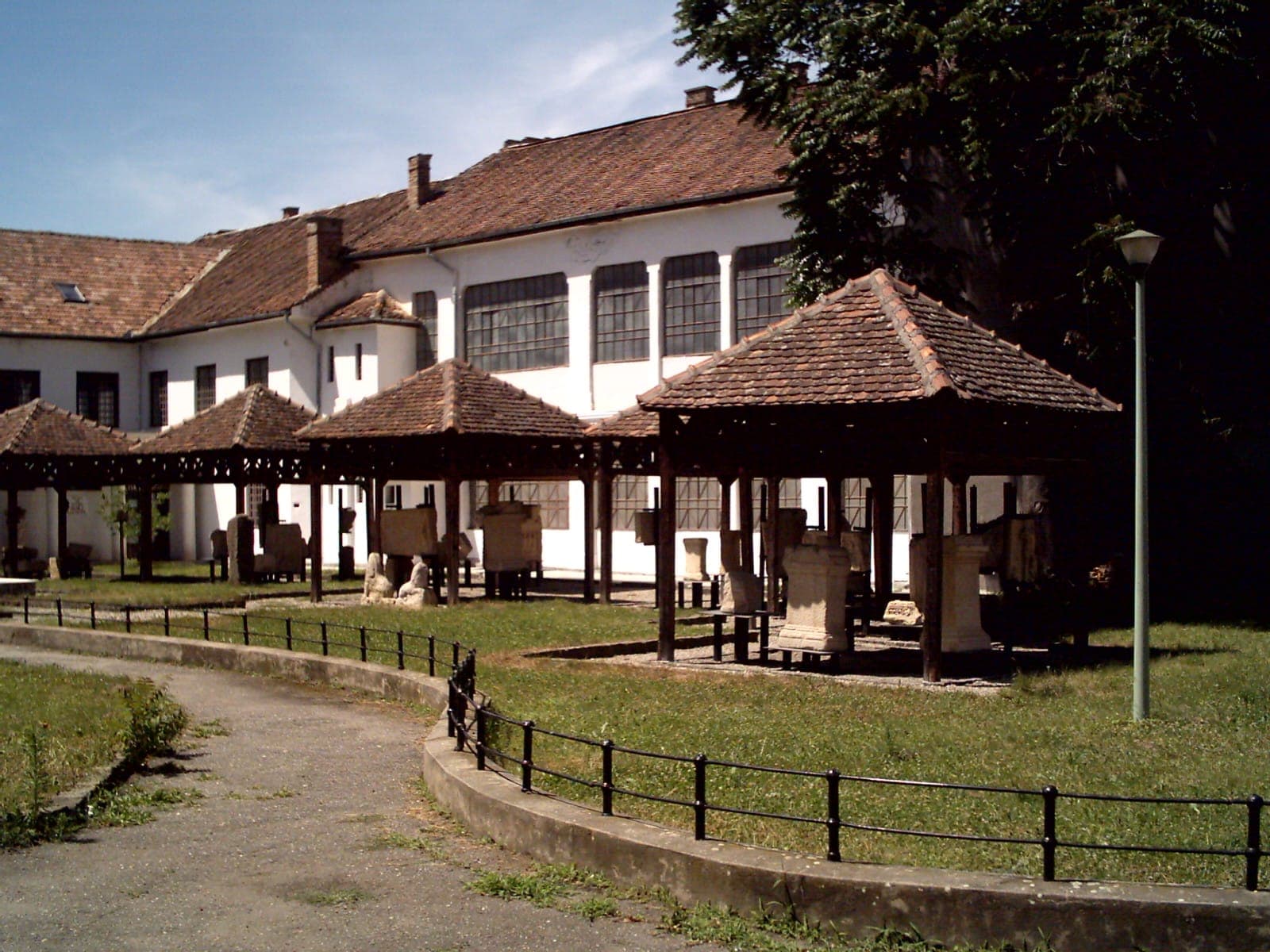
In the courtyard, the lapidarium gathers Roman, medieval and modern stone monuments; the Roman ones, the majority, come mainly from Buciumi and Porolissum: votive altars, funerary monuments and architectural fragments.
Good to know
The "Ioan Sima" Art Gallery, the museum's second section, is in a separate building at Strada Gheorghe Doja 6 and has its own ticket. On Saturdays and Sundays only one of the two sections is open, in rotation.


- The reconstruction of the Cuciulat cave, with its Palaeolithic rock paintings.
- The stretch of the Roman Dacian frontier wall, with the control gate rebuilt after the one at Porolissum.
- The reconstructed Roman house, with hypocaust heating, a bath and a latrine.
- The original monuments dedicated to Jupiter Dolichenus, at the entrance to the temple façade.
- The courtyard lapidarium, with Roman votive altars and funerary monuments from Porolissum and Buciumi.
Good to know before you go
- Getting there
By car: from Cluj-Napoca it is ~83 km on the DN1F (~1 h 30 min), from Oradea ~121 km (~2 h 15 min), and from the Roman site of Porolissum ~14 km (~20 minutes). The museum is on Strada Unirii, ~250 m (a 3-minute walk) from Piața Iuliu Maniu.
Public transport: Zalău has coach connections with Cluj-Napoca and other towns in the region; from the coach station on Strada Tudor Vladimirescu to the museum it is ~1.9 km (~25 minutes on foot).
- Where to park
The museum has no car park of its own. You park on the streets and in the car parks of central Zalău, usually for a fee, and then walk for a few minutes.
- Fees & discounts
History Section: adults 12 lei, pensioners 6 lei, children and organised groups of pupils and students 5 lei. Multimedia room (both virtual tours): adults 30 lei, pensioners, children, pupils and students 15 lei. The "Ioan Sima" Art Gallery has a separate ticket: adults 20 lei, pensioners 10 lei, children and groups of pupils and students 5 lei. A guided tour in English costs 40 lei. Admission is free for the categories listed in the tariff, including children with special needs or disabilities and their companions, adults with a severe or marked disability and their companions, and war veterans.
- Rules
The visit is self-guided; a guided tour in English is charged separately. Photo shoots for personal events on the museum premises are charged (120 lei per day). Do not touch the exhibits and follow the instructions of the gallery staff.
- Facilities
Multimedia room with virtual and augmented reality (CLIO HIGH TECH) · guided tours in English for a fee · lapidarium in the courtyard
Frequently asked questions about Zalău County Museum of History and Art
How much is a ticket to Zalău County Museum of History and Art?
A ticket to Zalău County Museum of History and Art costs 12 lei (pensioners 6 lei, children 5 lei). More under “Fees & discounts”
What are the opening hours of Zalău County Museum of History and Art?
Opening hours at Zalău County Museum of History and Art: Monday closed, Tuesday–Friday 09:00 – 17:00, Saturday–Sunday closed. More under “Opening hours”
How long does a visit to Zalău County Museum of History and Art take?
A visit to Zalău County Museum of History and Art takes about 1 – 1½ hours (including the courtyard lapidarium).
Can you visit Zalău County Museum of History and Art with kids?
Yes, Zalău County Museum of History and Art is suitable for children (life-size reconstructions).
Where can I park at Zalău County Museum of History and Art?
There is paid parking at Zalău County Museum of History and Art (on the streets in the centre). More under “Where to park”
How do I get to Zalău County Museum of History and Art?
Zalău County Museum of History and Art is located at Strada Unirii 9, Zalău, Sălaj County. More under “Getting there”
When is the best time to visit Zalău County Museum of History and Art?
The best season for Zalău County Museum of History and Art: All year round (open all year).
Reviews
Other attractions nearby
The closest attractions to Zalău County Museum of History and Art, sorted by distance.


