Horezu Monastery
Horezu, Vâlcea County · Oltenia

About Horezu Monastery
At a glance: Monasteries and churches in Horezu, Vâlcea County. The visit takes 1 – 1½ hours. Information verified on 7 October 2026.
Horezu Monastery, whose historic and official name is Hurezi Monastery, is the most important foundation of Prince Constantin Brâncoveanu and the largest monastic ensemble surviving in Wallachia. Brâncoveanu laid the foundations in 1690, in the second year of his reign, on his family's estate below the Căpățânii Mountains; the great church was consecrated on 8 September 1693, and the remaining buildings were finished in 1697. The name comes, tradition says, from the huhurezi, the tawny owls whose calls can be heard at night in the surrounding forests.
The prince planned the monastery as his family's burial place and had his own tomb prepared in the narthex. Beheaded in Constantinople in 1714, he was eventually buried in Bucharest, so the tomb at Hurezi remained empty. Beyond its architecture, the monastery was a cultural centre: a rich library and a school of mural and icon painting that influenced religious art across the Balkans. A community of nuns has lived here since 1872. In 1993 the ensemble was inscribed on its own, as a separate site ("Monastery of Horezu"), on the UNESCO World Heritage List.
What you can see
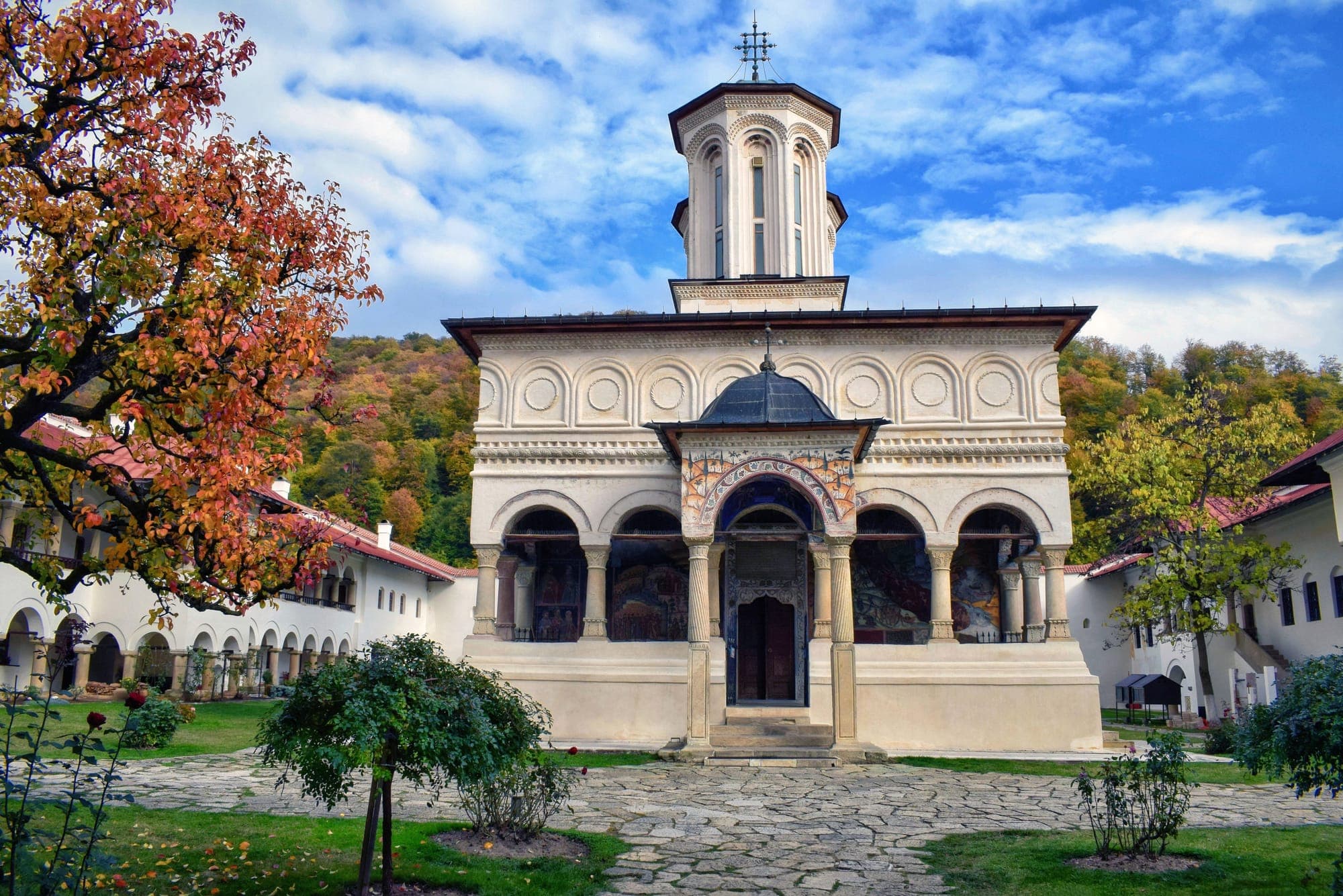
The great church of Saints Constantine and Helena, white, with two towers and a trefoil plan, has an open porch on ten stone columns carved with tendrils and flowers, with painted vaults. In the narthex is the large votive painting of Brâncoveanu, Lady Maria and their children, alongside portraits of the Basarab and Cantacuzino families, and in the nave the gilded limewood iconostasis and the princely throne. The rectangular courtyard is enclosed by arcaded cells on two levels, the princely apartments with the bell tower above the gate (where the collection of icons and church objects is on display), the chapel and the refectory. Don't miss the loggia of Abbot Dionisie Bălăcescu. Outside the walls are the infirmary church built by Lady Maria and two hermitages.
Good to know
It is a working convent: enter in modest dress and keep quiet. In May 2026 the canonisation of St Matrona of Hurezi, a former abbess of the monastery, was proclaimed here.
- The porch of the great church, with its ten carved stone columns and painted vaults.
- The votive painting in the narthex, with Constantin Brâncoveanu, Lady Maria and their children.
- The empty tomb Brâncoveanu prepared for himself in the narthex of the church.
- The loggia of Abbot Dionisie Bălăcescu, with its outside staircase and carved stone balustrade.
- The infirmary ensemble, with Lady Maria's church and the kiosk on the wall, on the hill next to the precinct.
Good to know before you go
- Getting there
By car: from Râmnicu Vâlcea take the DN67 towards Târgu Jiu, ~44 km (~1 hour) to the town of Horezu; from there follow the signs to the village of Romanii de Jos, another ~3.5 km along Strada Mănăstirii. From Târgu Jiu it is ~72 km on the DN67 (~1½ hours), from Bucharest ~225 km via Pitești and Râmnicu Vâlcea (~3½–4 hours), from Craiova ~115 km (~2½ hours). It combines easily with the pottery workshops of Horezu and with Bistrița Monastery.
Public transport: Horezu has no railway station; trains run to Râmnicu Vâlcea, from where buses leave for Horezu roughly every hour (~1 hour's journey). From Horezu to the monastery it is ~3.5 km: a taxi or a walk of almost an hour along the paved road.
- Fees & discounts
The monastery's website does not publish prices for visiting, for the museum collection or for photography; ask at the gate.
- Rules
Modest dress: shoulders and knees covered, women with their heads covered in the church. Keep quiet within the walls and switch phones off during services. Do not take photos in the church without the nuns' permission; do not touch the frescoes or the carved columns.
- Facilities
collection of icons and church objects in the princely apartments · monastic icon workshops · guesthouses, restaurants and pottery workshops in the town of Horezu · the courtyard is level and stone-paved, the church has steps at the entrance
Frequently asked questions about Horezu Monastery
- How long does a visit to Horezu Monastery take?
- A visit to Horezu Monastery takes about 1 – 1½ hours (with infirmary and hermitages).
- Can you visit Horezu Monastery with kids?
- Yes, Horezu Monastery is suitable for children (modest dress and quiet).
- How do I get to Horezu Monastery?
- Horezu Monastery is located at Strada Mănăstirii 164, Romanii de Jos village, ~3.5 km north of the centre of Horezu, Horezu, Vâlcea County. By car: from Râmnicu Vâlcea take the DN67 towards Târgu Jiu, ~44 km (~1 hour) to the town of Horezu; from there follow the signs to the village of Romanii de Jos, another ~3.5 km along Strada Mănăstirii. From Târgu Jiu it is ~72 km on the DN67 (~1½ hours), from Bucharest ~225 km via Pitești and Râmnicu Vâlcea (~3½–4 hours), from Craiova ~115 km (~2½ hours). It combines easily with the pottery workshops of Horezu and with Bistrița Monastery. Public transport: Horezu has no railway station; trains run to Râmnicu Vâlcea, from where buses leave for Horezu roughly every hour (~1 hour's journey). From Horezu to the monastery it is ~3.5 km: a taxi or a walk of almost an hour along the paved road.
- When is the best time to visit Horezu Monastery?
- The best season for Horezu Monastery: April – October (autumn, with the forests in colour).
Reviews
Other attractions nearby
The closest attractions to Horezu Monastery, sorted by distance.
 21 km from Horezu Monastery
 23 km from Horezu Monastery
 24 km from Horezu Monastery