Negru Vodă Monastery
About Negru Vodă Monastery
Negru Vodă Monastery stands on the site of the old princely court of Câmpulung, one of the first centres of Wallachia. Tradition, also preserved in an inscription placed by Matei Basarab, links the foundation to Radu Negru, the semi-legendary prince from the country's beginnings, and dates it to 1215. Historians attribute it to Basarab I and his son, Nicolae Alexandru, in the first half of the 14th century. Basarab I died in Câmpulung in 1352 and, according to tradition, was buried here.
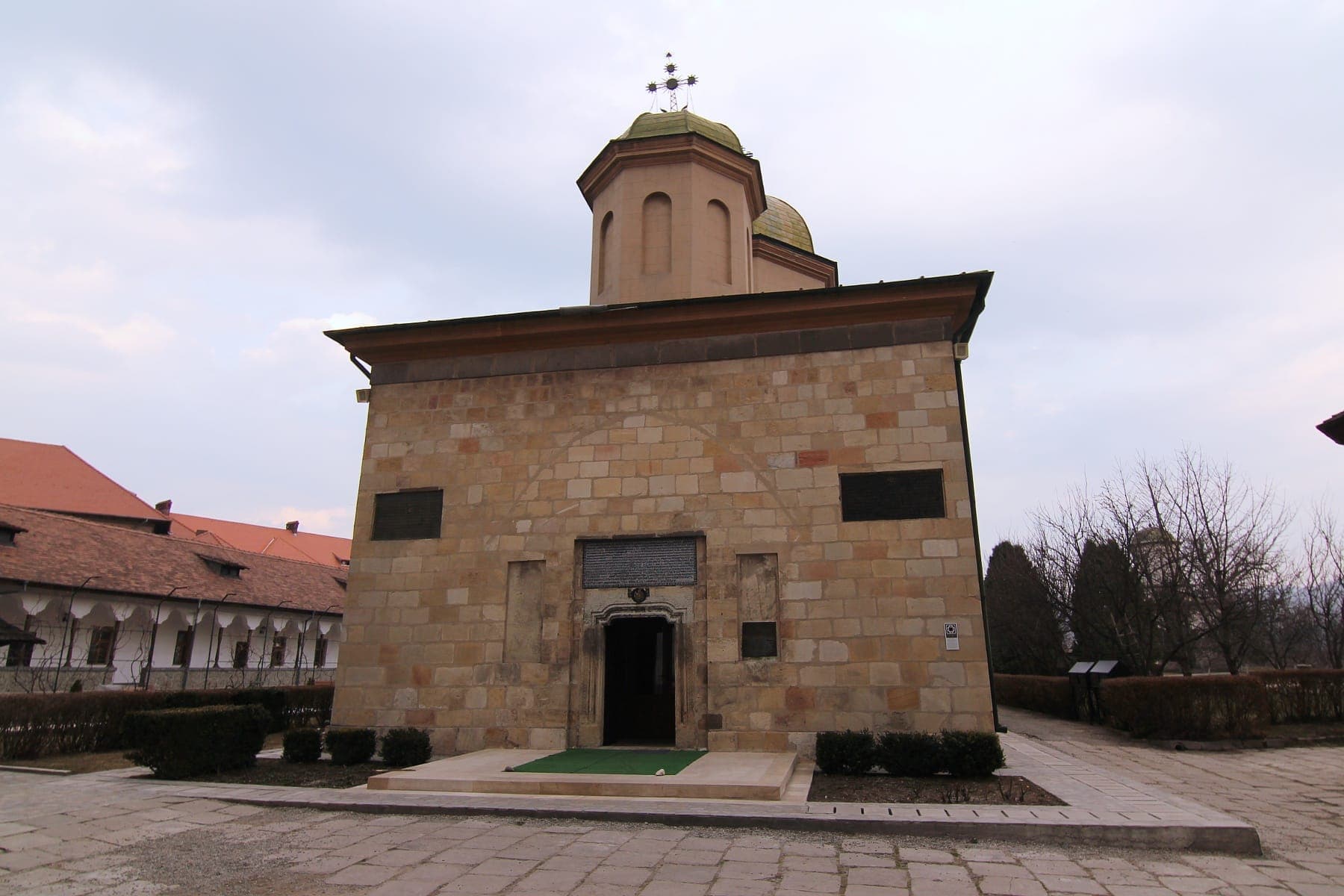
The princely church of the Dormition of the Mother of God was brought down by the 1628 earthquake and rebuilt by Matei Basarab in 1635–1636; after the 1802 earthquake it was rebuilt from the ground up and consecrated in 1832. Inside is the tombstone of Nicolae Alexandru Basarab, who died on 16 November 1364, with a Slavonic inscription: the oldest surviving funerary slab of a ruler of Wallachia. Since 2013 the monastery has also held the relics of Saint Ioanichie the New of Muscel.
What you can see
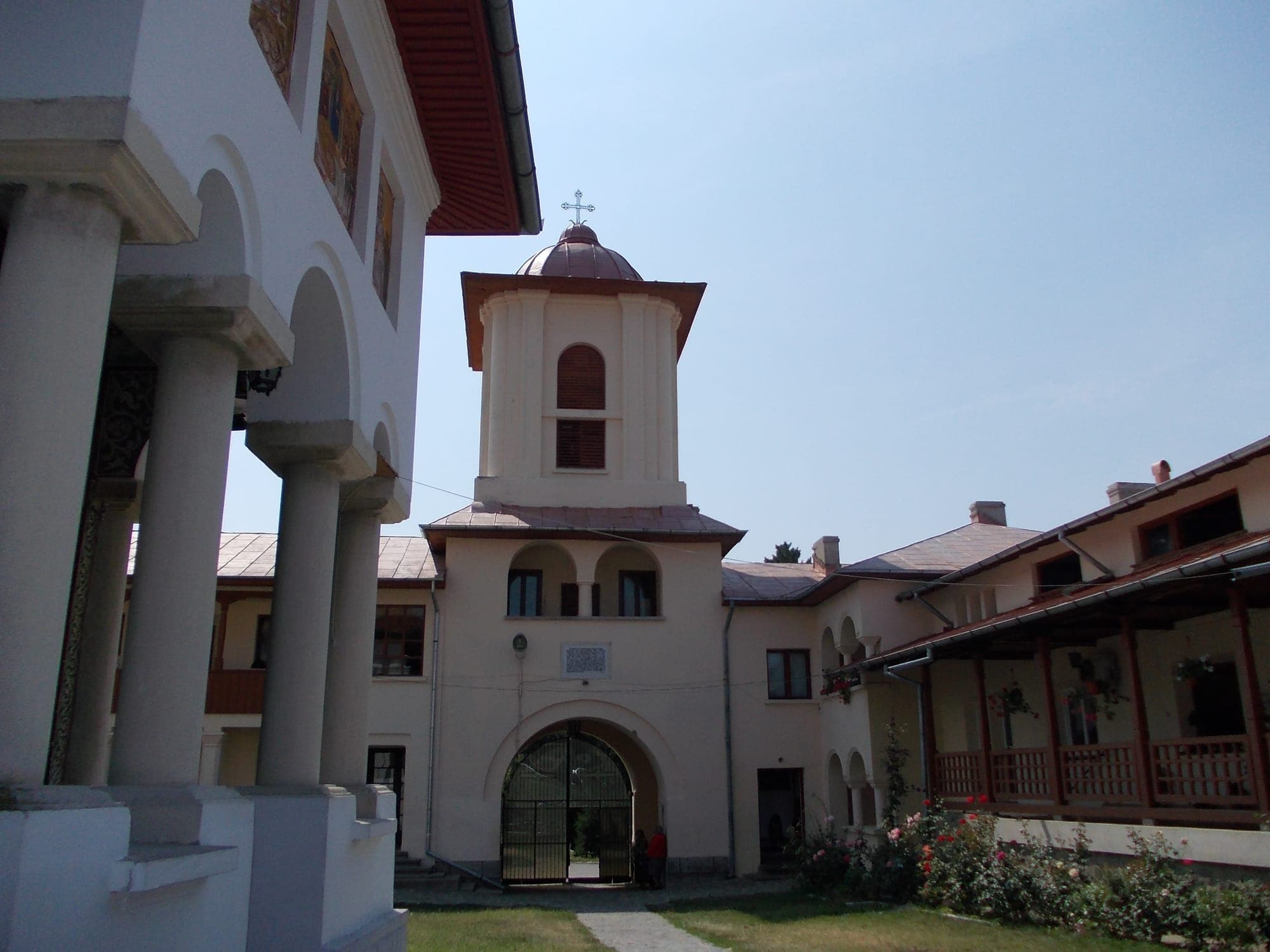
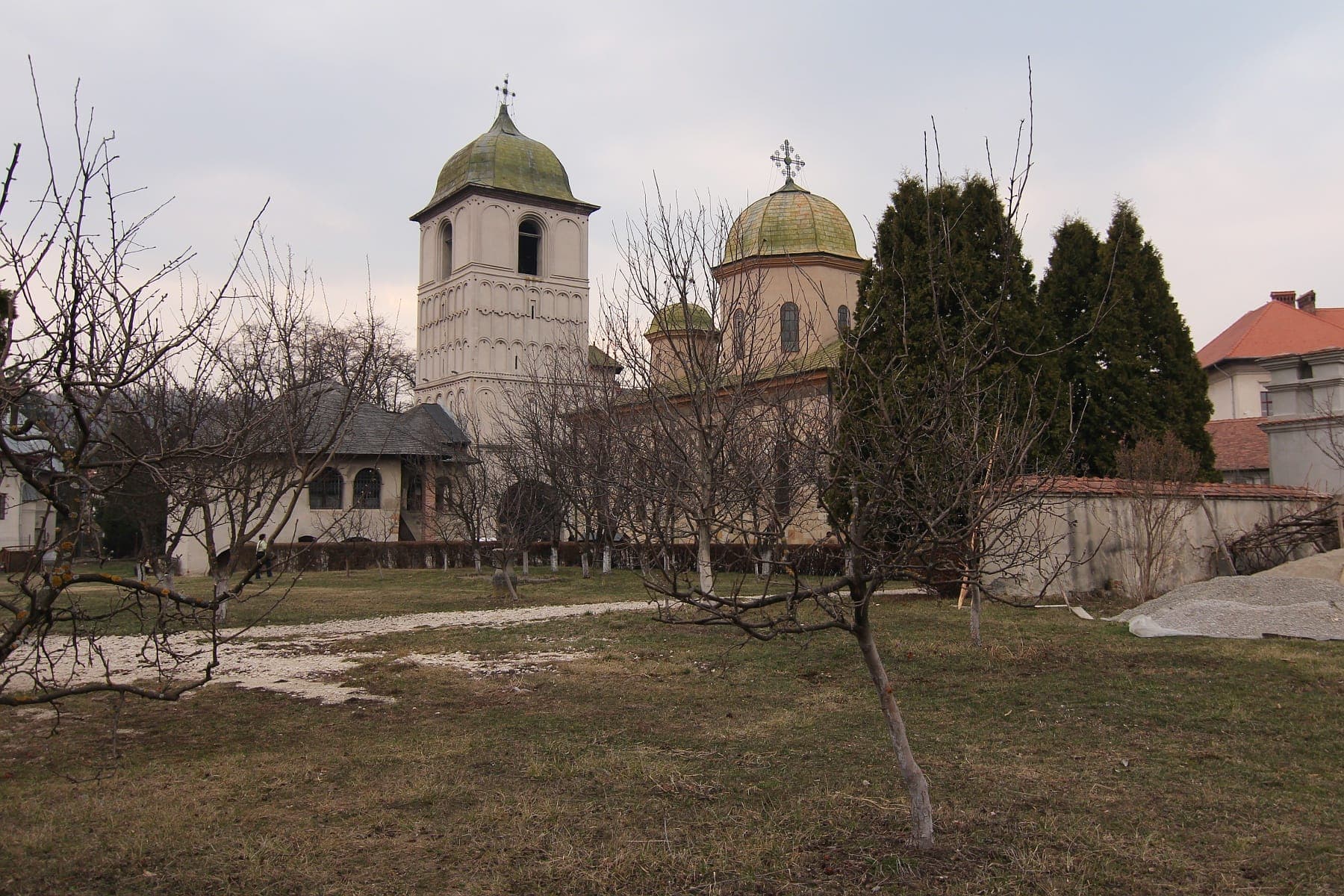
The bell tower at the entrance, built in 1647 by Matei Basarab, is around 35 m tall with a base of about 10 m. In the courtyard are the princely church, with its west front of stone blocks and the inscription above the door, the Princely House of 1650, with arches and an outside staircase, the abbot's house, the monks' cells with a porch on wooden posts, and the infirmary church of the Nativity of Saint John the Baptist, rebuilt in masonry in 1718. The Princely House holds the monastery's collection of church art, with liturgical treasures and more than 2,000 old books. In the 1640s Matei Basarab also had a printing press next to the monastery.
Good to know
In August 2026 the monastery signed a 40-month project to restore the infirmary church, the precinct wall and the cells, so there may be work areas in the courtyard.
Information verified on 2 November 2026.
- The tombstone of Nicolae Alexandru Basarab, from 1364, with its Slavonic inscription, in the princely church.
- Matei Basarab's bell tower, from 1647, about 35 m tall, right at the entrance to the precinct.
- The 1650 Princely House, with its stone arches and outside staircase, home to the monastery's collection.
- The church's west front of stone blocks, with the inscription above the door.
- The infirmary church of the Nativity of Saint John the Baptist, from 1718, with its octagonal tower.
Good to know before you go
- Getting there
By car: the monastery is on Strada Negru Vodă, the town section of the DN73, in the south of Câmpulung, ~1.2 km from the town hall. From Pitești it is ~52 km on the DN73 (~1 hour 20 min); from Bucharest ~166 km on the A1 to Pitești and then on the DN73 (~2½ hours); from Brașov ~85 km on the DN73, through Bran and Rucăr (~1¾ hours). Jidova Roman Fort is ~5.5 km to the south, on the same road.
- Rules
Modest dress: shoulders and knees covered, women with their heads covered in church. Keep quiet within the precinct and put phones on silent during services. Do not take photos in the church without the staff's permission. Keep out of the restoration work areas.
Frequently asked questions about Negru Vodă Monastery
How long does a visit to Negru Vodă Monastery take?
A visit to Negru Vodă Monastery takes about 45 min (courtyard, church and tower).
Can you visit Negru Vodă Monastery with kids?
Yes, Negru Vodă Monastery is suitable for children (quiet courtyard, modest dress).
How do I get to Negru Vodă Monastery?
Negru Vodă Monastery is located at Strada Negru Vodă 64, Câmpulung, Argeș County. More under “Getting there”
When is the best time to visit Negru Vodă Monastery?
The best season for Negru Vodă Monastery: All year round (feast day on 15 August).
Reviews
Other attractions nearby
The closest attractions to Negru Vodă Monastery, sorted by distance.
 7 km from Negru Vodă Monastery
 11 km from Negru Vodă Monastery
 17 km from Negru Vodă Monastery