Palace of the Parliament
București
The heaviest building in the world, raised by Ceaușescu in the 1980s on Spirii Hill; the guided tour passes through marble-clad state rooms hung with crystal chandeliers weighing several tonnes.
Bucharest is the capital and largest city of Romania, set on the plain along the Dâmbovița river. The city mixes layers that do not match, and that is exactly what makes it interesting: churches and inns from the time of the princes, boulevards and villas from the years when it was called "Little Paris", the monumental blocks and palaces of the communist era, then the glass towers built after 1990. If you are wondering what to visit in Bucharest, you can choose between museums, large parks, the Old Town with its taverns and a handful of palaces, each telling a piece of the country's history.
The Palace of the Parliament, the huge building put up by Ceaușescu, is visited on guided tours and dominates the whole centre. The Royal Palace on Calea Victoriei houses the National Museum of Art, while Cotroceni Palace, the president's residence, has a museum of its own. Primăverii Palace preserves the Ceaușescu family home almost unchanged. For nature, Văcărești Nature Park is a wetland gone wild among the apartment blocks, and the Romanian Athenaeum and the Village Museum round off the list.
79 results
The heaviest building in the world, raised by Ceaușescu in the 1980s on Spirii Hill; the guided tour passes through marble-clad state rooms hung with crystal chandeliers weighing several tonnes.

Romania's first urban nature park: 183 ha of ponds, reed beds and willows inside an abandoned reservoir in southern Bucharest, home to over 180 bird species, otters and foxes, a few hundred metres from the tower blocks.

The concert hall in the heart of Bucharest, built in 1886–1888 and paid for largely by public subscription: Ionic columns outside, a fresco over 70 m long telling the story of the Romanians inside.

The royal residence of King Ferdinand and Queen Marie, today the seat of the Romanian Presidency and the National Cotroceni Museum: period salons, the king's library, the queen's apartments and Șerban Cantacuzino's rebuilt church.

An open-air ethnographic museum on the shore of Lake Herăstrău, in the middle of Bucharest: farmsteads, wooden churches, mills and workshops brought from all over the country and rebuilt here since 1936.

The Bucharest home of Nicolae and Elena Ceaușescu from 1965 to 1989, also known as the Ceaușescu Mansion or Spring Palace, with its lavish interiors, mosaic pool and private cinema, seen on guided tours only.

The former residence of Romania's kings on Revolution Square, now the National Museum of Art of Romania: the Throne Hall, the Voivodes' Staircase and the country's largest collection of Romanian and European art.

Romania's National Cathedral, on Arsenal Hill next to the Palace of the Parliament: a 127 m Neo-Byzantine church with its altar consecrated in 2018 and its painting consecrated in 2025, open to visitors only in announced periods.

The pedestrian quarter between Calea Victoriei and Piața Unirii, with streets named after the old guilds, the ruins of the Princely Court, Bucharest's oldest church and covered arcades from the 19th century.

The capital's zoological garden, open since 1959 in Băneasa Forest, with tigers, lions, bears, wolves, zebras, monkeys and more than 150 species on almost 6 hectares.

The University of Bucharest's botanical garden, in Cotroceni: more than 18 hectares with a rose garden, an Italian garden, a lake with an island, greenhouses with palms and orchids, and a botanical museum.
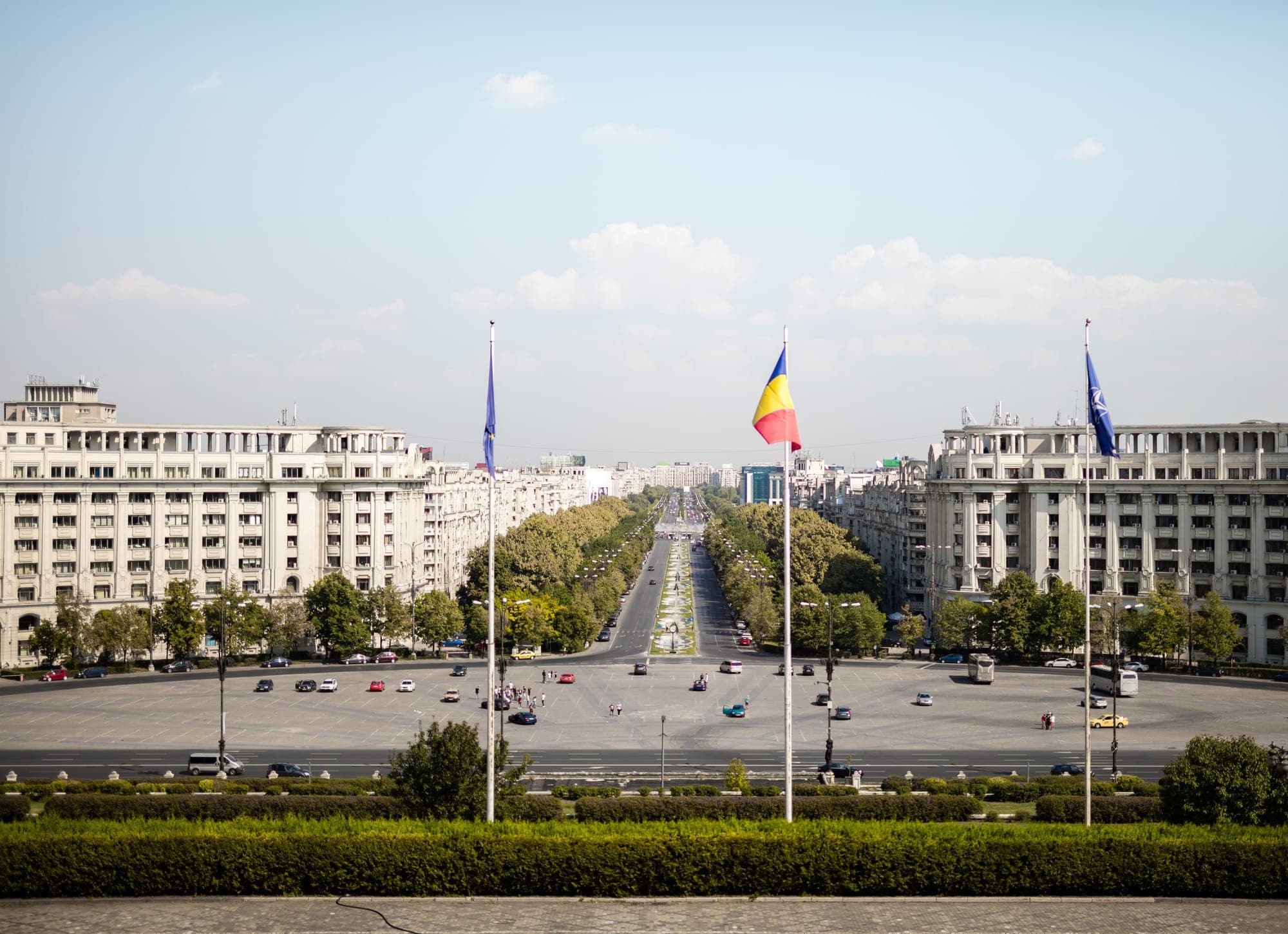
The wide esplanade in front of the Palace of the Parliament, at the end of Bulevardul Unirii: a venue for big concerts and New Year's Eve shows and home to the Bucharest Christmas Market.

A synagogue built in 1845–1846 by Ashkenazi Jews who had come from Poland, with a neoclassical façade and a painted, gilded hall; it houses the permanent exhibition on the Holocaust in Romania.

Bucharest's largest park, on the shore of Lake Herăstrău: nearly 190 hectares of strolling paths, the Japanese Garden, Caryatid Alley and Rose Island.

A church built in 1852–1858 on Calea Șerban Vodă, near Metropolitan Hill, with two towers on the façade and a central dome, paintings by Gheorghe Tattarescu, stained glass made in Vienna and a fragment of the relics of Saint Spyridon.
Audio walk through central Bucharest

Audio tour: from royal to communist Bucharest
Audio tour of communist-era Bucharest
Audio walk along Calea Victoriei
Audio tour of Bucharest's Jewish heritage
Bucharest sightseeing tour + Village Museum

Food tour of Bucharest's markets and old neighbourhoods

Not in București itself, but in the surrounding area — sorted by distance from București.