The Oradea State Theatre building, designed by the Viennese firm Fellner & Helmer and opened in 1900: an Ionic portico on Piața Ferdinand and an auditorium with boxes and a balcony, still in use every week.
A Roman fort in the Teleajen Valley, built during the Dacian Wars, with stone walls and a building with hypocaust heating; currently being developed as an archaeological park.
Monuments and historic sitesFortresses and fortifications
A late Roman fort on the first terrace of the Danube, north of Hinova village, with low stone walls and seven towers; the largest prehistoric gold hoard in Romania was found here.
Monuments and historic sitesFortresses and fortifications
A Roman fort and settlement on the banks of the Mureș near Deva, with its amphitheatre and Roman baths surviving in open fields, beneath the towers of the Mintia power station.
Monuments and historic sitesFortresses and fortificationsUNESCO
A late Roman fort built in the 4th century north of the Danube, and its hypocaust baths, whose walls can be seen in the centre of Pietroasele commune, close to where the "Golden Hen with Chicks" treasure was found.
Monuments and historic sitesFortresses and fortifications
The most important Roman fort in the Jiu valley, beside Răcari railway station in Brădești commune, once home to a unit of Moorish horsemen; excavations go on, and the granary foundation was found in 2025.
Monuments and historic sitesFortresses and fortifications
The oldest documented bastion of Brașov's walled town, mentioned in 1416: a hexagonal stone fortification with brick arches and a house from 1794 inside. It can be seen from the outside, from the path.
Fortresses and fortificationsMonuments and historic sites
A Saxon peasant fortress of brick on Burgbasch Hill above the village: a bell tower with a Gothic chapel and the imposing ruin of a hall church that was never finished.
Fortresses and fortificationsMonuments and historic sites
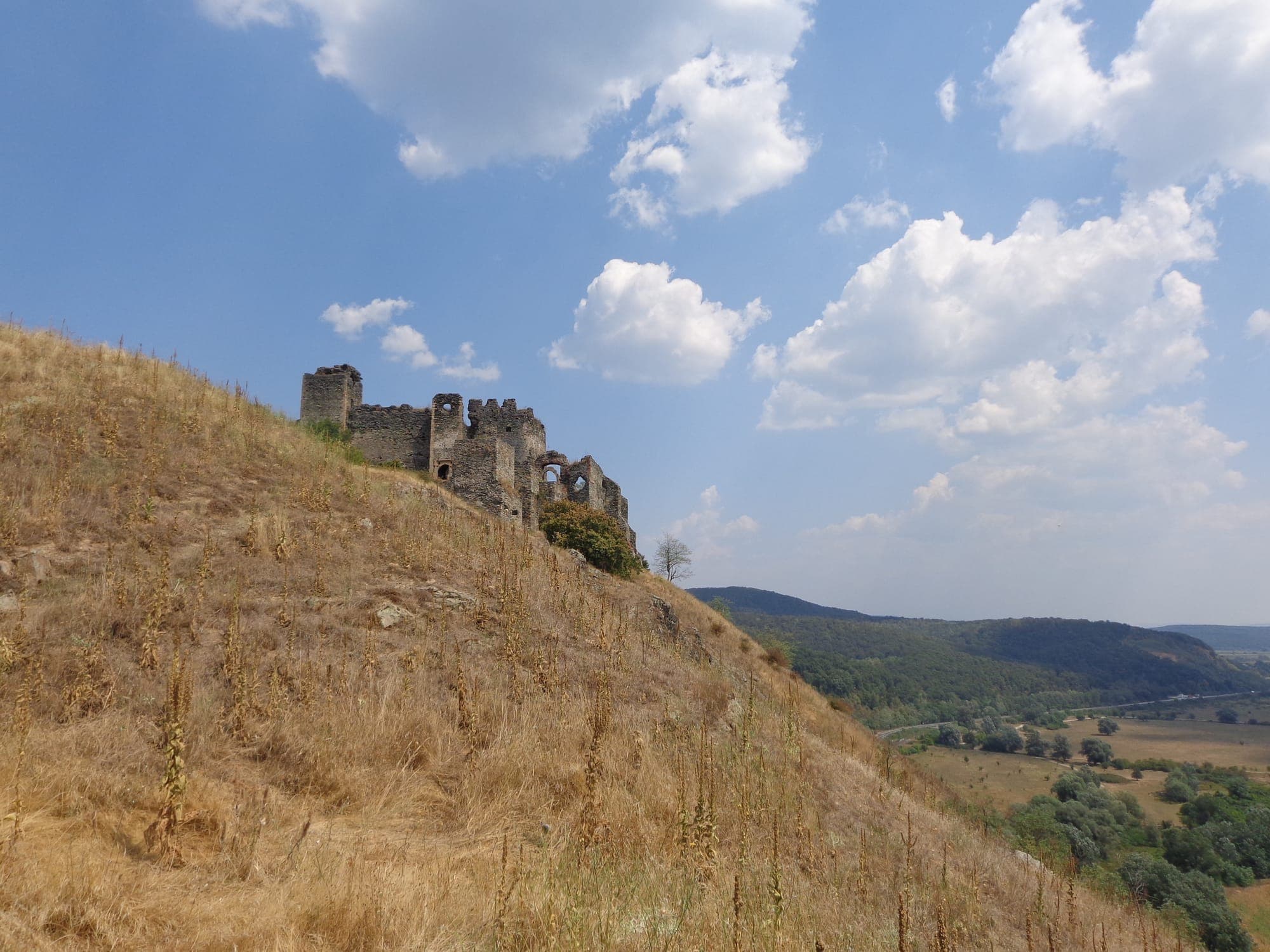
The ruins of a 13th-century royal fortress on a rock above the Mureș and Șoimoș village, near Lipova, with towers, a wide inner courtyard and views over the river valley.
Fortresses and fortificationsMonuments and historic sites
The Gothic hall church on Piața Unirii, built in the 14th–15th centuries, with a 76 m Neo-Gothic tower, a Baroque pulpit and the frescoes of the Schleunig chapel.
A small convent in the Old Town with a Brâncoveanu-style church from 1724, façades painted with saints in medallions, an arcaded courtyard and a lapidary of stones from vanished Bucharest churches.
The Daco-Roman and Roman-Byzantine fortress in Corabia, with its excavated walls and towers, a 6th-century basilica, the "secret well" and the northern pier of Constantine the Great's bridge over the Danube.
Fortresses and fortificationsMonuments and historic sitesUNESCO
The central square of old Brăila, from which the streets of the historic centre fan out, with the blue Public Clock of 1909, the Holy Archangels church, a former mosque, and the statue of Trajan.
The cula on Gârdanul Hill near Drobeta-Turnu Severin, linked to the name of Tudor Vladimirescu: a fortified boyar house with a brick-columned gallery and a watchtower, currently being restored.
Fortresses and fortificationsMonuments and historic sites