

Endless Column
Târgu Jiu, GJ
The 29.35 m column of brass-coated cast-iron modules raised by Constantin Brâncuși in 1938 in Târgu Jiu for the heroes of 1916: the eastern end of the “Heroes' Avenue” ensemble, a UNESCO World Heritage Site.
100 results
The 29.35 m column of brass-coated cast-iron modules raised by Constantin Brâncuși in 1938 in Târgu Jiu for the heroes of 1916: the eastern end of the “Heroes' Avenue” ensemble, a UNESCO World Heritage Site.

The capital of the Dacian kingdom, hidden in the beech forests of the Orăștie Mountains: the walls of Decebalus's fortress, the paved road and the sacred area with andesite and limestone sanctuaries, a UNESCO site.

Romania's largest Gothic church, built by the Saxons of Brașov between 1383 and 1477; inside are the 1839 Buchholz organ and a rare collection of Anatolian carpets.

The Art Nouveau building on the Constanța seafront, opened in 1910, left to decay after 1990 and reopened in 2025 after restoration, with exhibitions on its history and on the Black Sea.

Constantin Brâncoveanu's largest foundation, officially Hurezi Monastery: the model ensemble of the Brâncovenesc style, built in 1690–1693 and a UNESCO site since 1993.

A glacial lake at 2,034 m in the Bâlea cirque of the Făgăraș Mountains, at the top of the Transfăgărășan; reachable by car in summer and by cable car all year round.

The Unirea mine, dug between 1938 and 1970, is a string of 14 salt halls over 50 m high, 208 m underground, which you reach by minibus; 100 km from Bucharest.

Vlad the Impaler's fortress, often called Poenari Castle, perched on a ridge above the Argeș Gorge on the Transfăgărășan; 1,480 steps lead up to walls that look out over the whole valley.

Romania's largest year-round spa resort, 8 km from Oradea: thermal springs of up to 49 °C, open-air baths that run all winter and a reserve of water lilies and thermal lotuses.

The Neo-Romanian summer residence of the 'Nabob' Gheorghe Grigore Cantacuzino, with a ballroom lined with coats of arms, a terrace facing the Bucegi Mountains and the Nevermore Academy exterior from Wednesday.
A narrow limestone gorge in the Piatra Mare Mountains near Brașov, with seven rock steps climbed on metal ladders and walkways; at the top you can ride a zip line back down.

Romania's most visited cave: 488 m of lit galleries beneath the village of Chișcău, full of stalactites and stalagmites, with the bones of some 140 cave bears left where they were found.

A working salt mine near Râmnicu Vâlcea that you enter by bus through a tunnel: huge galleries with swirling salt walls, sports courts, an ice rink and the country's largest underground church.

The Baroque palace of Governor Samuel von Brukenthal on Sibiu's Great Square has housed Romania's oldest museum since 1817: a gallery of European painting with van Eyck, Titian and Bruegel.
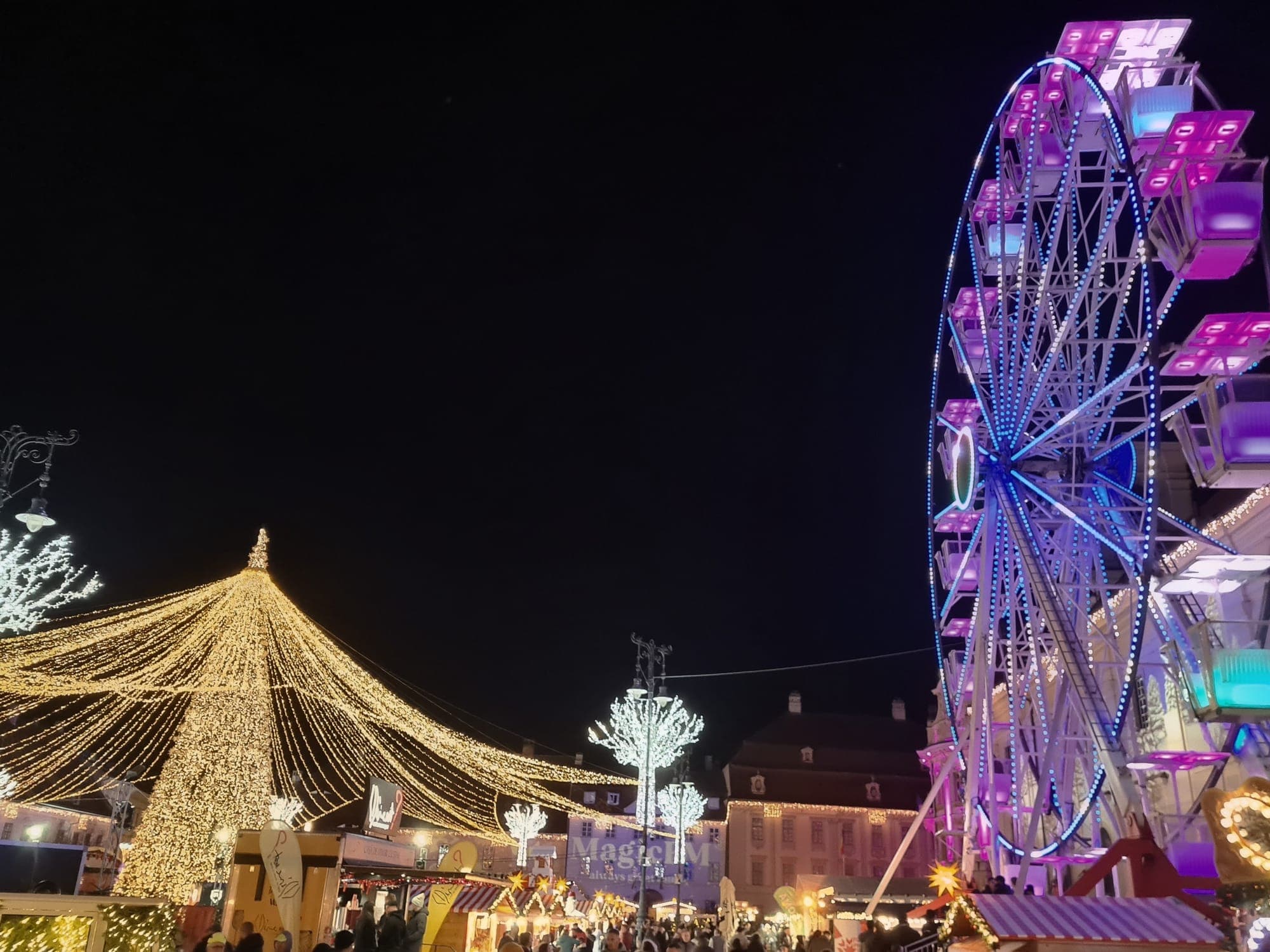
The main square of old Sibiu, about 140 by 90 metres, enclosed by merchants' houses with "eyes" in their roofs, by the Brukenthal Palace, the Jesuit church and the Council Tower.



