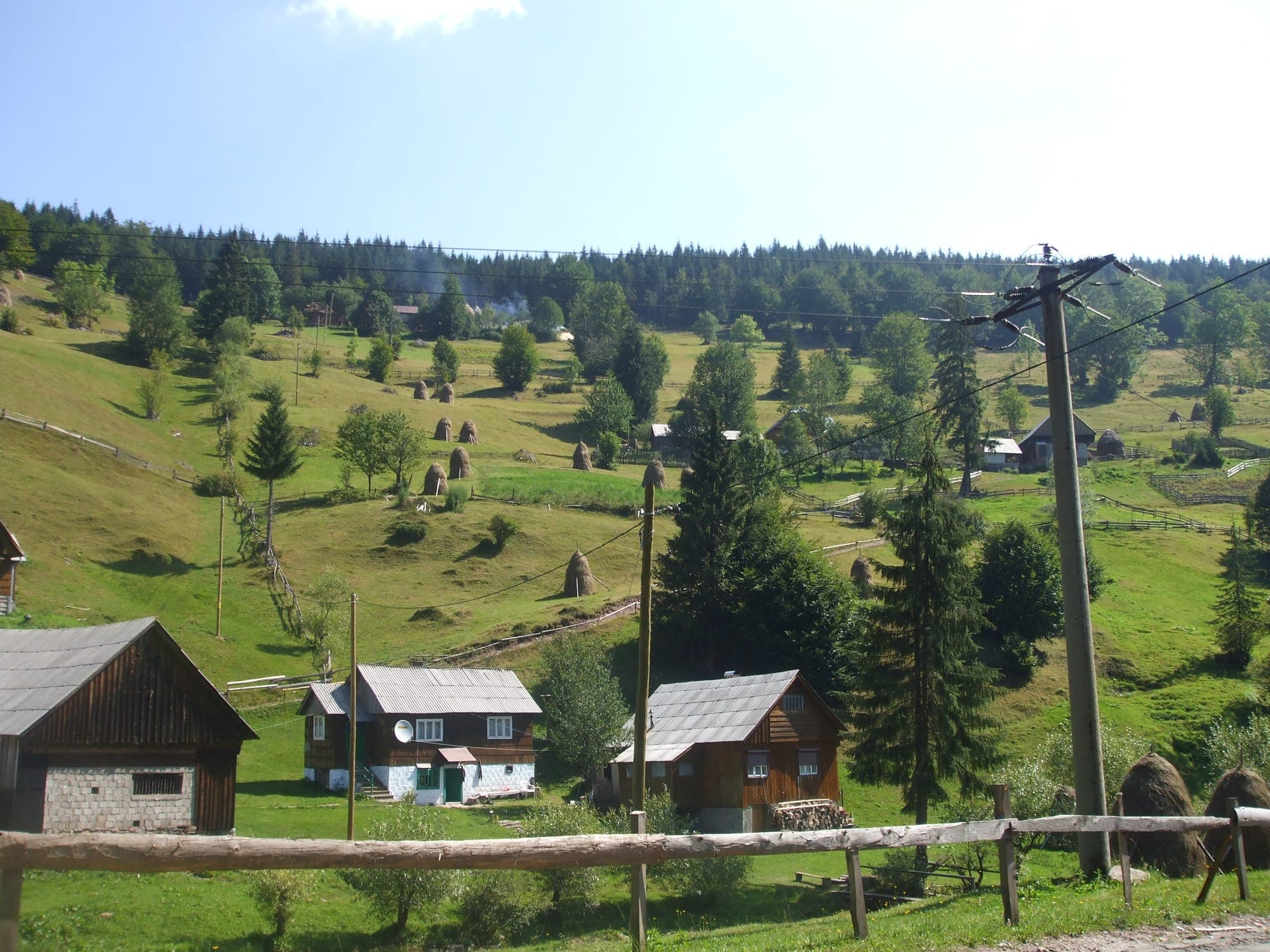
About Transapuseana
At a glance: Scenic roads in Alba County. Opening hours: daily open 24 hours. Ticket: Free. The visit takes 3½ – 4 hours. Information verified on 29 September 2026.
Transapuseana is the name of county road DJ107I, which leaves the centre of Aiud, climbs into the Trascău Mountains and, after 78 km, drops down to the DN74 at Cerbu, near Abrud. It crosses the communes of Râmeț, Ponor, Mogoș and Bucium, an area where the villages sit not in the valleys but along ridges and slopes, with homesteads spread out at over 1,000 m. It is not an alpine road like the Transalpina: its appeal lies in the wide views over forested hills and the villages of the Moți, the highlanders of the Apuseni.
Until recently the road was mostly dirt and gravel, and some villages were almost cut off in winter. Alba County Council rebuilt it with EU funds in two sections: the first, 43 km between Aiud and the Ponor area, was handed over in April 2024, and the second, about 35 km to Bucium, in December 2024. At roughly 73 million euros, it is the largest investment ever made in a county road in Romania. During construction it was known as the "Transalpina of the Apuseni"; it was later given the official name Transapuseana.
What you can see
From Aiud the road climbs through Aiudul de Sus and through forest onto the Trascău ridge, past the village of Râmeț and through Brădești, below Pleașa peak (1,250 m). Next come Măcărești, Bârlești-Cătun, Cojocani and Valea Barnii, then Mogoș, where you can still see barns and old houses with tall thatched roofs, haystacks and orchards on the slopes. After Mogoș the road enters Bucium commune, passes below the Detunate, two basalt peaks, and descends through Izbita and Bucium-Sat to the DN74.
Good to know
The road is fully paved and open all year, but it is narrow in places, with hairpin bends and no petrol stations along the way. Râmeț Monastery, the Râmeț Gorge, the Geogel Gorge and the Detunate are not on the road itself but a few kilometres from it, reached by side roads or footpaths.
- The barns and houses with tall thatched roofs in the villages of Mogoș commune, among the last of their kind in Romania.
- The stretch along the Trascău ridge between Râmeț and Brădești, below Pleașa peak, with forest and pasture on either side.
- Detunata Goală and Detunata Flocoasă, the basalt peaks of Bucium commune, a few kilometres from the road.
- A detour to Râmeț Monastery and the Râmeț Gorge, below the road in the Geoagiu valley.
Good to know before you go
- Getting there
By car: the eastern end is in the centre of Aiud, on the DN1 between Alba Iulia (~30 km) and Turda, close to the Aiud exit of the A10 Sebeș–Turda motorway; Aiud is ~70 km from Cluj-Napoca. The western end is at Cerbu, on the DN74, a few kilometres from Abrud; from Alba Iulia you get there on the DN74 via Zlatna. The whole route, Aiud to the DN74, is 78 km and takes about two hours without stops. Fill up in Aiud or Abrud: there are no petrol stations along the road.
Public transport: Aiud has a railway station on the Cluj-Napoca – Alba Iulia line, and Abrud has buses from Alba Iulia. We found no regular services covering the whole road; in practice, the Transapuseana is done by car, motorbike or bicycle.
- Where to park
There are no car parks built for visitors: people stop in the wider spots by the roadside, in the villages or at the guesthouses along the route. On the hairpins and bends, do not stop on the carriageway for photos.
- Fees & discounts
The road is public and free, with no toll. As a county road it does not require the road vignette (rovinieta); you do need one on the DN1 and the A10 to reach Aiud.
- Rules
The road is narrow in places, with hairpins and steep gradients: drive slowly, keep to your lane and watch for animals and farm vehicles in the villages. In winter drive only on winter tyres. On the paths to the gorges and the Detunate stay on the waymarked trails and wear walking boots; the Detunate and the Râmeț Gorge are protected areas.
- Facilities
No petrol stations along the route (fill up in Aiud or Abrud) · guesthouses and holiday cottages in Râmeț, Ponor, Mogoș and Bucium · weak or no mobile signal on some ridge sections · small shops in the larger villages
Frequently asked questions about Transapuseana
- How much is a ticket to Transapuseana?
- Admission to Transapuseana is free (public road, no toll). The road is public and free, with no toll. As a county road it does not require the road vignette (rovinieta); you do need one on the DN1 and the A10 to reach Aiud.
- What are the opening hours of Transapuseana?
- Opening hours at Transapuseana: daily open 24 hours. County road open at all times, with no seasonal closure; Alba County Council clears the snow. On the ridges, above 1,000 m, snow and ice usually arrive from November to April: in winter you need winter tyres, and it is worth checking Alba County Council's announcements before setting off.
- How long does a visit to Transapuseana take?
- A visit to Transapuseana takes about 3½ – 4 hours (with stops; ~2 hours without).
- Can you visit Transapuseana with kids?
- Yes, Transapuseana is suitable for children (lots of hairpin bends).
- Where can I park at Transapuseana?
- There is free parking at Transapuseana (roadside lay-bys). There are no car parks built for visitors: people stop in the wider spots by the roadside, in the villages or at the guesthouses along the route. On the hairpins and bends, do not stop on the carriageway for photos.
- How do I get to Transapuseana?
- Transapuseana is located at DJ107I, between Aiud (DN1) and Cerbu (DN74), via Râmeț, Ponor, Mogoș and Bucium, Alba County. By car: the eastern end is in the centre of Aiud, on the DN1 between Alba Iulia (~30 km) and Turda, close to the Aiud exit of the A10 Sebeș–Turda motorway; Aiud is ~70 km from Cluj-Napoca. The western end is at Cerbu, on the DN74, a few kilometres from Abrud; from Alba Iulia you get there on the DN74 via Zlatna. The whole route, Aiud to the DN74, is 78 km and takes about two hours without stops. Fill up in Aiud or Abrud: there are no petrol stations along the road. Public transport: Aiud has a railway station on the Cluj-Napoca – Alba Iulia line, and Abrud has buses from Alba Iulia. We found no regular services covering the whole road; in practice, the Transapuseana is done by car, motorbike or bicycle.
- When is the best time to visit Transapuseana?
- The best season for Transapuseana: May – October (open in winter too, with snow).
Reviews
Other attractions nearby
The closest attractions to Transapuseana, sorted by distance.
 9 km from Transapuseana
 12 km from Transapuseana