St Joseph's Cathedral
București
A red-brick basilica in the Romanesque style with Gothic touches, built between 1875 and 1883 to plans by Friedrich von Schmidt; the cathedral of the Roman Catholic Archdiocese of Bucharest.
79 results
A red-brick basilica in the Romanesque style with Gothic touches, built between 1875 and 1883 to plans by Friedrich von Schmidt; the cathedral of the Roman Catholic Archdiocese of Bucharest.

The largest park in southern Bucharest, laid out between 1965 and 1974 around a lake of about 13 hectares, with long avenues, playgrounds and the Polyvalent Hall.

The 27 m interwar monument at the end of Șoseaua Kiseleff, built in memory of the Great Union, with 292 steps up to a terrace overlooking northern Bucharest.

The 1833–1835 palace near University Square, one of Bucharest's oldest aristocratic residences, houses the permanent exhibition “Time of the City”, on the history of the capital.

The opera house on Mihail Kogălniceanu Boulevard, built in 1953 to plans by Octav Doicescu, with a portico of three arches and a horseshoe-shaped auditorium.

The seat of the Savings and Consignment Bank on Calea Victoriei, built in 1897–1900 to plans by the French architect Paul Gottereau: a monumental façade, corner cupolas and a central dome of glass and metal.

The museum on Kiseleff Road holds the 1907 dioramas, the Deinotherium skeleton and over 2 million zoological, palaeontological and mineralogical pieces, in a building inaugurated in 1908.
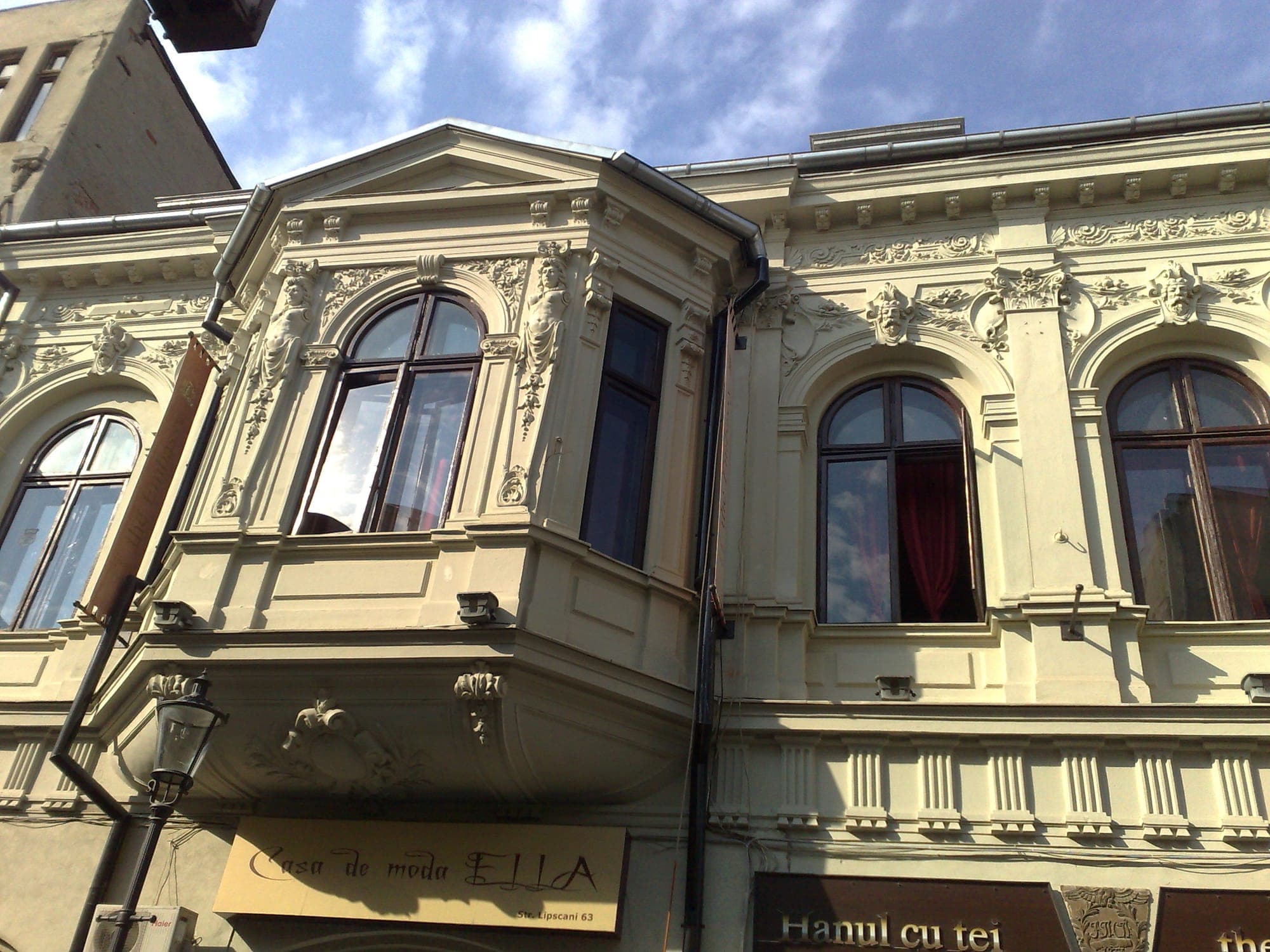
The only historic inn in Bucharest to have kept its original form: a cobbled pedestrian passage between Strada Lipscani and Strada Blănari, with shops, art galleries and antique dealers.

An inn from 1808, built by the merchant and diplomat Manuc Bei beside the Old Court: a listed building with an inner courtyard and wooden balconies, where the 1812 Russo-Turkish peace talks took place.

The museum in the Neo-Romanian building on Kiseleff Road, named European Museum of the Year in 1996, keeps over 100,000 objects of peasant art and civilisation.

The last church founded by Constantin Brâncoveanu in Bucharest, built in 1705–1707 at the edge of the Old Town, with a porch on twelve stone columns, the founder's crypt and Kilometre Zero in front.

The church built in 1654–1658 on Metropolitan Hill, a patriarchal cathedral since 1925, with the relics of Saint Demetrius the New and a Brâncoveanu bell tower from 1698.

A church built in 1905–1909 by the Russian embassy, with seven Russian-style towers, brick façades with glazed ceramic, a gilded iconostasis and interior painting with icons by Viktor Vasnetsov.

An Art Deco tower of about 52 m on Calea Victoriei, built in 1931–1933 on a steel frame to plans by Louis Seabury Weeks; for a long time the tallest building in Bucharest.

The house museum of the collector Krikor H. Zambaccian, near Piața Dorobanților: Romanian art from Grigorescu to Baba alongside Cézanne, Renoir, Matisse and Picasso, in a 1940s villa.
Audio walk through central Bucharest

Audio tour: from royal to communist Bucharest
Audio tour of communist-era Bucharest
Audio walk along Calea Victoriei
Audio tour of Bucharest's Jewish heritage
Bucharest sightseeing tour + Village Museum

Food tour of Bucharest's markets and old neighbourhoods

Not in București itself, but in the surrounding area — sorted by distance from București.