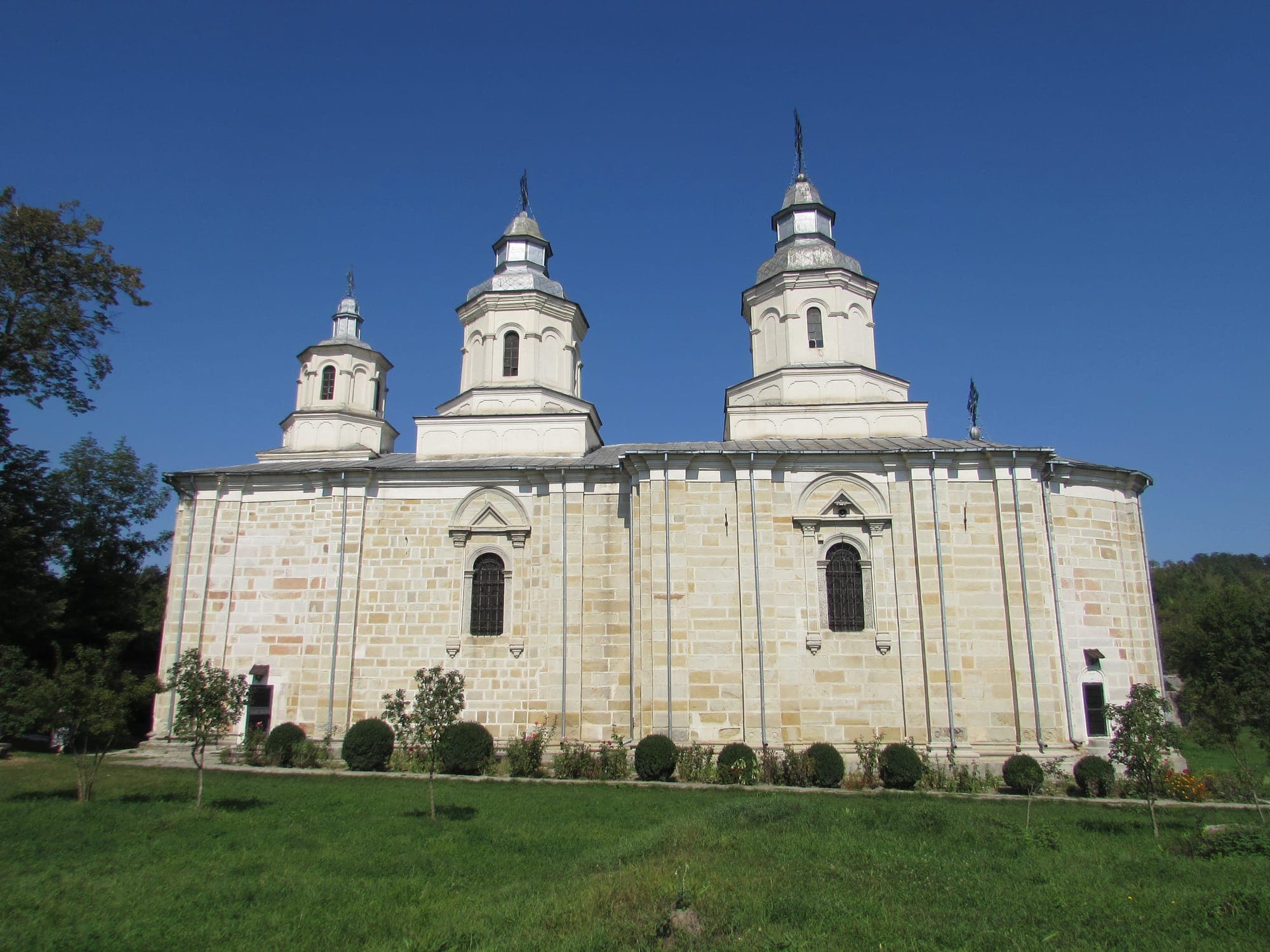
About Huși Episcopal Cathedral
At a glance: Monasteries and churches in Huși, Vaslui County. Opening hours: Monday–Saturday 06:30 – 22:00, Sunday 07:30 – 22:00. Ticket: Free. The visit takes 45 min. Information verified on 10 October 2026.
In the heart of Huși, within a walled precinct guarded by a gate tower, stands the cathedral of the Diocese of Huși, the Church of Saints Peter and Paul. Stephen the Great built it in 1495 as the church of the princely court he had founded in the market town of Huși; according to the Slavonic inscription, work was completed on 30 November 7003 from the Creation of the World, a date that sources convert to either 1495 or 1494. As a court church it was never endowed with estates or villages.
In 1598 Ieremia Movilă founded the Diocese of Huși here and the church became a cathedral. Earthquakes, fires and plunder brought it to ruin, so Bishop Inochentie pulled it down to the foundations and rebuilt it between 1753 and 1756. Only the foundations and the inscription, set into the wall, survive from Stephen's church. Today's church is triconch in plan, with two towers (the second added in 1891 and rebuilt after the 1940 earthquake) and Baroque facades in two registers separated by a belt course. The communist regime abolished the diocese in 1949 and it was re-established in 1996; the cathedral was reconsecrated in 1998.
What you can see
The most precious object is Stephen the Great's inscription, carved in marble in Slavonic above the door in the south porch, beside the inscriptions of 1793 (Veniamin Costachi) and of 1941–1945. The interior painting is that of Dumitru Bănică from 1997–1998, after most of Gheorghe Tattarescu's painting of 1890–1891 had fallen in the 1940 earthquake. In the nave, in front of the bishop's throne, the relics of the left hand of Saint Great Martyr Kyriaki, patron saint of the diocese, brought from Athos in 1787, are venerated.
The precinct holds further layers of history: the gate and bell tower of 1938, in the Moldavian style, with mosaics of Saints Peter and Paul and of Saint Kyriaki; the brick enclosure wall; the statue of Stephen the Great from 1995; the obelisk in memory of Metropolitan Veniamin Costachi; the graves of Bishops Grigorie Leu and Iacov Antonovici; and the wooden cross and grave of Archimandrite Mina Dobzeu, who baptised Nicolae Steinhardt in prison. The Episcopal Palace of 1782–1792 is the bishop's residence and has, in its cellars, remains of Stephen's princely court.
Good to know
The cathedral is a working church: the daily services (matins in the morning, the liturgy, vespers in the evening) take priority, so visit without disturbing them. The Episcopal Palace and the other buildings in the precinct are not open to visitors. The Diocesan Museum operates separately, in an 1889 building at 10 Strada 1 Decembrie; call the diocese beforehand to arrange entry.
- Stephen the Great's Slavonic inscription, the only surviving part of the church he built in 1495, in marble above the door of the south porch.
- The relics of the left hand of Saint Great Martyr Kyriaki, brought from Athos in 1787, venerated in the nave.
- The gate and bell tower of 1938, in the Moldavian style, with mosaics of Saints Peter and Paul and of Saint Kyriaki.
- The statue of Stephen the Great in the grounds and the obelisk raised in memory of Metropolitan Veniamin Costachi.
- The graves of the bishops and the grave of Father Mina Dobzeu, who baptised Nicolae Steinhardt.
Good to know before you go
- Getting there
By car: the cathedral is in the centre of Huși, on Strada Ștefan cel Mare, within the Episcopal precinct. From Vaslui it is ~43 km (~55 minutes), from Bârlad ~66 km (~1 hour 10 minutes), from Iași ~76 km (~1 hour 30 minutes).
Public transport: Huși is linked to Vaslui, Bârlad and Iași by intercity buses and minibuses; check timetables beforehand. From the town centre the cathedral is a few minutes' walk.
- Rules
It is a working cathedral: modest dress (shoulders and knees covered, men's heads uncovered), quiet in the church and the grounds, respect for the services. Photograph inside discreetly and without flash, and ask permission during services. Do not touch the graves or the sacred objects.
Frequently asked questions about Huși Episcopal Cathedral
- How much is a ticket to Huși Episcopal Cathedral?
- Admission to Huși Episcopal Cathedral is free (entry to the church is free).
- What are the opening hours of Huși Episcopal Cathedral?
- Opening hours at Huși Episcopal Cathedral: Monday–Saturday 06:30 – 22:00, Sunday 07:30 – 22:00. The opening hours (weekdays 6:30 am–10 pm; Sundays and feast days 7:30 am–10 pm) are those posted by the diocese on its September 2026 liturgical programme. During services, visit quietly and without disturbing the worshippers. Check the liturgical programme on the diocese's website.
- How long does a visit to Huși Episcopal Cathedral take?
- A visit to Huși Episcopal Cathedral takes about 45 min (church, precinct and inscription).
- Can you visit Huși Episcopal Cathedral with kids?
- Yes, Huși Episcopal Cathedral is suitable for children (modest dress and quiet).
- How do I get to Huși Episcopal Cathedral?
- Huși Episcopal Cathedral is located at 1 Strada Ștefan cel Mare, Huși, Vaslui County. By car: the cathedral is in the centre of Huși, on Strada Ștefan cel Mare, within the Episcopal precinct. From Vaslui it is ~43 km (~55 minutes), from Bârlad ~66 km (~1 hour 10 minutes), from Iași ~76 km (~1 hour 30 minutes). Public transport: Huși is linked to Vaslui, Bârlad and Iași by intercity buses and minibuses; check timetables beforehand. From the town centre the cathedral is a few minutes' walk.
- When is the best time to visit Huși Episcopal Cathedral?
- The best season for Huși Episcopal Cathedral: All year round (open all year).
Reviews
Other attractions nearby
The closest attractions to Huși Episcopal Cathedral, sorted by distance.
 33 km from Huși Episcopal Cathedral
 75 km from Huși Episcopal Cathedral
 Top 10084 km from Huși Episcopal Cathedral