
Sulina or Sfântu Gheorghe? The beaches of the Danube Delta (and Gura Portiței)

Between Sulina and Sfântu Gheorghe you choose by what you want besides the beach: Sulina is a port town with the old lighthouse, the palace of the European Commission of the Danube and the maritime cemetery, 2–3 km from a fine-sand beach with terraces, showers and parasols in summer, while Sfântu Gheorghe is a fishing village 2 km from a 30 km wild beach with nothing built on it. Both lie at the mouth of a branch of the Danube on the Black Sea, inside the Danube Delta Biosphere Reserve, and neither has a road: you get there only by water, and a beach day almost certainly means a night there.
Below the two are compared, together with the other beaches in the reserve: Gura Portiței, the strip of sand between the sea and Lake Golovița, and Vadu Beach and Corbu Beach, in the south of the reserve, the only ones you can reach by car. For each: what the beach is like, what you find on it, what you see in the town or village and around it, and how isolated it is. How to get there, on which boats and how long it takes is explained in the guide to Danube Delta trips.
In short
- Sulina has a beach with facilities: about 5 km of fine sand, 2–3 km east of the town, with terraces, showers, boardwalks and parasols for hire in summer.
- Sfântu Gheorghe Beach is, according to the commune's town hall, 30 km long and 1–2 km wide, 2 km from the village, with nothing built apart from a few drinks terraces in summer.
- There is no lifeguard at either Sulina or Sfântu Gheorghe: the reserve administration classes them as wild beaches, and you go into the water at your own risk.
- In Sulina you see the Old Lighthouse (a museum), the palace of the European Commission of the Danube and the maritime cemetery; at Sfântu Gheorghe, the 57 m lighthouse from 1967, the mouth of the branch and the Sacalin islands, closed to visitors.
- Gura Portiței is a strip of sand between the Black Sea and Lake Golovița that you reach only by boat from Jurilovca, with a single resort and wild beach beyond it.
- Vadu and Corbu are the wild beaches in the south of the reserve, in Constanța County, the only ones you can reach by car, on a final ~3.5 km of dirt road.
- On every beach in the reserve you need the ARBDD access permit, and tents and caravans are banned outside authorised campsites.
Danube Delta beaches compared: Sulina, Sfântu Gheorghe, Gura Portiței, Vadu, Corbu
All five are inside the Danube Delta Biosphere Reserve, so they share the same rules: an access permit, no tents outside authorised campsites, no cars on the sand. What sets them apart is the facilities, the distance from the village or town and the way you get there.
| Beach | What it is like | On the beach | To the town or village | What you see nearby | Access |
|---|---|---|---|---|---|
| Sulina | ~5 km of fine sand, wide, shallow water for tens of metres | terraces, showers, toilets, parasols in summer; no lifeguard | 2–3 km from the town | Old Lighthouse, Commission palace, maritime cemetery, the jetty with its lighthouse | by water only, from Tulcea |
| Sfântu Gheorghe | 30 km long, 1–2 km wide, with shells | a few drinks terraces in summer; no lifeguard | 2 km from the village | 57 m lighthouse, mouth of the branch, Sacalin islands | by water only, from Tulcea or Murighiol |
| Gura Portiței | a strip a few tens of metres wide between sea and lake | reed parasols, one resort; wild beach beyond the breakwater | no village; Jurilovca is across the lake | Lake Golovița, Argamum Citadel | by boat only, from Jurilovca |
| Vadu | white sand with shells, low dunes | nothing: no water, shade or toilets | ~4 km from Vadu village | Grindul Chituc, a strictly protected area | by car, the last ~3.5 km on a dirt road |
| Corbu | sand with shells, dunes, a low cliff | terraces, a shop and eco toilets in summer | ~5 km from Corbu village | the view towards Vadu and Chituc | by car, the last ~3.5 km on a dirt road |
Data from the beach pages on this site and, for Sfântu Gheorghe, from the commune's town hall website (October 2026). The length of Sulina Beach is the one on the attraction page; for Gura Portiței, Vadu and Corbu no length is published.


Sulina or Sfântu Gheorghe (Danube Delta)?
The big difference is between a town and a village. In Sulina you sleep in a town with streets, shops, a pharmacy and a hospital, you have something to visit when the wind blows, and the beach has facilities: terraces, showers, wooden boardwalks, a playground, reed parasols and sunloungers in season. In Sfântu Gheorghe you are in a fishing village with no road, with a much longer and wider beach on which, after a few hundred metres, you meet no one.
If you come with small children, Sulina is simpler: the water stays shallow for tens of metres, and the way to the sand is on tarmac. At Sfântu Gheorghe you walk 2 km on a dirt road or ride the “trocarici”, the trailer pulled by a tractor. If you want an empty beach and the Danube flowing into the sea, choose Sfântu Gheorghe. Neither has a lifeguard, and the terraces open only in summer.
Anyone searching for a “Sulina Sfântu Gheorghe trip” usually wants to see both: there is no road between them, and the connection by water is in the guide to Danube Delta trips.
Sulina Beach: fine sand at the end of the Sulina branch
Sulina Beach is Romania's easternmost beach, where the Sulina branch enters the Black Sea. The sand is alluvial and very fine, in a strip much wider than in the resorts further south, and the water deepens in gentle steps. From the town centre you go 2–3 km east, 20–30 minutes on foot, by bicycle or by motorbike taxi, past the maritime cemetery.
To the north you see the long jetty that pushes the branch out to sea, with the lighthouse at its end; to the south the beach empties and goes on with nothing built. Behind the sand grow sea buckthorn and protected dune plants, among them the sea bindweed, which must not be trampled. There is no natural shade. The sunrise here is the first in the country. Sulina town hall writes that the beach received the QualityCoast award, Gold category, in 2011.
What to see in Sulina: the Old Lighthouse, the Commission palace and the maritime cemetery
Sulina, which the town hall calls “the easternmost town in Europe”, was the seat of the European Commission of the Danube, which turned the fishing village into an international port. From that era three places remain to see on foot:
- The Old Lighthouse of Sulina, the white tower over 17 m high in the middle of the town, dated 1870, now a museum about “Europolis”, Jean Bart and the conductor George Georgescu, with a spiral staircase up to the lantern.
- The palace of the European Commission of the Danube, the Commission's administrative building, one of the most imposing in the town, according to the town hall.
- The maritime cemetery, a complex of several faiths, Orthodox, Lipovan, Western churches, Muslim and Jewish, with monuments to British sailors and to members of the Commission.
Around it, Sulina is a starting point for Letea Forest, with old oaks, dunes and feral horses, which can be visited only with a guide, on approved routes. On the way to Tulcea, on the Sulina branch, lies Crișan, from where you reach Caraorman Forest and the village of Mila 23, on the Old Danube.


Sfântu Gheorghe Beach (Danube Delta): 30 km of wild sand
Sfântu Gheorghe Beach lies where the southernmost branch of the Danube flows into the Black Sea. The commune's town hall gives it as 30 km long and 1–2 km wide, and along its whole length there is no promenade and no hotel: low dunes, shrubs and a waterline full of shells and rapa whelks. Because the Danube's fresh water flows out right next to it, the sea is less salty than in the south and turns murky quickly after storms.
From the village to the sand it is about 2 km east, 20–30 minutes on foot on a dirt road, or by “trocarici” for a few lei. At the entrance there are a few drinks terraces in summer; otherwise, nothing. Trading is banned on a 150 m strip from the waterline, and there is no shade at all, so bring your own parasol and water.
What to see in Sfântu Gheorghe, Tulcea: the lighthouse, the mouth of the branch, Sacalin
Sfântu Gheorghe is a fishing village recorded since the 14th century, at the end of the branch of the same name. What you see besides the beach:
- The mouth of the branch, at the southern end of the beach, where the fresh water visibly mixes with the sea.
- The lighthouse, built in 1967, 57 m tall, of iron and glass, the landmark you see from the sand and from the water.
- The islands of Sacalinul Mare and Sacalinul Mic, in the Sacalin-Zătoane reserve: landing on them is banned, but you can look at them from a boat or from the beach.
- The old fish-processing station, built in 1950–1953, the largest in the delta in its day, now derelict, and the Village Museum, opened in 2014, according to the commune's town hall.
In August the village fills up for the Anonimul film festival, held here since 2004. Unlike Sulina, near Sfântu Gheorghe there is no attraction on this site apart from the beach; the rest of the delta is presented on the Danube Delta page.
 Top 20
Gura Portiței: the beach between the sea and Lake Golovița
The third option for a beach in the delta is Gura Portiței, in the south of the reserve, on the Razim–Sinoe lake complex. It is a strip of sand a few tens of metres wide, with the sea on one side and Lake Golovița on the other, so on the same day you see the sunrise over the sea and the sunset over the reeds. No road reaches it: the car stays in Jurilovca, and the rest is a boat crossing over the lake.
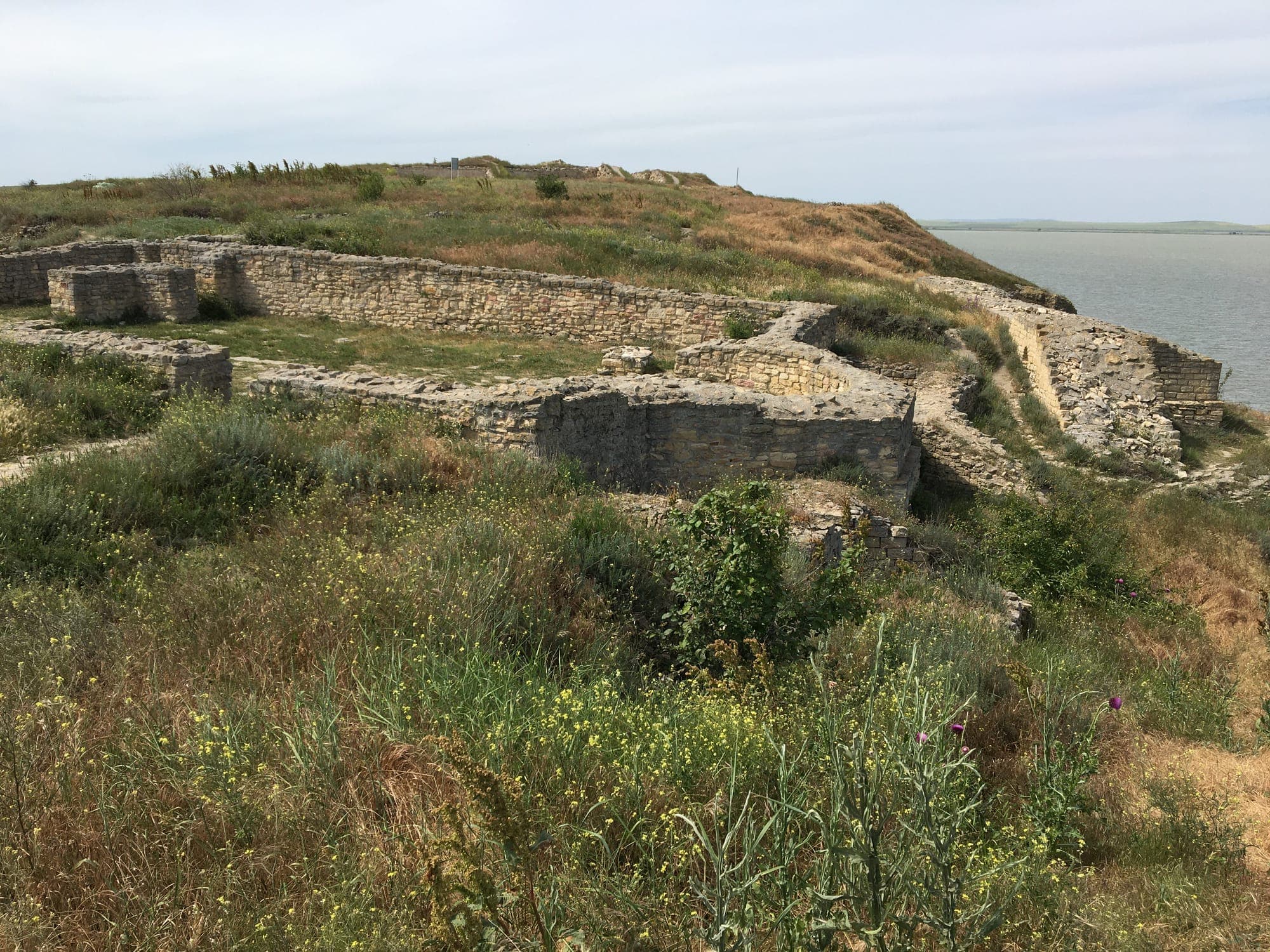
Unlike Sulina and Sfântu Gheorghe, there is no village here, only a single resort, with reed parasols on the beach in front of it; beyond the breakwater of concrete tetrapods the shore stays wild, with shells. Fire is banned along the whole strip. Boat trips on Lake Sinoe leave from Gura Portiței, and near Jurilovca, on Cape Doloșman, are the ruins of Argamum Citadel, ~7 km from the village.
Vadu and Corbu: the reserve's beaches you can reach by car
If you want a wild beach without a boat or a night on the spot, the reserve has two beaches in the south, in Constanța County, that you can reach by car: Vadu Beach and Corbu Beach, with the last ~3.5 km on a dirt road. They are not the Delta proper but its southern coast, near the port of Midia. Vadu has nothing built, Corbu has terraces and toilets in summer; how to choose between them is in the wild beaches guide).


Sfântu Gheorghe in Covasna, the Sulina hotel and Sulina's lighthouses
Three mix-ups come up often in searches:
- “Sfântu Gheorghe” on its own is usually the town in Covasna County. The delta village is Sfântu Gheorghe, Tulcea County, at the mouth of the Sfântu Gheorghe branch on the Black Sea; search for it as “Sfântu Gheorghe Delta” or “Sfântu Gheorghe Tulcea”.
- “Sulina Mamaia” is a hotel in Mamaia with the same name, not the town in the delta.
- “The Sulina lighthouse” can be any of four: the Old Lighthouse, the museum in the middle of the town; the new lighthouse, cylindrical, 48 m tall, near the end of the south jetty; and the two small lighthouses on the north and south jetties of the canal, according to Sulina town hall. Only the old lighthouse is a museum, with a ticket.
Before you go to the beach in the delta
What is specific to the beaches in the reserve:
- No lifeguard at Sulina, Sfântu Gheorghe, Vadu and Corbu: the administration classes them as wild beaches. At Gura Portiței the resort's rules use flags and buoys.
- No tent or caravan on the beach: ARBDD bans them throughout the reserve outside authorised campsites, and at Vadu no place has been authorised for camping or parking. Fire is banned, as are cars and quad bikes on the sand and dunes.
- No natural shade on any of them; at Vadu there is not even water to buy.
- The ARBDD access permit (5 lei a day) is compulsory on all of them, including for children, who get it free; how to get it is explained in the guide to a first visit to the delta.
Sulina in winter: the beach terraces are closed and the boats run only on a few days a week, but the Old Lighthouse stays open, Tuesday to Sunday (the opening hours are on the lighthouse page).
Frequently asked questions
- Sulina or Sfântu Gheorghe, which is better for the beach?
- For facilities and small children, Sulina: a fine-sand beach with terraces, showers and parasols in summer, 2–3 km from the town. For a wild, empty beach, Sfântu Gheorghe: 30 km of sand, 2 km from the village, with nothing built. Neither has a lifeguard.
- How far is the beach from Sulina town?
- 2–3 km east of the centre, 20–30 minutes on foot on a tarmac road; you can also go by bicycle or by motorbike taxi.
- Does Sfântu Gheorghe Beach in the Danube Delta have a lifeguard?
- No. The Danube Delta Biosphere Reserve Administration classes the beaches at Sfântu Gheorghe and Sulina as wild beaches, without a lifeguard, so you go into the water at your own risk.
- Can you camp on the beach at Sulina or Sfântu Gheorghe?
- No. In the Danube Delta Biosphere Reserve tents and caravans are banned outside authorised campsites, and fire is banned.
- What is there to see in Sulina besides the beach?
- The Old Lighthouse, now a museum about the town of “Europolis” and Jean Bart, the palace of the European Commission of the Danube and the maritime cemetery of several faiths. Trips to Letea Forest also leave from Sulina.
- Can you visit the Sulina lighthouse?
- The Old Lighthouse, yes: it is a museum on Strada a II-a, with a ticket of 20 lei for adults, 10 lei for pensioners and 5 lei for pupils (ICEM Tulcea, October 2026). From 1 October 2026 it is open Tuesday–Sunday, 8:00–16:00. For Sulina's other lighthouses no visiting hours are published.
- Is Gura Portiței in the Danube Delta?
- Yes, in the southern part of the Danube Delta Biosphere Reserve: a strip of sand between the Black Sea and Lake Golovița that you reach only by boat from Jurilovca.
- Which beach in the delta can you reach by car?
- Only Vadu and Corbu, in the south of the reserve, in Constanța County, with the last ~3.5 km on a dirt road. No road reaches Sulina, Sfântu Gheorghe or Gura Portiței.
- What can you do in Sulina in winter?
- The beach stays open, but the terraces are closed, and the boats from Tulcea run only on a few days a week. From 1 October 2026 the Old Lighthouse is open Tuesday–Sunday, 8:00–16:00.
Sources
- Sulina town hall: Sulina Beach
- Sulina town hall: the Commission palace
- Sulina town hall: the cemetery complex
- Sulina town hall: the town's lighthouses
- Sfântu Gheorghe (Tulcea) town hall: about the commune
- Sfântu Gheorghe (Tulcea) town hall: local sights
- ARBDD: questions and answers for visitors
- ICEM Tulcea: prices (Old Lighthouse Museum, Sulina)
- ICEM Tulcea: Old Lighthouse Museum, Sulina
All guides
- Ski slopes in Romania: the ski resorts and ski areas by region, with a map
- When the ski slopes open and where the snow comes first: the ski season in Romania
- Sledging, alpine coasters and tubing in Romania: where to go with a sledge
- The longest ski slope in Romania and the other records: the largest ski area, the highest, the hardest
- The nearest ski slopes to Bucharest, Cluj, Brașov, Sibiu, Iași, Timișoara and Oradea: distances for a day of skiing
- Beginner and kids' ski slopes in Romania: where to learn to ski, ski schools and slope colours
- Caves in Romania: the ones you can visit, by area, with a map
- Ice caves and underground glaciers in Romania: Scărișoara, Focul Viu, Vârtop, Borsec
- Apuseni caves: a 2–3 day route through Bihor and Alba
- The largest cave in Romania and the other records: the longest, the deepest, the oldest show cave
- The nearest cave to Bucharest, Brașov, Cluj, Sibiu, Oradea and Timișoara: distances for a day trip
- Famous caves in Romania you cannot visit: Movile, Topolnița, Vântului, Coliboaia, Peștera cu Oase (and what to see instead)
- Stalactites and stalagmites: what they are, how a cave forms and where to see them in Romania
- The Danube Delta: map, what it is, the villages and what to see
- Danube Delta trip: one, two or three days, where to start and how to get to Sulina and Sfântu Gheorghe
- Things to do in Tulcea: what to see in the city and around it
- Birds and wildlife of the Danube Delta: pelicans, where and when to see them
- Visiting the Danube Delta for the first time: the access permit, mosquitoes and when to go
- Fishing in the Danube Delta: the fishing permit, the 2026 closed season and where you may fish
- Deltas near Bucharest: Văcărești, Comana (the Neajlov Delta) and Balta Mică a Brăilei
- The Romanian Black Sea coast: the resorts in order, north to south, with a map
- The best beaches in Romania (and the Blue Flag ones)
- The Black Sea season in Romania: when it opens, how long it lasts and when the water is warmest
- Wild beaches on the Romanian coast: Corbu, Vadu, Tuzla and the south
- Which Romanian seaside resort to choose: for young people, families, quiet, budget
- The Romanian seaside with kids: resorts, shallow beaches and what to do off the beach
- Things to do in Constanța: what to see in the city, on the seafront and nearby
- Jellyfish, sharks and lifeguard flags in the Black Sea
- Salt mines in Romania: the complete guide to the salt mines you can visit
- The largest, the deepest and the oldest salt mine in Romania
- The nearest salt mine to Bucharest, Cluj, Brașov, Sibiu, Iași, Timișoara, Oradea, Constanța and other cities
- Salt mines with children and babies: from what age, which one suits, what to bring
- Turda or Slănic Prahova? Which salt mine to choose
- Visiting a salt mine for the first time: temperature, clothing, how long, lift or bus, dogs
- Salt lakes and salt baths in Romania: where to swim, season and prices
- Salt mine therapy in Romania: what the operators say, how long to stay, which mines have a treatment base