
The best beaches in Romania (and the Blue Flag ones)

There is no official ranking of the most beautiful beaches in Romania. What can be checked are a few public criteria: the Blue Flag, awarded in 2026 to only five beach sectors, two in Năvodari, two in Eforie Sud and one in Olimp, the water quality measured by the authorities, plus the sand, the length and width of the beach, how the water deepens, the facilities and the scenery. By length, first place goes to Mamaia, with 8 km, the longest managed beach on the coast.
Below, the managed beaches, with lifeguards and sun-lounger sectors, are set side by side for each criterion, with the source of the figures. Wild beaches, with no lifeguards and no facilities, have their own guide, the wild beaches of the coast, and the resorts in order, from north to south, are in the guide to the Romanian coast.
In short
- In 2026 the Blue Flag flies over five beach sectors in Romania: Phoenicia Beach and Axxis Beach in Năvodari, Azur Beach and Citadel Beach in Eforie Sud, Phoenicia Blue View Beach in Olimp (CCDG, August 2026).
- No beach in Mamaia, Constanța, Costinești, Vama Veche or Mangalia has the Blue Flag in the 2026 season.
- For the 2025 season, the European Environment Agency rated 41 of the 49 bathing sites on the Romanian coast as having "excellent" water and 8 as "good"; none was "sufficient" or "poor".
- Mamaia has the longest managed beach on the coast, 8 km, up to 200–250 m wide in places after the 2020–2021 beach nourishment.
- On the Năvodari – Mamaia Nord beach, the underwater shelf runs for almost 200 m without getting deeper than 2 m.
- According to their pages, Venus, Vama Veche, Eforie Nord and the north of Mamaia have fine sand; the sand brought in by the nourishment works in southern Mamaia is coarser, with shells.
- Mangalia Beach has been a nourishment building site since September 2026, and the new beach is expected for summer 2027.
The best beaches in Romania, by criteria you can check
"Beautiful" can't be measured, but the criteria people look for can be checked: an international environmental flag, the water tests, how wide and long the beach is, what the sand is like, how gently the sea deepens. The table sets the managed beaches of the coast side by side, from north to south. Where a figure is missing, it isn't published on the beach's page. All the beaches in the table have lifeguards in season and free access; you only pay for the sun lounger and the umbrella.
| Beach | Length | Width | Blue Flag 2026 | Water (MoH, 2021–2024) | Sand, entry into the water |
|---|---|---|---|---|---|
| Năvodari – Mamaia Nord | ~6 km | wide, emptier towards the north | yes: Phoenicia, Axxis | excellent, 6 sites | water under 2 m for ~200 m; coarse at the Mamaia end |
| Mamaia | 8 km | 200–250 m in places | no | excellent, 9 sites | fine in the north, coarse with shells elsewhere; gentle entry |
| Constanța (Modern, Trei Papuci, Tataia) | 3.4 km | over 100 m in places | no | excellent, 2 sites | gentle entry; bay enclosed by breakwaters at Modern |
| Eforie Nord | ~3 km | up to ~100 m | no | excellent | fine sand; bays between breakwaters |
| Eforie Sud | 5.7 km | 100–140 m | yes: Azur, Citadel | excellent | beach rebuilt in 2021–2023 |
| Costinești | ~1 km | widest at the Obelisk | no | excellent, 2 sites | bay open to the east; works in progress |
| Neptun–Olimp | ~3 km | ~100 m on average | yes: Phoenicia Blue View (Olimp) | excellent, 5 sites | gentle entry after nourishment |
| Jupiter–Cap Aurora | ~1 km in Jupiter | not published | no | excellent, with one good site (Jupiter 3) | small bays between breakwaters |
| Venus | not published | over 100 m in places | no | excellent, with one good site (Venus I-2) | fine sand, gentle entry |
| Saturn | not published | not published | no | Adras excellent, Diana good; the strip towards Venus: one good site | south under nourishment |
| Mangalia | not published | narrow, being widened | no | excellent | gentle entry; building site since September 2026 |
| 2 Mai | not published | wide in the north | no | excellent | gentle entry in the north; works in progress |
| Vama Veche | ~2 km | wide | no | excellent | fine sand |
Lengths, widths, sand and entry into the water: the beach pages on the site. Blue Flag: the CCDG list for the 2026 season (August 2026). Water: the Ministry of Health classification for the 2021–2024 seasons, the latest published per site; "good" is the second of four classes. Checked on 30 October 2026.
 Top 100


Blue Flag beaches in Romania in 2026
The official list is published by the Carpathian-Danubian Centre of Geoecology (CCDG), a member of the Foundation for Environmental Education (FEE), which runs the programme. For the 2026 season, on the page updated on 24 August 2026, CCDG lists five beaches:
- Phoenicia Beach, Năvodari, and Axxis Beach, Năvodari, on Năvodari – Mamaia Nord Beach, the only ones in the north of the coast;
- Azur Beach and Citadel Beach, in Eforie Sud;
- Phoenicia Blue View Beach, in Olimp, on the Neptun–Olimp beach.
The flag is given to a specific sector, not to the whole resort, and is awarded for one season. The FEE criteria require, among other things, water that meets the programme's standards, with samples and results on display, lifeguards or life-saving equipment, first aid, toilets, access for people with disabilities and environmental information on the beach. Mamaia, Constanța, Costinești, Vama Veche and Mangalia have no Blue Flag sector in 2026.
The cleanest beaches in Romania: bathing water quality
"Clean" has an official measure only for the water. Every year the Ministry of Health designates the bathing sites, and their water is tested in season, under the European directive, with at most a month between samples, for two bacteria, Escherichia coli and intestinal enterococci. On the coast, the 2026 list has 48 sites in Constanța County, from Năvodari to Vama Veche, plus Gura Portiței.
The latest classification published per site, for the 2021–2024 seasons, gives "excellent" water almost everywhere and "good" at four sites: Jupiter 3 (Hotel Capitol), Venus I-2 (Hotel Afrodita), the Venus–Saturn 2 strip (Actetis) and Saturn II (Diana beach). For the 2025 season, the European Environment Agency reports 41 sites with excellent water and 8 with good water on the Romanian coast, with no "sufficient" or "poor" water.
The tests say nothing about algae, jellyfish, litter on the sand or how clear the water looks. Beaches that are not designated bathing sites, among them Tuzla Beach, known for its turquoise-green water, don't appear in the official classification. Tuzla is described in the guide to wild beaches.
Beaches in Romania with fine sand
According to the beach pages, fine sand is found at Venus, at Vama Veche, with some 2 km of wide beach, and at Eforie Nord. In Mamaia, the sand is finer in the north, towards Summerland, where the beach is also at its widest.
The beach nourishment of recent years has changed the sand over long stretches. In Mamaia, the 2020–2021 works brought sand from the seabed, coarser and full of shells, over almost 7 km; the same works also reached the southern end of Năvodari – Mamaia Nord Beach, up to the Arena Regia hotel. The widened beaches in Eforie Sud, Neptun–Olimp and Jupiter are also imported sand, and their pages don't describe the grain.
Very fine alluvial sand is found at Sulina Beach, in the delta, at the mouth of the Sulina branch: the comparison with Sfântu Gheorghe is in the guide to the delta beaches.

 Top 100
The longest and widest beaches on the Romanian coast
Length. Mamaia has the longest managed beach on the coast, 8 km, from the entrance on the Constanța side to almost Năvodari. Next come Năvodari – Mamaia Nord, with about 6 km up to the breakwater of Midia port, and Eforie Sud, with 5.7 km of nourished beach from Belona port to the boundary with Tuzla. Constanța's beaches total 3.4 km, and Eforie Nord and Neptun–Olimp about 3 km each.
Width. In Mamaia, the beach reaches 200–250 m in places, and in the north you walk over 200 m from the promenade to the water. In Eforie Sud, the dry strip is 100–140 m wide, in Neptun–Olimp about 100 m on average, and in Constanța and Venus it exceeds 100 m in places.
Shallow water. The longest stretch of shallow water is at Năvodari: almost 200 m without getting deeper than 2 m. Mamaia, Constanța, Neptun–Olimp and Venus also have a gentle entry, while Jupiter and Eforie Nord have bays enclosed by breakwaters, with calm water. The best beaches for children are compared in the guide to the coast with children.
Top 100Managed beaches: lifeguards, showers and access for people with disabilities
All the beaches in the table have lifeguards in the summer season, with the hours contracted by each town hall: in Mamaia and Constanța 08:30–19:30, in Eforie 08:00–19:00, extended to 20:00 on the 40 peak days. Showers, changing cabins and toilets belong to the managed sectors, not to the whole beach, and between the sectors there are free stretches where you sit on a towel.
For people with disabilities, the sand is hard to cross with a wheelchair everywhere. What is published: floating chairs at three sectors in Constanța (White Beach – Trei Papuci, Zoom Beach and the Neversea beach), the 4.2 km granite promenade at Năvodari, flat and step-free, and the Mangalia–Saturn seafront, with ramps. Access for people with disabilities is also one of the Blue Flag criteria.
If you're after quiet, the beach page points to the north of Năvodari beach, wide and almost empty even in August. The other quiet beaches, without a resort, are in the guide to wild beaches.
Beaches with scenery: wrecks, cliffs, lakes and bays
At Mamaia, Costinești, Mangalia, 2 Mai and Vama Veche, the sun rises straight out of the sea. The beaches differ in what's around them:
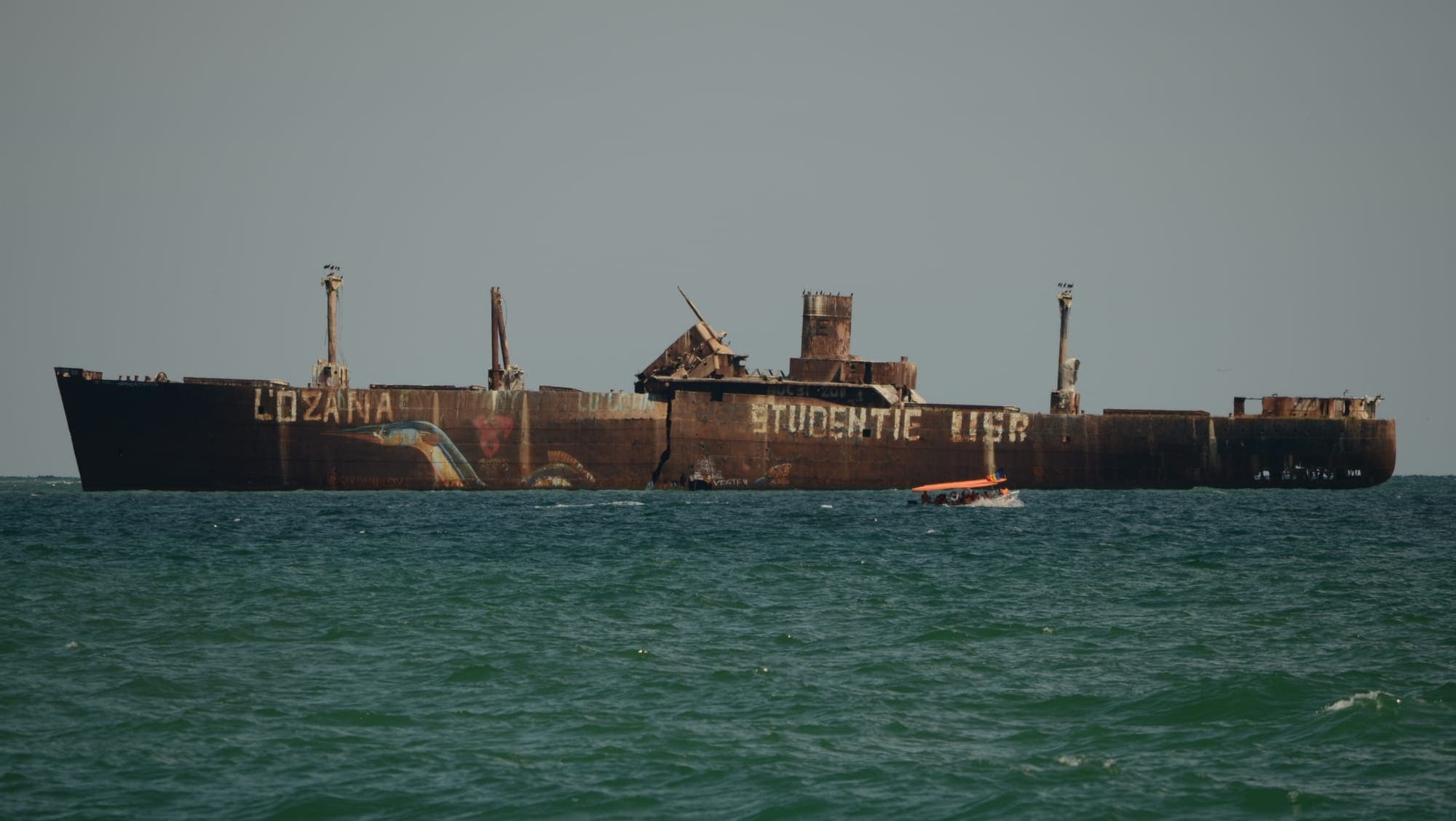
- Wrecks. At Costinești, the Evangelia wreck, the Greek cargo ship that ran aground in October 1968, rusts at the northern end of the beach. At Vama Veche, the bow of the cargo ship Akra Aktion, which ran aground in February 1981, can be seen a few hundred metres offshore.
- Cliffs. Eforie Sud sits on the highest cliff on the coast, with interwar villas above the beach. In Constanța, Modern beach lies below the cliff of the old town, with the Greek Church and Tomis Port nearby.
- Lakes and forest. In Mamaia, the sun sets over Lake Siutghiol, a few hundred metres behind the beach. At Neptun–Olimp, the Neptun lakes lie right behind the sand, and the Comorova forest begins a few hundred metres away.
- Bays. At 2 Mai, the beach is a small bay, with fishing boats beside the fishermen's station (cherhana) and the waters of the 2 Mai – Vama Veche Marine Reserve in front.

Beaches under works in 2026–2027: Mangalia, Saturn, Costinești, 2 Mai
Several beaches in the south are building sites of the coastal erosion reduction project, led by the Dobrogea-Litoral Water Basin Administration. Works stop in summer and resume in autumn, so in the off-season stretches of beach are closed.
- Mangalia: four new breakwaters, finished in spring 2026, and from September 2026 nourishment over 2.5 km; the wide beach is expected for summer 2027.
- Saturn: the southern part is in the same lot, with nourishment resumed at the end of September 2026.
- Costinești: five breakwaters and nourishment meant to bring the beach to 100 m wide over 2.7 km.
- 2 Mai: new breakwaters and nourishment until 2027; in summer 2026, the old nudist beach and the footpath to Vama Veche were closed.
The Blue Flag is not the lifeguard's flag (and other mix-ups)
The Blue Flag is not a warning flag. The flags at the lifeguard posts show whether you can go into the water that day; what each colour means is in the guide to jellyfish, sharks and lifeguard flags. The Blue Flag is an environmental award for a whole season and flies over the awarded sector.
Wild beaches (Corbu Beach, Vadu Beach, Tuzla) are not part of the comparison here: they have no managed sectors and are not designated bathing sites. They are described in the guide to wild beaches.
The delta beaches (Sulina Beach, Sfântu Gheorghe Beach, Gura Portiței) are in the Sulina or Sfântu Gheorghe guide.
Lake Techirghiol, next to Eforie Nord, is a salt lake with mud, not a sea beach: it is in the guide to salt baths and salt lakes.
How to check a beach before you go
The Blue Flag list changes every year: CCDG keeps it on its website, and the 2026 page was last updated on 24 August 2026. The water classification per site is on the "Bathing waters" page of the Ministry of Health, and the country summary in the annual report of the European Environment Agency. Lifeguard hours and parking and sun-lounger prices are on each beach's page. What to pack, how to get there and when the season is are in the practical section of the guide to the coast.
Frequently asked questions
- What is the most beautiful beach in Romania?
- There is no official ranking. By criteria that can be checked: Mamaia has the longest managed beach (8 km), and in 2026 the Blue Flag went to five sectors in Năvodari, Eforie Sud and Olimp.
- Which beaches in Romania have the Blue Flag in 2026?
- Five, according to the CCDG list updated in August 2026: Phoenicia Beach and Axxis Beach (Năvodari), Azur Beach and Citadel Beach (Eforie Sud) and Phoenicia Blue View Beach (Olimp).
- Does Mamaia have a Blue Flag beach?
- Not in the 2026 season. The nearest Blue Flag sectors are Phoenicia and Axxis, on the Năvodari – Mamaia Nord beach, just north of Mamaia.
- What are the cleanest beaches in Romania?
- Officially, only the water is measured. In the Ministry of Health classification for 2021–2024, almost all bathing sites have excellent water, and four, at Jupiter, Venus, Saturn and on the Venus–Saturn strip, have good water. For 2025, the European Environment Agency gives 41 excellent and 8 good sites on the Romanian coast.
- Where can you find beaches with fine sand in Romania?
- According to the beach pages, Venus, Vama Veche, Eforie Nord and the north of Mamaia have fine sand. In the rest of Mamaia and at the southern end of Năvodari beach, the sand brought in by nourishment is coarser, with shells.
- What is the longest beach in Romania?
- Among the managed beaches, Mamaia, with 8 km. Next come Năvodari – Mamaia Nord, with about 6 km, and Eforie Sud, with 5.7 km.
- Which beach has the shallowest water?
- Năvodari – Mamaia Nord Beach: the underwater shelf runs for almost 200 m without getting deeper than 2 m. Mamaia, Constanța, Neptun–Olimp and Venus also have a gentle entry.
- Does a Blue Flag on the beach mean you can swim?
- No. The Blue Flag is an environmental award for the whole season. Whether you can go into the water on a given day is shown by the flags at the lifeguard posts.
- Is Mangalia Beach open in 2027?
- Since September 2026, the beach has been a nourishment building site, and the new, widened beach is expected for summer 2027 (status as of October 2026).
Sources
- CCDG: Romanian beaches awarded the Blue Flag in 2026
- CCDG: the Blue Flag programme
- Blue Flag (FEE): beach criteria
- Ministry of Health: bathing waters (lists of sites and classifications)
- Ministry of Health: classification of bathing sites 2021–2024
- Ministry of Health: natural bathing sites 2026
- European Environment Agency: bathing water quality in Romania, 2025 season (June 2026)
All guides
- Ski slopes in Romania: the ski resorts and ski areas by region, with a map
- When the ski slopes open and where the snow comes first: the ski season in Romania
- Sledging, alpine coasters and tubing in Romania: where to go with a sledge
- The longest ski slope in Romania and the other records: the largest ski area, the highest, the hardest
- The nearest ski slopes to Bucharest, Cluj, Brașov, Sibiu, Iași, Timișoara and Oradea: distances for a day of skiing
- Beginner and kids' ski slopes in Romania: where to learn to ski, ski schools and slope colours
- Caves in Romania: the ones you can visit, by area, with a map
- Ice caves and underground glaciers in Romania: Scărișoara, Focul Viu, Vârtop, Borsec
- Apuseni caves: a 2–3 day route through Bihor and Alba
- The largest cave in Romania and the other records: the longest, the deepest, the oldest show cave
- The nearest cave to Bucharest, Brașov, Cluj, Sibiu, Oradea and Timișoara: distances for a day trip
- Famous caves in Romania you cannot visit: Movile, Topolnița, Vântului, Coliboaia, Peștera cu Oase (and what to see instead)
- Stalactites and stalagmites: what they are, how a cave forms and where to see them in Romania
- The Danube Delta: map, what it is, the villages and what to see
- Danube Delta trip: one, two or three days, where to start and how to get to Sulina and Sfântu Gheorghe
- Things to do in Tulcea: what to see in the city and around it
- Birds and wildlife of the Danube Delta: pelicans, where and when to see them
- Visiting the Danube Delta for the first time: the access permit, mosquitoes and when to go
- Fishing in the Danube Delta: the fishing permit, the 2026 closed season and where you may fish
- Sulina or Sfântu Gheorghe? The beaches of the Danube Delta (and Gura Portiței)
- Deltas near Bucharest: Văcărești, Comana (the Neajlov Delta) and Balta Mică a Brăilei
- The Romanian Black Sea coast: the resorts in order, north to south, with a map
- The Black Sea season in Romania: when it opens, how long it lasts and when the water is warmest
- Wild beaches on the Romanian coast: Corbu, Vadu, Tuzla and the south
- Which Romanian seaside resort to choose: for young people, families, quiet, budget
- The Romanian seaside with kids: resorts, shallow beaches and what to do off the beach
- Things to do in Constanța: what to see in the city, on the seafront and nearby
- Jellyfish, sharks and lifeguard flags in the Black Sea
- Salt mines in Romania: the complete guide to the salt mines you can visit
- The largest, the deepest and the oldest salt mine in Romania
- The nearest salt mine to Bucharest, Cluj, Brașov, Sibiu, Iași, Timișoara, Oradea, Constanța and other cities
- Salt mines with children and babies: from what age, which one suits, what to bring
- Turda or Slănic Prahova? Which salt mine to choose
- Visiting a salt mine for the first time: temperature, clothing, how long, lift or bus, dogs
- Salt lakes and salt baths in Romania: where to swim, season and prices
- Salt mine therapy in Romania: what the operators say, how long to stay, which mines have a treatment base