
The Romanian Black Sea coast: the resorts in order, north to south, with a map

From north to south, the Romanian Black Sea coast has the wild beaches of Vadu and Corbu, then Năvodari – Mamaia Nord, Mamaia, the city of Constanța, Eforie Nord, Eforie Sud, Tuzla beach, Costinești, Olimp–Neptun, Jupiter–Cap Aurora, Venus, Saturn, the town of Mangalia and the villages of 2 Mai and Vama Veche, right up against the border with Bulgaria. The whole strip lies in Constanța County, along about 55 km of road from Constanța to Vama Veche, and by law the tourist season runs from 1 May to 30 September. Further north, in the Danube Delta, are the beaches at Sulina, Sfântu Gheorghe and Gura Portiței, which you reach by water.
This guide puts the resorts in order, in a table and on the map, then gives each of them a few lines: what it is, who it suits and where to find its page. At the end come the sights between the resorts and the practical side: how to get there, how to get around between resorts and what to pack for the seaside.
In short
- From north to south, the resorts of the Romanian Black Sea coast are Năvodari – Mamaia Nord, Mamaia, Eforie Nord, Eforie Sud, Costinești, Olimp–Neptun, Jupiter–Cap Aurora, Venus, Saturn, then Mangalia, 2 Mai and Vama Veche.
- Mamaia has the longest developed beach on the Romanian coast, 8 km, and Eforie Nord is the second-largest resort.
- Vama Veche is the last settlement on the coast, about 55 km from Constanța and one kilometre from the border with Bulgaria.
- Vadu and Corbu beaches, north of Năvodari, are wild, inside the Danube Delta Biosphere Reserve, with no buildings and no lifeguards.
- The tourist season on the Black Sea coast starts on 1 May and ends on 30 September, under Emergency Ordinance 19/2006; each town hall sets the period with lifeguards (in 2026, at Costinești, 1 June – 14 September).
- The Constanța–Mangalia railway line, closed from October 2025 for works, reopened in June 2026, with direct trains in summer 2026.
The resorts on the Romanian Black Sea coast in order, north to south
The coast with developed beaches is the strip between Năvodari and Vama Veche, with Constanța in the middle. The north, towards the Danube Delta, has wild beaches; the south is the string of resorts built between 1967 and 1973 north of Mangalia. The table lists them in the order you meet them along the shore, with the road distance from Constanța.
Their pages, in the same order: Vadu Beach, Corbu Beach, Năvodari – Mamaia Nord Beach, Mamaia, Constanța, Eforie Nord, Eforie Sud, Tuzla Beach, Costinești, Neptun–Olimp, Jupiter–Cap Aurora, Venus, Saturn, Mangalia, 2 Mai and Vama Veche. All of them are also on the Seaside category page.
| Resort | What it is | Who it suits | From Constanța | Page on the site |
|---|---|---|---|---|
| The delta beaches | Sulina, Sfântu Gheorghe, Gura Portiței: beaches with no road to them | a beach far from the resorts, reached by water | from Tulcea or Jurilovca, by ship or boat | Sulina Beach, Sfântu Gheorghe Beach, Gura Portiței |
| Vadu | wild beach with shells, in the Danube Delta Biosphere Reserve | peace and quiet, no lifeguards and no buildings | ~44 km | Vadu Beach |
| Corbu | wild beach with dunes and a low earth cliff, at the edge of the reserve | peace and quiet, no lifeguards and no buildings | ~30 km | Corbu Beach |
| Năvodari – Mamaia Nord | 6 km of beach: clubs in the south, the town's wide beach in the north | parties in Mamaia Nord; families on the town beach, with shallow water | ~11–18 km | Năvodari – Mamaia Nord Beach |
| Mamaia | the largest resort, 8 km of beach between the sea and Lake Siutghiol | clubs, Aqua Magic, gondola lift | 6–7 km | Mamaia |
| Constanța | the port city, with the peninsula, the Casino and the city beaches | a day in the city between two beach days | in the city | Constanța |
| Eforie Nord | the second-largest resort, its beach next to Lake Techirghiol | families; mud cures | 14 km | Eforie Nord |
| Eforie Sud | the spa resort dating from 1899, on the highest cliff on the coast | interwar villas and a widened beach | ~17 km | Eforie Sud |
| Tuzla | strip of sand below the cliff, next to the lighthouse | a beach without a resort, with lifeguards | ~22 km | Tuzla Beach |
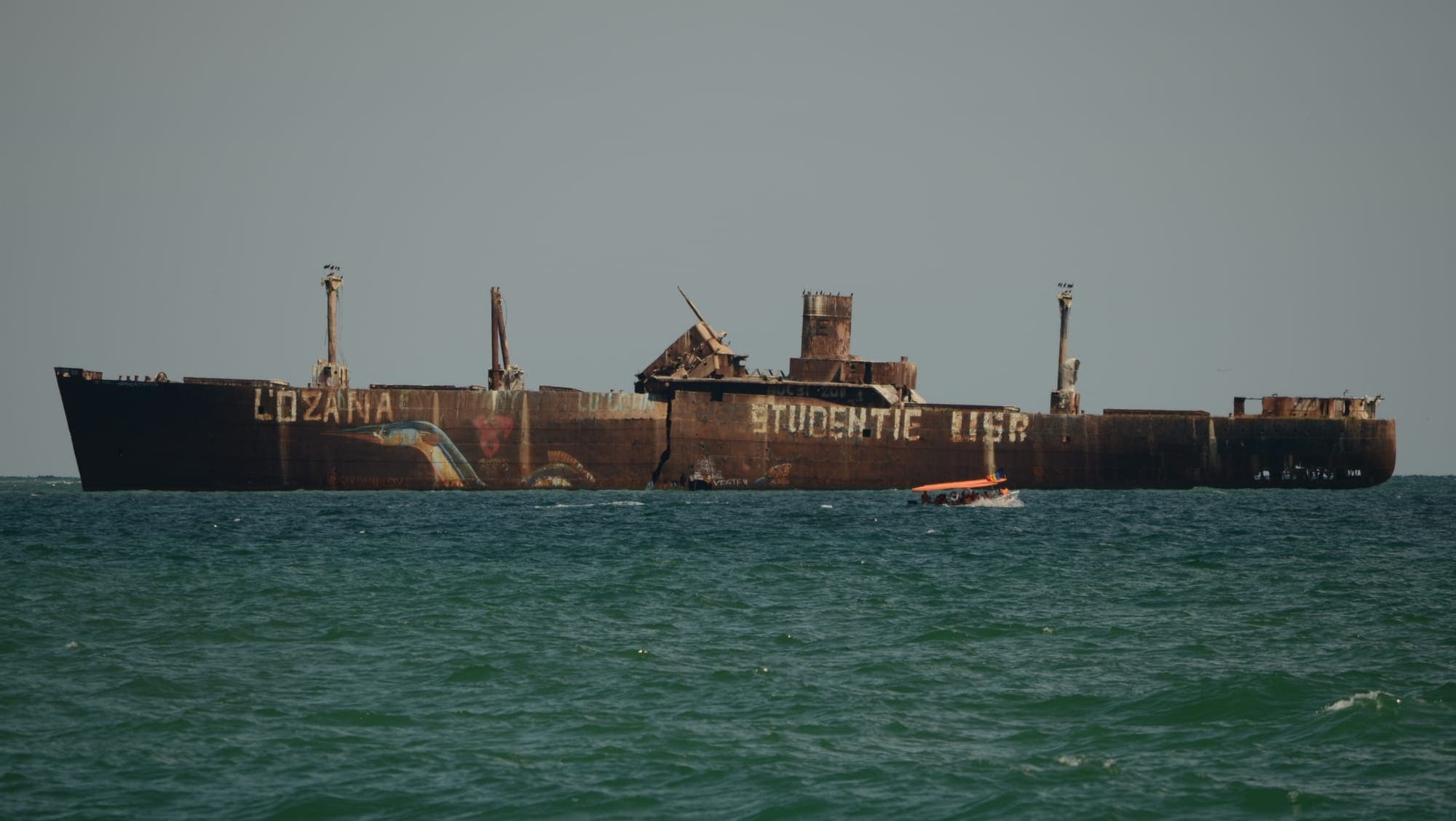
| Costinești | the “youth resort”, with the Obelisk and the Evangelia wreck | young people, students | 31 km | Costinești |
| Olimp–Neptun | two adjoining resorts in the Comorova forest, with lakes behind the beach | widened beach, 1970s architecture | ~38 km | Neptun–Olimp |
| Jupiter–Cap Aurora | small bays between breakwaters; the stepped hotels of Cap Aurora | beach in bays, forest behind | ~40 km | Jupiter–Cap Aurora |
| Venus | hotels with women's names around a lake, sulphurous waters | lush greenery, treatments | ~42 km | Venus |
| Saturn | tower hotels next to Mangalia, spa sanatorium | treatments, close to the town and the station | ~44 km | Saturn |
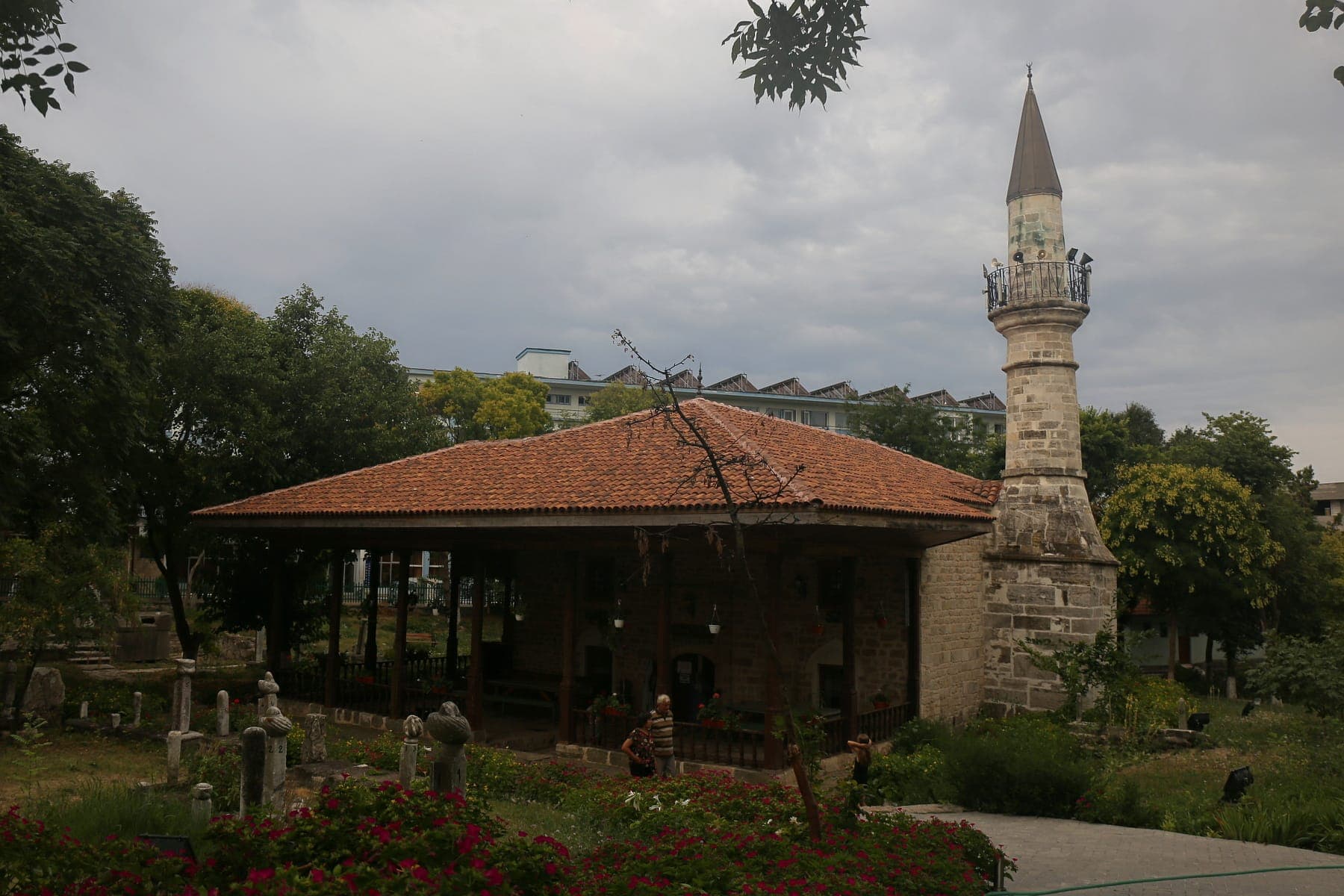
| Mangalia | the southern town: the 1575 mosque, Callatis, the marina | an afternoon in town | ~44 km | Mangalia |
| 2 Mai | Lipovan fishing village, beach in a small bay | a village instead of a resort, the marine reserve | ~50 km | 2 Mai |
| Vama Veche | the last village, 1 km from Bulgaria, 2 km of fine-sand beach | bohemian atmosphere, bars open until morning | ~55 km | Vama Veche |
The road distances from Constanța and the descriptions come from the attraction pages (the getting-there sections), checked on 30 October 2026; they are approximate. The delta beaches are in Tulcea County, the rest in Constanța County.
Map of the Romanian coast: where each resort is
On the map, the coast reads in five parts. The wild north, between the Danube Delta and the port of Midia, with Vadu and Corbu, already belongs to the Danube Delta Biosphere Reserve. Năvodari and Mamaia occupy the sand bar between the sea and Lake Siutghiol, up to the edge of Constanța. The near south, beyond the port of Constanța Sud, has the dunes at Agigea, Eforie Nord and Eforie Sud on the strip between the sea and Lake Techirghiol, then Tuzla and Costinești.
The string of resorts next to Mangalia starts with Olimp and Neptun and runs down through Jupiter, Cap Aurora, Venus and Saturn. All six are localities of the municipality of Mangalia. The last part, 2 Mai and Vama Veche, belongs to the commune of Limanu and ends at the border with Bulgaria. The road linking them all in the south is the DN39 (E87).
All the attractions are on the site map, filtered on the Seaside category or on the Constanța County map; the rest of the county is on the Constanța County page.
What changed on the coast in 2025–2026: widened beaches, the train to Mangalia
Most of the beaches in the south look different from a few years ago. Apele Române (Romanian Waters) widened the shore by beach nourishment, behind new breakwaters: Mamaia in 2020–2021, by more than a hundred metres; Neptun from July 2024 and Olimp until 2025; Jupiter and Cap Aurora in summer 2024; Venus between 2023 and 2025. In Saturn and Mangalia the new breakwaters were finished in spring 2026, and the nourishment resumed at the end of September 2026. The new sand is coarser in places and full of shells, and the walk to the water has grown longer.
The Constanța Casino reopened in 2025, after restoration, with exhibitions. The Constanța–Mangalia railway line was closed from October 2025 for the modernisation of the Neptun and Costinești Tabără halts and reopened in June 2026. The Mangalia town hall's electric buses, between Mangalia and Olimp, cost 4 lei per journey from August 2026, after a few years of being free. The season calendar and the water temperature month by month are in the guide to the seaside season.
Mamaia: the longest developed beach on the coast
Mamaia sits on a sand bar some three hundred metres wide, between the sea and Lake Siutghiol, and has 8 km of beach, the longest developed strip on the Romanian coast. The resort opened in 1906 and is administratively part of Constanța; it begins 6–7 km from the old centre.
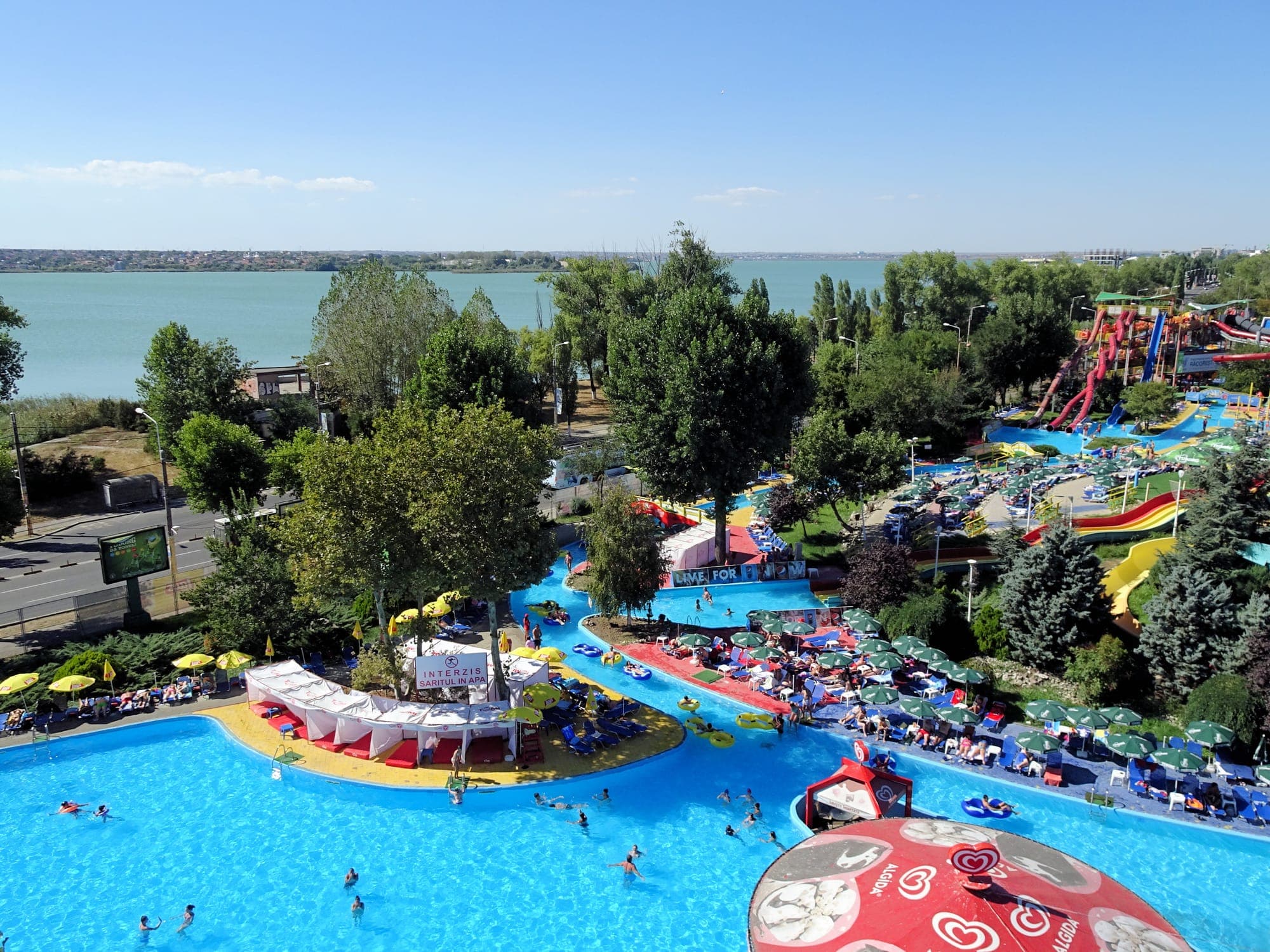
It has three parts: the south, towards Aqua Magic Mamaia, with the narrower beach; the centre, by the 1935 Casino, the busiest, with beach clubs and the 2.1 km gondola lift overhead; the north, towards Năvodari, with the wide beach. The sun rises out of the sea and sets over Lake Siutghiol, a few minutes' walk away. For a day with the children away from the beach, the water park and the Constanța Dolphinarium are described in the guide to the seaside with children.
Top 100Vama Veche: the last village on the coast, at the Bulgarian border
Vama Veche is the last settlement on the Romanian shore, in the commune of Limanu, ~55 km from Constanța and one kilometre from the border crossing to Durankulak. The name has stayed since 1913, when the customs post moved further south. Until 1989 the area was a guarded border zone, and the village was left almost untouched by the mass tourism of the resorts to the north.
The beach has some two kilometres of fine sand, with sections of sunbeds and free stretches, and the water in front of it belongs to the 2 Mai – Vama Veche Marine Reserve. The village has a few hundred inhabitants in winter and tens of thousands of people at weekends in August, with bars open until morning. Camping on the beach and on the dunes is forbidden; tents go only in licensed campsites. Offshore you can still see a piece of the wreck of the Akra Aktion, which ran aground in 1981.
 Top 100
Costinești: the youth resort and the Evangelia wreck
Costinești is a village 31 km south of Constanța that becomes a resort in summer and has called itself the “youth resort” for seven decades: the first Pioneer camp dates from 1949, and in the early 1990s it took in more than 60,000 young people in a single summer. The beach is about a kilometre long, in an east-facing bay sheltered by Cape Tuzla.
Two landmarks are visible from the sand: Wilhelm Demeter's white Obelisk, 18.5 m high, the meeting point in the resort, and The Evangelia wreck, the Greek cargo ship that ran aground in October 1968 at the northern end of the beach. You may not climb onto the wreck: the lifeguards forbid it, because the rusty metal cuts. The resort has its own railway halt, Costinești Tabără, about a kilometre from the beach.

Eforie Nord and Eforie Sud: the beach and the Techirghiol mud
Eforie Nord is the second-largest resort on the coast, after Mamaia, 14 km south of Constanța, on the strip between the sea and Lake Techirghiol. The beach is some three kilometres long, from Steaua de Mare to the port of Belona, divided by breakwaters into bays with calm water. From the sand to the Băile Reci (Cold Baths) on the lakeshore is a walk of a few hundred metres.
Eforie Sud, about 17 km from Constanța, is where spa tourism on the coast began, in 1899. It stands on the highest cliff on the coast, with interwar villas and an Art Deco casino from the 1930s, now derelict. Since 1966 the two have formed the town of Eforie. Between the port of Constanța Sud and Eforie Nord, the Agigea Marine Dunes Reserve preserves the only marine dunes left on the coast. Lake Techirghiol as a treatment, with the mud and the baths, is covered in the guide to salt baths and salt lakes. On the lake's northern shore, the town of Techirghiol has the spa sanatorium and the Saint Mary Monastery, with an 18th-century wooden church.


Mangalia: the town at the southern end of the coast
Mangalia is the municipality at the southern end of the coast, ~44 km from Constanța, with 31,950 inhabitants at the 2021 census. Administratively it also includes the resorts of Olimp, Neptun, Jupiter, Cap Aurora, Venus and Saturn. The town stands on top of the Greek colony of Callatis, from the 6th century BC.
The centre can be seen on foot in an afternoon: the Esmahan Sultan Mosque from 1575, the marina, the archaeology museum and the ruins of the Callatis Citadel are at most a kilometre or two from one another. Mangalia Beach starts at the harbour breakwater and runs up towards Saturn, below the promenade rebuilt in 2022; since autumn 2026 it has been widened by beach nourishment. Mangalia station is the end of the line from Constanța.


Olimp and Neptun: the resorts in the Comorova forest
Neptun–Olimp are two resorts joined to each other, some 6 km north of Mangalia and ~38 km from Constanța: Olimp is the northern part, Neptun the southern one. They were built in the Comorova forest, the only forest on the Romanian coast; Neptun opened to visitors in 1967, Olimp in 1972.
Olimp is recognisable by the Amfiteatru–Belvedere–Panoramic complex, with its floors stepped back above the beach. The beach has been widened in recent years and now has, on average, a hundred metres of dry sand, with a gentler entry into the sea. Behind it lie the Neptun I and Neptun II lakes, with rowing boats and pedalos. The Neptun (Comorova) halt is on the Constanța–Mangalia line.

Saturn: the resort joined to Mangalia
Saturn is the southernmost of the 1970s resorts and the only one that touches the town: Mangalia station is at its edge, about a kilometre from the beach. The first hotels took in tourists in 1971; the five 14-storey towers at either end can be seen from the whole beach between Mangalia and Venus.
The northern beach, towards Venus, was widened by 2025; the southern one is under way in autumn 2026. The Mangalia Spa Sanatorium, in the Hora hotel, offers baths with sulphurous water and seawater. Behind the sand bar lies the Mlaștina Hergheliei Nature Reserve, 98 hectares of reeds and sulphurous springs, with birds on migration.


Venus: the hotels with women's names and the sulphurous waters
Venus is about three kilometres north of Mangalia and 42 km from Constanța, between Cap Aurora and Saturn. The first seven hotels opened in 1969, with women's names, and the custom was kept until 1972; hence the nickname “the girls' resort”. The small hotels and villas are scattered among the trees, around a lake in the middle of the resort.
The beach has fine sand and a gentle entry into the sea; it was widened between 2023 and 2025, and in the north the bays closed off by breakwaters keep the water calmer. Under the resort there are sulphurous waters, used in treatments since 1973. Venus has no railway halt of its own; the nearest station is Mangalia.

Jupiter and Cap Aurora: the bays between the breakwaters
Jupiter–Cap Aurora are two neighbouring resorts, 5–6 km north of Mangalia and about 40 km from Constanța: Jupiter comes right after Neptun, and Cap Aurora links up with Venus. Jupiter received its first tourists in 1968. Cap Aurora is the youngest and smallest resort in the south: on 1 July 1973 ten hotels named after precious stones opened all at once.
In Jupiter the beach is about a kilometre long, cut by stone breakwaters into small bays, with Lake Tismana right behind. Cap Aurora sits on a rocky promontory, with its hotels stepping down towards the beach. The new sand was laid in summer 2024. The resorts have no station; the nearest is the Neptun halt.

Năvodari and Mamaia Nord: the beach north of Mamaia
Năvodari – Mamaia Nord Beach carries Mamaia's sand on northwards, for some six kilometres, to the breakwater of the port of Midia. There are two different zones: Mamaia Nord, in the south, about 11 km from the centre of Constanța, with new apartment blocks, beach clubs and music until morning; the town beach of Năvodari, in the north, about 18 km away, wider and emptier.
The sea deepens gently: the underwater shelf runs for almost two hundred metres without going deeper than two metres. A 4.2 km granite promenade runs the whole length, and parking on public land is free, unlike in Mamaia. Two sections here, Phoenicia and Axxis, have the Blue Flag for the 2026 season; the beach ranking is in the guide to the most beautiful beaches in Romania.

2 Mai: the fishing village between Mangalia and Vama Veche
2 Mai is a village in the commune of Limanu, ~5 km south of Mangalia and ~50 km from Constanța, between the shipyard breakwater and Vama Veche. Its first inhabitants were Old Believers who had fled Russia, and around the time of the First World War Lipovan fishermen came from Tulcea County; sea fishing, with the boats pulled up on the sand next to the fish station, carries on to this day.
The beach lies in a small bay open to the east. From the 1950s the village was the holiday spot of writers and actors from Bucharest, far from the official resorts. The waters south of the fish station belong to the 2 Mai – Vama Veche Marine Reserve, the only marine reserve on the coast, with stone reefs and fields of seaweed well worth seeing with a mask.


Constanța: the port city in the middle of the coast
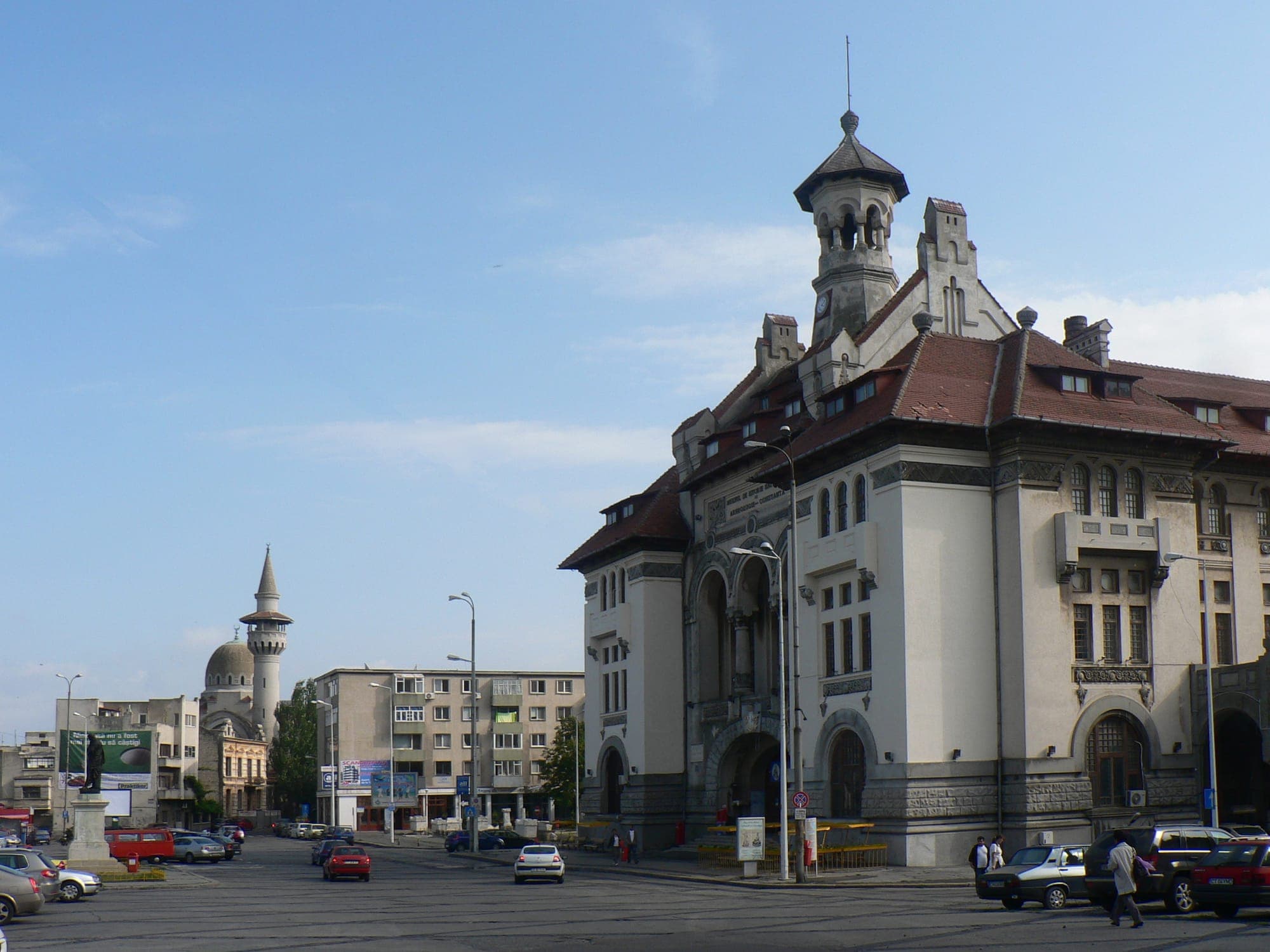
Constanța is the port city of the coast, with 263,707 inhabitants at the 2021 census, between Mamaia to the north and Eforie to the south. The old centre stands on the peninsula of ancient Tomis and can be seen on foot in a day: the Constanța Peninsula, with Ovid Square and the mosque, the seafront promenade and the Constanța Casino. From Pescărie to below the cliff of the old town stretch the Constanța City Beaches, 3.4 km of sand, with Tataia, Trei Papuci and Modern.
What to visit in the city, in what order and what to do when it rains is in the guide to things to do in Constanța.
The wild beaches: Corbu, Vadu and Tuzla
North of the port of Midia, the coast is left without hotels. Corbu Beach, ~30 km from Constanța, has sand with shells, low dunes and a low earth cliff. Vadu Beach, ~44 km away, is a wide strip of white sand without a single building. Both are in the Danube Delta Biosphere Reserve, with no sunbeds and no lifeguards, and the last ~3.5 km to the sand are on broken concrete and dirt road.
In the south, Tuzla Beach, ~22 km from Constanța, is a narrow strip of sand below a high cliff, reached by paths down, next to the 1900 lighthouse, the oldest still working on the Romanian coast. Unlike Corbu and Vadu, it has lifeguards. The comparison between them, Vadu or Corbu, and the other beaches without a resort are in the guide to wild beaches.


The Danube Delta beaches: Sulina, Sfântu Gheorghe, Gura Portiței
Sulina Beach, Sfântu Gheorghe Beach and Gura Portiței are in the Danube Delta, in Tulcea County, and have no road to them: you reach Sulina and Sfântu Gheorghe by ship from Tulcea, and Gura Portiței by boat from Jurilovca. Which of them suits you is in the guide Sulina or Sfântu Gheorghe.
Sights on the coast, away from the beach
Between the resorts there are a few places with their own page, good for a day without the beach. From north to south:
- Histria Citadel, on the shore of Lake Sinoe, the ruins of the oldest city on Romanian territory, a colony of Miletus from the 7th century BC;
- Lake Siutghiol, the freshwater lake behind Mamaia, with water-sports centres and Ovid's Island;
- Aqua Magic Mamaia, the water park from 2003, and the Constanța Dolphinarium, the first in the country, opened in 1972;
- the Constanța Casino and the Constanța Peninsula, the old centre on the site of Tomis;
- the Agigea Marine Dunes Reserve, protected since 1939, with a free themed trail;
- Lake Techirghiol, the largest salt lake in Romania, with the cold baths with mud;
- The Evangelia wreck, at Costinești, seen from the shore and from the breakwater;
- the Mlaștina Hergheliei Nature Reserve, between Saturn and Venus, and the Callatis Citadel, in Mangalia;
- the 2 Mai – Vama Veche Marine Reserve, for snorkelling and diving.
From the northern resorts you can also take a day trip into the delta; the options are in the guide to trips into the Danube Delta.
 Top 100

Top resorts on the coast: the largest and the best known
By size, the first are Mamaia, with the longest developed beach, and Eforie Nord, the second resort on the coast. By how often they are searched for, just ahead of them or right behind come Vama Veche, Costinești, Eforie Sud and Mangalia; the southern resorts, Neptun, Olimp, Jupiter, Venus and Saturn, are searched for mostly with “beach” in front.
Which resort suits you, for young people, families, peace and quiet or budget, and the frequent comparisons (Mamaia or Eforie Nord, Eforie Nord or Sud, Costinești or Mamaia) are in the guide to choosing a resort. For children there is the guide to the seaside with children, and the ranked beaches, including those with the Blue Flag, are in the guide to the most beautiful beaches.
Practical: how to get to the sea, how to get around and what to pack
Getting there. From Bucharest you take the A2 motorway to Constanța, then the A4 ring road and the DN39 southwards or Mamaia Boulevard northwards: ~230 km to Mamaia, ~250 km to Eforie Nord, ~270 km to Neptun and ~300 km to Vama Veche. By train, the Constanța–Mangalia line stops at Eforie Nord, Eforie Sud, Costinești Tabără, Neptun and Mangalia; it was closed for works from October 2025 and reopened in June 2026, so check the timetable before you go. At summer weekends the entrances to Mamaia and Costinești and the road to Vama Veche get congested.
Getting around between resorts. In Constanța and Mamaia the CT Bus buses run; towards Năvodari, the line 23 minibuses. Southwards, minibuses leave daily from Constanța railway station and from the bus stations, and between Mangalia and Olimp, through all the resorts, run the Mangalia town hall's electric buses, 4 lei per journey from August 2026. From Mangalia, minibuses leave for 2 Mai and Vama Veche. Parking is charged in Mamaia and free on public land in Năvodari.
The season in brief. Under Emergency Ordinance 19/2006, the tourist season on the coast runs from 1 May to 30 September. The beach sections are set up from mid-May, and lifeguards are on duty only in season, in the period set by each town hall: in 2026, between 1 June and 14 September at Costinești, between 1 May and 30 September at Năvodari. The months, the water and the crowds are in the guide to the seaside season.
What to pack for the seaside. Shade: on the big beaches there is almost no natural shade, and on the wild beaches there is nothing to rent. Water and food for the beaches without a resort, Vadu, Corbu, Tuzla, where there are no shops; you take your rubbish back with you. Shoes that grip on paths for Tuzla and for the rocks at 2 Mai and Cap Aurora. A swimming mask for the marine reserve in the south. Your identity card if you cross from Vama Veche into Bulgaria, only through the border crossing. For the delta beaches you need the access permit of the Danube Delta Biosphere Reserve.
Safety in the water. The beach is public property and access to the sand is free, including through the sections with sunbeds. Lifeguards are only on the developed beaches and only in season; Vadu and Corbu have none at all. At their posts are the flags that show whether swimming is allowed; what each flag means, and the jellyfish and sharks of the Black Sea, are in the guide to jellyfish, sharks and beach flags.
Frequently asked questions
- What are the resorts on the Romanian Black Sea coast, in order?
- From north to south: Năvodari – Mamaia Nord, Mamaia, (the city of Constanța), Eforie Nord, Eforie Sud, Costinești, Olimp, Neptun, Jupiter, Cap Aurora, Venus, Saturn, (the town of Mangalia), 2 Mai and Vama Veche. North of Năvodari are the wild beaches of Corbu and Vadu.
- What is the largest resort on the Romanian Black Sea coast?
- Mamaia, with 8 km of beach, the longest developed strip on the coast. The second-largest is Eforie Nord.
- What is the last resort on the coast, towards Bulgaria?
- Vama Veche, in the commune of Limanu, about 55 km from Constanța. The border crossing to Durankulak is one kilometre further south.
- How far is it from Bucharest to the Black Sea coast?
- On the A2 motorway, about 230 km to Mamaia and 250 km to Eforie Nord; to Vama Veche, at the southern end, about 300 km, on the A2 and then on the coast road.
- When does the season open on the Romanian coast?
- Under Emergency Ordinance 19/2006, the tourist season on the Black Sea coast starts on 1 May and ends on 30 September. The beaches are set up from mid-May, and the period with lifeguards varies: in 2026, 1 June – 14 September at Costinești, 1 May – 30 September at Năvodari.
- Can you get to the Romanian seaside by train in 2026?
- Yes. The Constanța–Mangalia line, with stops at Eforie, Costinești Tabără, Neptun and Mangalia, reopened in June 2026, after the works that began in October 2025. Check the timetable before you set off.
- What should you pack for the seaside?
- Your own shade, water, shoes for paths and rocks and a swimming mask for the marine reserve in the south; for the wild beaches, food as well, because they have no shops. For Bulgaria, your identity card.
- Where are there wild beaches on the Romanian coast?
- In the north, Corbu and Vadu, in the Danube Delta Biosphere Reserve, without lifeguards; in the south, Tuzla, below the cliff next to the lighthouse, with lifeguards. The delta beaches, Sulina and Sfântu Gheorghe, can only be reached by water.
- Where can you see a map of the Romanian Black Sea coast?
- On the site map, filtered on the Seaside category, are all the resorts and beaches from Sulina to Vama Veche, each with its own page.
Sources
- Emergency Ordinance 19/2006 on the use of the Black Sea beach (tourist season 1 May – 30 September)
- Constanța City Hall (Constanța and Mamaia)
- Năvodari Town Hall
- Eforie Nord: tourist information centre
- Costinești Town Hall
- Mangalia City Hall (Olimp, Neptun, Jupiter, Cap Aurora, Venus, Saturn)
- Mangalia City Hall: electric bus timetable (2026)
- Limanu Town Hall (2 Mai and Vama Veche)
- Tuzla Town Hall
- Danube Delta Biosphere Reserve Authority (Vadu, Corbu, access permits)
- Apele Române (Romanian Waters): rehabilitation of beach sections
- Constanța Casino: visiting
All guides
- Ski slopes in Romania: the ski resorts and ski areas by region, with a map
- When the ski slopes open and where the snow comes first: the ski season in Romania
- Sledging, alpine coasters and tubing in Romania: where to go with a sledge
- The longest ski slope in Romania and the other records: the largest ski area, the highest, the hardest
- The nearest ski slopes to Bucharest, Cluj, Brașov, Sibiu, Iași, Timișoara and Oradea: distances for a day of skiing
- Beginner and kids' ski slopes in Romania: where to learn to ski, ski schools and slope colours
- Caves in Romania: the ones you can visit, by area, with a map
- Ice caves and underground glaciers in Romania: Scărișoara, Focul Viu, Vârtop, Borsec
- Apuseni caves: a 2–3 day route through Bihor and Alba
- The largest cave in Romania and the other records: the longest, the deepest, the oldest show cave
- The nearest cave to Bucharest, Brașov, Cluj, Sibiu, Oradea and Timișoara: distances for a day trip
- Famous caves in Romania you cannot visit: Movile, Topolnița, Vântului, Coliboaia, Peștera cu Oase (and what to see instead)
- Stalactites and stalagmites: what they are, how a cave forms and where to see them in Romania
- The Danube Delta: map, what it is, the villages and what to see
- Danube Delta trip: one, two or three days, where to start and how to get to Sulina and Sfântu Gheorghe
- Things to do in Tulcea: what to see in the city and around it
- Birds and wildlife of the Danube Delta: pelicans, where and when to see them
- Visiting the Danube Delta for the first time: the access permit, mosquitoes and when to go
- Fishing in the Danube Delta: the fishing permit, the 2026 closed season and where you may fish
- Sulina or Sfântu Gheorghe? The beaches of the Danube Delta (and Gura Portiței)
- Deltas near Bucharest: Văcărești, Comana (the Neajlov Delta) and Balta Mică a Brăilei
- The best beaches in Romania (and the Blue Flag ones)
- The Black Sea season in Romania: when it opens, how long it lasts and when the water is warmest
- Wild beaches on the Romanian coast: Corbu, Vadu, Tuzla and the south
- Which Romanian seaside resort to choose: for young people, families, quiet, budget
- The Romanian seaside with kids: resorts, shallow beaches and what to do off the beach
- Things to do in Constanța: what to see in the city, on the seafront and nearby
- Jellyfish, sharks and lifeguard flags in the Black Sea
- Salt mines in Romania: the complete guide to the salt mines you can visit
- The largest, the deepest and the oldest salt mine in Romania
- The nearest salt mine to Bucharest, Cluj, Brașov, Sibiu, Iași, Timișoara, Oradea, Constanța and other cities
- Salt mines with children and babies: from what age, which one suits, what to bring
- Turda or Slănic Prahova? Which salt mine to choose
- Visiting a salt mine for the first time: temperature, clothing, how long, lift or bus, dogs
- Salt lakes and salt baths in Romania: where to swim, season and prices
- Salt mine therapy in Romania: what the operators say, how long to stay, which mines have a treatment base