The princely court built by Constantin Brâncoveanu in 1698 for his eldest son, with a loggia-fronted palace, walled courtyards and restored gardens, ~50 km from Bucharest.
An open-air ethnographic museum on the shore of Lake Herăstrău, in the middle of Bucharest: farmsteads, wooden churches, mills and workshops brought from all over the country and rebuilt here since 1936.
Museums and memorial housesVillages and traditions
The museum on Kiseleff Road holds the 1907 dioramas, the Deinotherium skeleton and over 2 million zoological, palaeontological and mineralogical pieces, in a building inaugurated in 1908.
Bihor's county museum, housed since its move in the former Royal Cadet School of 1898: archaeology, history, art, ethnography, natural sciences and a vivarium under one roof.
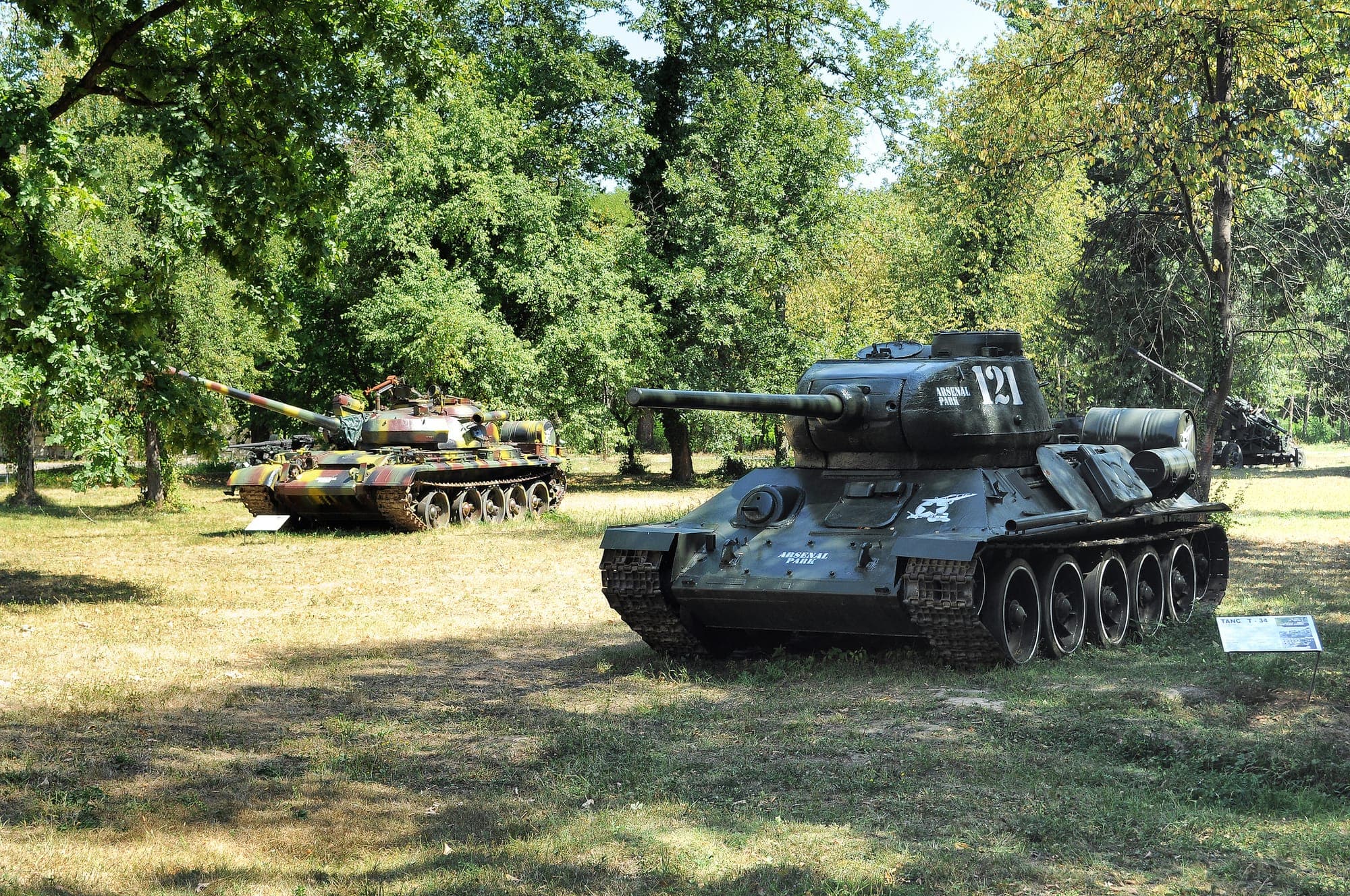
A military-themed park at Orăștie, on 88 hectares of forest: an open-air museum of military hardware, an adventure park, a 607 m zip line and a summer water park.
The Roman Catholic bishops' residence, built in 1762–1777 by Franz Anton Hillebrandt, is Romania's largest Baroque palace; today it hosts church art exhibitions, and the garden is open daily.
Castles and palacesMuseums and memorial housesParks and gardens
The museum in the Jean Mihail Palace, built in 1898–1907 to plans by Paul Gottereau, holds six works by Brâncuși, including “The Kiss”, as well as Romanian and European art.
The old school in the courtyard of St Nicholas' Church in Șcheii Brașovului, now a museum: a classroom with wooden benches, a replica of Coresi's printing press and Romanian books five centuries old.
Museums and memorial housesMonuments and historic sites
The house in the village of Liveni, rebuilt on the foundations of the one where George Enescu was born in 1881, holds an exhibition on the composer's childhood: the pianino, rugs, photographs and early scores.
The largest surviving piece of Timișoara's bastioned fortress, built by the Austrians in the 1730s and restored with EU funds, now home to the National Museum of Banat.
Fortresses and fortificationsMuseums and memorial houses
The museum of the Memorial of the Revolution Association, in a former military building in Timișoara: clothes and flags from the days of December 1989, a chapel of the hero-martyrs and the only section of the Berlin Wall in Romania.
Museums and memorial housesMonuments and historic sites
Romania's first open-air museum, on Hoia hill: farmsteads, workshops, peasant installations and three wooden churches gathered over ~16 hectares into a scattered village.
Museums and memorial housesVillages and traditions
The public aquarium in central Tulcea, with fish from the Danube and the Black Sea, coral reef tanks and a tunnel among sturgeon, plus an exhibition on the Delta's wildlife.
Vaslui County's museum, in a neoclassical palace that was once a prefecture: archaeology, history, art, local figures, plus an astronomical observatory and planetarium.
The Eminovici family house in Ipotești, rebuilt on the foundations of the one from Mihai Eminescu's childhood, with the family's wooden church, his parents' graves and a peasant house holding an ethnographic collection.
Museums and memorial housesMonuments and historic sites