
Jellyfish, sharks and lifeguard flags in the Black Sea

On lifeguarded beaches on the Romanian coast, the red-and-yellow flag means a supervised beach, fine for swimming; yellow below it means swimming is recommended only for experienced swimmers, and red below it means going into the water is forbidden. That is what the Methodological Norms approved by Government Decision (HG) 1136/2007, the act that organises lifeguard services, set out. The jellyfish of the Black Sea, according to the “Grigore Antipa” National Institute for Marine Research and Development (INCDM), are not dangerous. There is a shark: the spiny dogfish, a bottom-dwelling fish that fishermen catch.
Below are all the flags and what to do at each, the buoys, where and when the lifeguards are on duty, the two jellyfish species you may see near the shore and what is known for certain about the spiny dogfish. How warm the water is month by month and when the season opens are in the guide to the beach season.
In short
- The red-and-yellow flag flown on its own at the lifeguard post means a supervised beach intended for swimming (HG 1136/2007, art. 20 and annex 5).
- A red flag placed below the red-and-yellow one means going into the water is forbidden; a yellow flag placed below it means swimming is recommended only for experienced swimmers.
- Anyone who goes into the water when bathing is forbidden or swims beyond the buoys risks a fine of 500–1,000 lei, under art. 23 of the same norms (the version published on legislatie.just.ro in October 2026).
- The black-and-white chequered flag marks the boat zone, where swimming is forbidden; the Romanian norms have no green flag.
- The INCDM “Grigore Antipa” states that the jellyfish species of the Black Sea are not dangerous; Rhizostoma pulmo, up to 60 cm across, can irritate the skin on prolonged contact.
- The shark commonly found in the Black Sea is the spiny dogfish (Squalus acanthias), up to 1.4 m long, which lives on the bottom; its dorsal spines can pierce the skin of whoever catches it.
- Help from lifeguards and from the first aid posts on the beach is free, and lifeguards are on duty only during the summer season.
Lifeguard flags on the beach: what each colour means
The flags are raised at the lifeguards' observation posts, and their meaning is the same on every beach in Romania, from the sea to open-air pools: it is fixed by art. 20 and annex no. 5 of the Methodological Norms approved by HG 1136/2007. The basic flag is the red-and-yellow one, split horizontally, red on top and yellow below. When it flies on its own, the beach is supervised and you can swim. The other colours go below it and complete it.
The norms require beach operators to mark with flags the zones where you may or may not go into the water (art. 5), and require you to respect the signs, not to go beyond the buoys and not to go into the water when bathing is forbidden (art. 6). On the boards on the beach, the instructions must be written in Romanian and in two international languages.
| Flag | What it means | What you do |
|---|---|---|
| Red-and-yellow, on its own | beach supervised by lifeguards, intended for swimming; boats are not allowed | swim in the marked zone, up to the buoys |
| Red-and-yellow + yellow below | supervised zone, but swimming is recommended only for experienced swimmers | if you are not a confident swimmer, stay near the shore; children stay out |
| Red-and-yellow + red below | conditions do not allow going into the water: entering the water is forbidden | do not go in at all; come out if the lifeguard calls you |
| Black-and-white chequers | zone reserved for boats, swimming is forbidden | do not swim there; move to the bathing zone |
| White, with a logo or name (optional) | the name of the company providing the lifeguard service | nothing to do: it is not a signal about the water |
| White flag with the “Star of Life” | location of the first aid post (art. 22) | take anyone injured or stung there |
Source: the Methodological Norms on the organisation of public water rescue services (lifeguards) and of first aid posts on the beach, approved by HG 1136/2007, art. 20, art. 22(4) and annex no. 5, version on legislatie.just.ro, checked on 30 October 2026.
Red flag on the beach: no swimming
The red flag never appears on its own: it goes below the red-and-yellow one, at the lifeguard post, when “conditions do not allow people into the water” (art. 20(c)). The norms do not list what these conditions are. As long as it is raised, you do not go into the water, not even knee-deep.
Breaching the obligations in art. 6, among them going into the water when bathing is forbidden and going beyond the buoys, is a minor offence, with a fine of 500 to 1,000 lei (art. 23). Fines are issued by people authorised by the town hall and by the Ministry of Internal Affairs, and within 48 hours you can pay half the minimum. The version of the act on the Ministry of Justice's legislation portal shows no published amendments at the end of October 2026.
Yellow flag and yellow-and-red flag on the beach
The two are often confused, because both have yellow in them. Yellow-and-red is the basic flag, red on top and yellow below: the beach is supervised and the water is fine for swimming. Plain yellow, placed below it, is the warning: swimming is recommended only for experienced swimmers (annex no. 5). The July 2024 notice from Constanța City Hall says the same thing in other words: “only for professional swimmers”.
If the red-and-yellow flag is not raised at the post, the beach is not signalled as supervised: this happens outside working hours, outside the season and on beaches without lifeguards.
Green flag and Blue Flag: what they are not
A green flag does not exist in the Romanian norms. A beach fine for swimming is marked with red-and-yellow, with no other flag below. The Constanța City Hall notice adds that no warning flags, or only the operator's white flag, means you can swim.
The Blue Flag is something else: an award given to a stretch of beach, not a lifeguard's signal about the state of the sea. In 2026 it went, for example, to the Phoenicia and Axxis sections of Năvodari – Mamaia Nord Beach. Which beaches hold the award is in the guide to the most beautiful beaches in Romania.

The orange buoys: how far out you may swim
The limit up to which you may swim is marked with orange buoys, with the depth written on them in black, placed no more than 50–100 m apart (art. 21). Where the bottom is even, they lie along the 1.50 m depth line on beaches for adults and the 0.70 m line on those for children. Holes and ledges on the seabed are marked with beacons, and you do not go into zones marked this way.
The boat corridor starts at the shore and is marked with a line of small buoys coloured alternately red and yellow. Pedalos and boats go in and out that way, so you do not swim in it.
Lifeguards on the coast: where and when they are on duty
Town halls with tourist beaches on the Black Sea coast are required to set up lifeguard services and first aid posts (art. 3). Lifeguards wear red and yellow kit marked “SALVAMAR”, and any help they or the first aid posts give is free (art. 25). If you see someone in danger, you alert the post (art. 6(f)).
Lifeguards are on duty only during the summer season, in the daytime. Each town hall contracts its own service and publishes its own hours; the published hours are in the table. When the season on the coast starts and ends is in the guide to the beach season. On Corbu Beach and Vadu Beach there is no post at all: what that means is in the guide to wild beaches.
| Beach | Who provides the lifeguards | Published hours |
|---|---|---|
| Mamaia and the beaches in Constanța | Constanța City Hall: over 100 lifeguards and first aid staff | 08:30–19:30, throughout the summer season (notice from July 2024) |
| Năvodari – Mamaia Nord | Năvodari Town Hall | 08:00–19:00 (1 May–15 July, 15 August–30 September), 08:00–20:00 (15 July–15 August) |
| Costinești | Costinești Town Hall, the company Rescue Mar: 16 observation posts, two first aid points | 1 June–14 September 2026, 08:00–19:00, until 20:00 between 16 July and 15 August |
| Tuzla | posts paid for by the town hall, first aid point | only during the summer season; hours not published |
| Mangalia, Saturn, Venus, Cap Aurora, Jupiter | Mangalia City Hall, tender for summer 2026 | only during the summer season; hours not published |
| 2 Mai and Vama Veche | Limanu Town Hall, contract for 2026 | only during the summer season, in the daytime |
| Corbu and Vadu | none | no lifeguards |
From the beach pages on the site and from the Constanța City Hall notice “A safe holiday on the beaches of Constanța and Mamaia” (July 2024), checked on 30 October 2026. The hours are set every year; confirm them at the post on the beach.
 Top 100


 Top 100
Jellyfish in the Black Sea: which species there are
The INCDM “Grigore Antipa” in Constanța names two jellyfish species you are very likely to come across in the water:
- The cold-water jellyfish (Aurelia aurita): translucent and harmless, up to 30 cm across; you see it in cooler water.
- The warm-water jellyfish (Rhizostoma pulmo): milky white, with a slight purple tinge, up to 60 cm. The institute warns that it can cause irritation on prolonged contact.
According to the same institute, jellyfish often appear off the Romanian coast mainly between July and October, especially after storms or sudden rises in temperature.
Are the jellyfish in the Black Sea dangerous?
No, according to the INCDM “Grigore Antipa”: “the jellyfish species of the Black Sea are not dangerous”. The institute writes that when they multiply, the effect on tourism is mostly a visual one. The only warning it gives is for Rhizostoma pulmo, the large white-and-purple jellyfish, which can irritate the skin if you stay in contact with it for a long time.
The institute gives no guidance on what to do after a sting, and this text gives no medical advice. Lifeguarded beaches have a first aid post, marked with a white flag bearing the “Star of Life”, where help is free. If the reaction worries you, see a doctor.
Are there sharks in the Black Sea? The spiny dogfish
Yes. The shark commonly found in the Black Sea is the spiny dogfish (Squalus acanthias), writes the FAO in a 2025 guide for the region's fishermen, which asks for catch data to be sent to the INCDM “Grigore Antipa”. It reaches up to 1.4 m and 14 kg, has white spots on both sides of its body and a spine on each of its two dorsal fins. A related species, the longnose spurdog (Squalus blainville), up to 1 m, is also present, but much more rarely.
The FAO guide to the sharks of the Mediterranean and Black Sea describes it as a bottom fish, over soft seabeds, between 10 and 700 m deep. It is caught accidentally in fishermen's nets, longlines and trawls. The only danger the FAO notes is for whoever holds it: the dorsal spines are rigid and sharp and can pierce the skin. If you see one caught by a fisherman, do not grab it. In Romania and Bulgaria, the minimum legal catch size is 90 cm.
Seaweed on the beach at Mamaia and along the coast: where it comes from
The INCDM explains why green seaweed piles up on the shore in summer: macroalgae grow strongly when the water is warm and clear and rich in nutrients, especially nitrogen and phosphorus, and strong waves tear them off the rocks and keep washing them ashore. The institute monitors the algae every year along the whole coast and regularly publishes notices on the quality of bathing water and beaches in the Mamaia–Mangalia sector.
Where to go into the water carefully on the coast
A few places have their own rules or risks, set out on their pages:
- At Mamaia, the seabed has holes left from works in places, so go into the water in front of the lifeguard posts.
- At Tuzla Beach, the bottom drops suddenly close to the shore and is rocky.
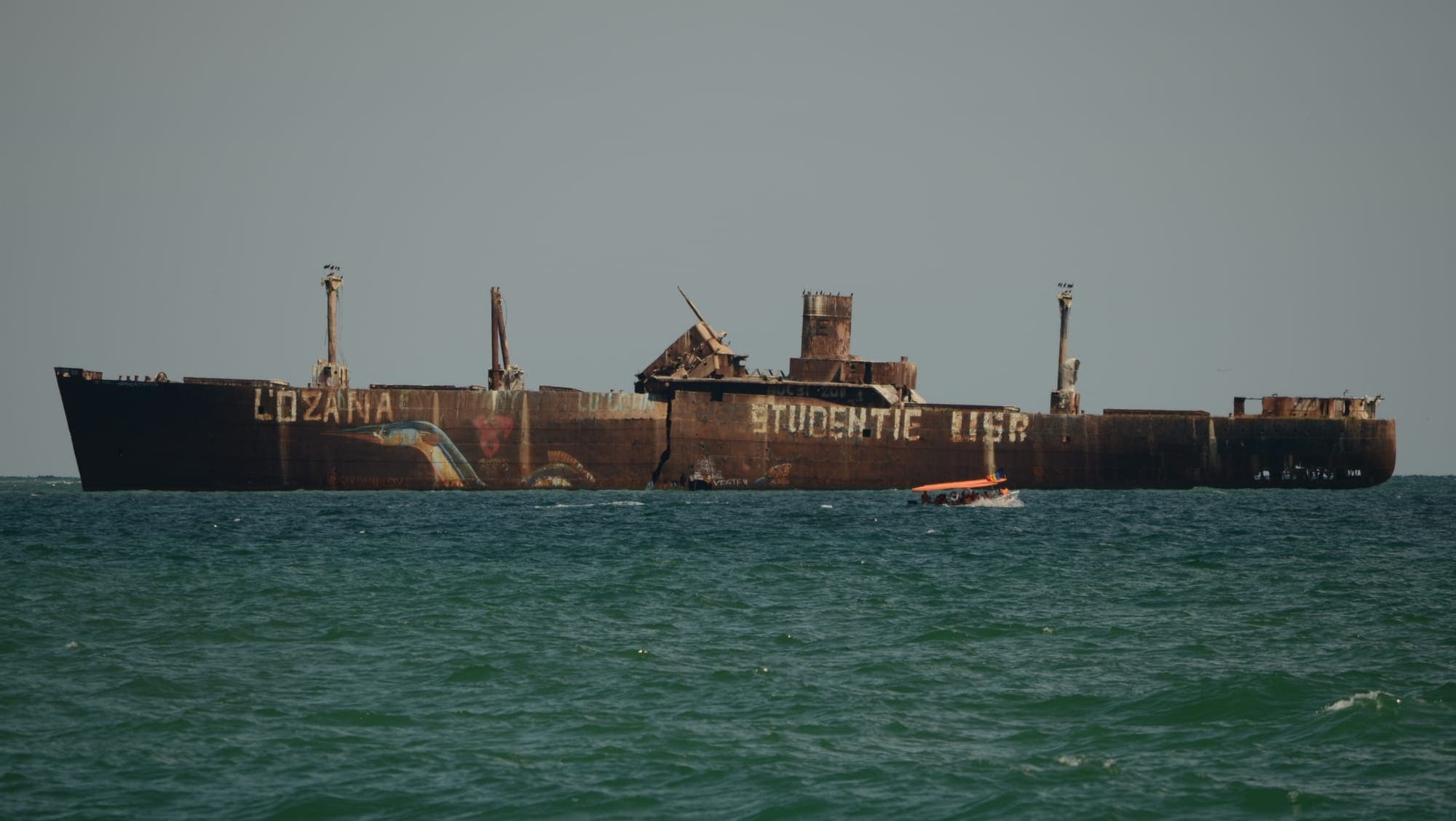
- At Costinești, do not swim out to the Evangelia wreck and do not climb onto it: the rusty metal cuts, and loose pieces float in the water.
- At Venus, do not climb onto the breakwaters made of tetrapods: the blocks are slippery and have deep gaps between them.
- In the 2 Mai – Vama Veche Marine Reserve, there is no swimming at all in zone A; in zone B, only under the lifeguards' rules.
What to take to the seaside, access and the season in brief are in the practical part of the guide to the Romanian coast.

Frequently asked questions
- What does a red flag on the beach mean?
- A red flag placed below the red-and-yellow one means going into the water is forbidden, because conditions do not allow access to the water (HG 1136/2007, art. 20 and annex 5). Breaking the rule carries a fine of 500–1,000 lei (art. 23, version from October 2026).
- What does a yellow and red flag on the beach mean?
- The red-and-yellow flag, red on top and yellow below, means a beach supervised by lifeguards, intended for swimming. If there is also a yellow flag below it, swimming is recommended only for experienced swimmers.
- What does a green flag on the beach mean?
- The Romanian lifeguard norms have no green flag. A beach fine for swimming is marked with the red-and-yellow flag, with no other flag below it.
- Are Black Sea jellyfish dangerous?
- No, according to the INCDM “Grigore Antipa”, which states that the jellyfish species of the Black Sea are not dangerous. Rhizostoma pulmo, the white-and-purple jellyfish up to 60 cm across, can irritate the skin on prolonged contact.
- What jellyfish species live in the Black Sea?
- The ones you often see off the Romanian coast are Aurelia aurita, translucent, up to 30 cm, and Rhizostoma pulmo, milky white with a purple tinge, up to 60 cm. They appear mainly between July and October, writes the INCDM.
- What should you do if a jellyfish stings you?
- Go to the first aid post on the beach, marked with a white flag bearing the “Star of Life”, where help is free, or see a doctor. This guide gives no medical advice.
- Are there sharks in the Black Sea?
- Yes: the spiny dogfish (Squalus acanthias), up to 1.4 m, commonly found as a fish caught accidentally by fishermen, and, much more rarely, the longnose spurdog (Squalus blainville), according to the FAO (2025). It lives on the bottom, between 10 and 700 m deep.
- When are lifeguards on the beach?
- Only during the summer season, in the daytime. At Costinești, in 2026, between 1 June and 14 September, 08:00–19:00; at Năvodari – Mamaia Nord, 08:00–19:00 or 08:00–20:00, depending on the period; at Constanța and Mamaia, 08:30–19:30 (notice from 2024).
- Is help from lifeguards free?
- Yes. The norms approved by HG 1136/2007 (art. 25) say that rescue and any help given by lifeguards and by first aid posts are free, and staff are not allowed to ask for money.
Sources
- Methodological Norms on the organisation of public water rescue services (lifeguards) and of first aid posts on the beach (HG 1136/2007), legislatie.just.ro
- HG 1136/2007 approving the methodological norms, legislatie.just.ro
- INCDM “Grigore Antipa”: You are very likely to find these jellyfish species in the Black Sea
- INCDM “Grigore Antipa”: Why algal blooms (macroalgae) occur in summer
- INCDM “Grigore Antipa”: notice on the quality of bathing water and beaches, Mamaia–Mangalia sector
- FAO (2025): Safe handling and release of the spiny dogfish in the Black Sea
- FAO: Field identification guide to the sharks and rays of the Mediterranean and Black Sea
- Constanța City Hall: A safe holiday on the beaches of Constanța and Mamaia (July 2024)
- Mangalia City Hall: public water rescue services (lifeguards) and first aid posts (2026)
All guides
- Ski slopes in Romania: the ski resorts and ski areas by region, with a map
- When the ski slopes open and where the snow comes first: the ski season in Romania
- Sledging, alpine coasters and tubing in Romania: where to go with a sledge
- The longest ski slope in Romania and the other records: the largest ski area, the highest, the hardest
- The nearest ski slopes to Bucharest, Cluj, Brașov, Sibiu, Iași, Timișoara and Oradea: distances for a day of skiing
- Beginner and kids' ski slopes in Romania: where to learn to ski, ski schools and slope colours
- Caves in Romania: the ones you can visit, by area, with a map
- Ice caves and underground glaciers in Romania: Scărișoara, Focul Viu, Vârtop, Borsec
- Apuseni caves: a 2–3 day route through Bihor and Alba
- The largest cave in Romania and the other records: the longest, the deepest, the oldest show cave
- The nearest cave to Bucharest, Brașov, Cluj, Sibiu, Oradea and Timișoara: distances for a day trip
- Famous caves in Romania you cannot visit: Movile, Topolnița, Vântului, Coliboaia, Peștera cu Oase (and what to see instead)
- Stalactites and stalagmites: what they are, how a cave forms and where to see them in Romania
- The Danube Delta: map, what it is, the villages and what to see
- Danube Delta trip: one, two or three days, where to start and how to get to Sulina and Sfântu Gheorghe
- Things to do in Tulcea: what to see in the city and around it
- Birds and wildlife of the Danube Delta: pelicans, where and when to see them
- Visiting the Danube Delta for the first time: the access permit, mosquitoes and when to go
- Fishing in the Danube Delta: the fishing permit, the 2026 closed season and where you may fish
- Sulina or Sfântu Gheorghe? The beaches of the Danube Delta (and Gura Portiței)
- Deltas near Bucharest: Văcărești, Comana (the Neajlov Delta) and Balta Mică a Brăilei
- The Romanian Black Sea coast: the resorts in order, north to south, with a map
- The best beaches in Romania (and the Blue Flag ones)
- The Black Sea season in Romania: when it opens, how long it lasts and when the water is warmest
- Wild beaches on the Romanian coast: Corbu, Vadu, Tuzla and the south
- Which Romanian seaside resort to choose: for young people, families, quiet, budget
- The Romanian seaside with kids: resorts, shallow beaches and what to do off the beach
- Things to do in Constanța: what to see in the city, on the seafront and nearby
- Salt mines in Romania: the complete guide to the salt mines you can visit
- The largest, the deepest and the oldest salt mine in Romania
- The nearest salt mine to Bucharest, Cluj, Brașov, Sibiu, Iași, Timișoara, Oradea, Constanța and other cities
- Salt mines with children and babies: from what age, which one suits, what to bring
- Turda or Slănic Prahova? Which salt mine to choose
- Visiting a salt mine for the first time: temperature, clothing, how long, lift or bus, dogs
- Salt lakes and salt baths in Romania: where to swim, season and prices
- Salt mine therapy in Romania: what the operators say, how long to stay, which mines have a treatment base