
Ice caves and underground glaciers in Romania: Scărișoara, Focul Viu, Vârtop, Borsec

In Romania you can see underground ice in four caves listed on this site: Scărișoara Ice Cave (Alba), the only one fitted with stairs and a walkway over the ice and the largest underground glacier in the country, Vârtop Cave (Alba), with ice in the first chamber, Focul Viu Ice Cave (Bihor), seen only from the gate, with a glacier that has shrunk a lot, and the Ice Cave (Peștera de Gheață) in the Scaunul Rotund reserve at Borsec (Harghita), where the ice lasts only through winter and spring. The ‘ice cave at Predeal’ is a small, undeveloped cavity in the Piatra Mare Mountains, reached only on mountain trails.
Below you will find each cave in turn, with the ice you see and how to get there, then how the ice forms, why it is melting and when there is most of it. For the other show caves, see the guide to the caves of Romania; for a trip through the Apuseni that links the caves in Alba and Bihor, the Apuseni caves route.
In short
- The Scărișoara glacier is the largest underground glacier in Romania: Apuseni Natural Park describes it as the cave with the largest block of underground ice in the world, with a volume estimated in recent studies at over 130,000 m³.
- The ice at the base of the Scărișoara glacier is at least 10,500 years old, according to the drilling published in 2017 by the ‘Emil Racoviță’ Institute of Speleology and its partners.
- The Scărișoara glacier is melting ever faster: in a single year the ice surface can lose 20–25 cm, compared with an average of 2–3 cm a year over the previous two decades, according to researchers at the Institute of Speleology (2023).
- The Focul Viu glacier, third in the country by volume according to Apuseni Natural Park (about 25,000 m³), has shrunk so much that in 2024 hikers saw only a white patch; the cave can only be seen from the gate.
- At Vârtop the ice is only in the first chamber and shrinks a lot in summer; the guided visit costs 15 lei, daily between 15 June and 1 September, otherwise at weekends, by appointment (Apuseni Natural Park, October 2026).
- The Ice Cave (Peștera de Gheață) at Borsec, in the Scaunul Rotund reserve, has ice only in winter and spring, has no lighting and is free to visit, with your own torch.
- The Ice Cave in Piatra Mare, searched for as the ‘Predeal Ice Cave’, is a small, undeveloped cavity with no administrator, opening hours or ticket; it is not a developed tourist site.
Which ice caves in Romania you can visit
An ice cave (or glacier cave) is a cave where the ice stays from one year to the next, not just the icicles at the entrance in cold winters. In Romania the best known are in the Apuseni Mountains, in Apuseni Natural Park: three of them even have ‘ghețar’ (glacier) in their name. The fourth, at Borsec, is a cold cave in travertine where ice forms in winter. The table shows what you see in each and how you get in.
| Cave | County | The ice | How to visit | Ticket (October 2026) |
|---|---|---|---|---|
| Scărișoara Ice Cave | Alba | ice block you cross on a walkway; over 130,000 m³ in recent studies | with a guide, on stairs into the shaft, all year | not officially published (~25 lei in 2026 reports) |
| Vârtop Cave | Alba | ice blocks in the first chamber, smaller in summer | with a guide, with your own torch; over 6 years old | 15 lei |
| Focul Viu Ice Cave | Bihor | ~25,000 m³ according to the park; much reduced in 2024 | only as far as the entrance gate, on foot | free |
| Ice Cave (Borsec) | Harghita | ice stalactites and stalagmites in winter and spring | open access, unlit, with a torch | free |
| Ice Cave (Piatra Mare, Predeal) | Brașov | ice or snow at the back of the cave, according to reports | undeveloped, only on mountain trails | no administrator |
From the attraction pages on this site and from parcapuseni.ro, checked on 31 October 2026. Prices change: check the page of each cave.
Scărișoara Ice Cave
Scărișoara Ice Cave lies at 1,165 m, near the village of Ghețari, ~10 km from Gârda de Sus. It is the only ice cave in Romania fitted out for ordinary visitors: you go down metal and wooden stairs into a shaft 60 m wide and almost 50 m deep, enter the Great Hall through a portal 24 m wide and cross a walkway with a handrail right above the ice. On the right, the ice slopes down towards the area called the Church, where every spring ice stalagmites grow from the water dripping from the ceiling.
On the cave's page, Apuseni Natural Park gives a volume of 75,000 m³ and an average thickness of 16 m, figures from old measurements. A ground-penetrating radar survey in 2016 found a maximum thickness of 36 m and estimated the volume at over 120,000 m³, and the park's page about its ten caves speaks of over 130,000 m³ in recent studies. The drilling published in 2017 dated the ice at the base to at least 10,500 years.
The visit takes ~45 minutes, is only with a guide, and inside it is around 0 °C even in summer. Opening hours and price: on the cave's page. On the road to Ghețari, ~2 km from Gârda de Sus, is Poarta lui Ionele Cave, without ice.
Top 100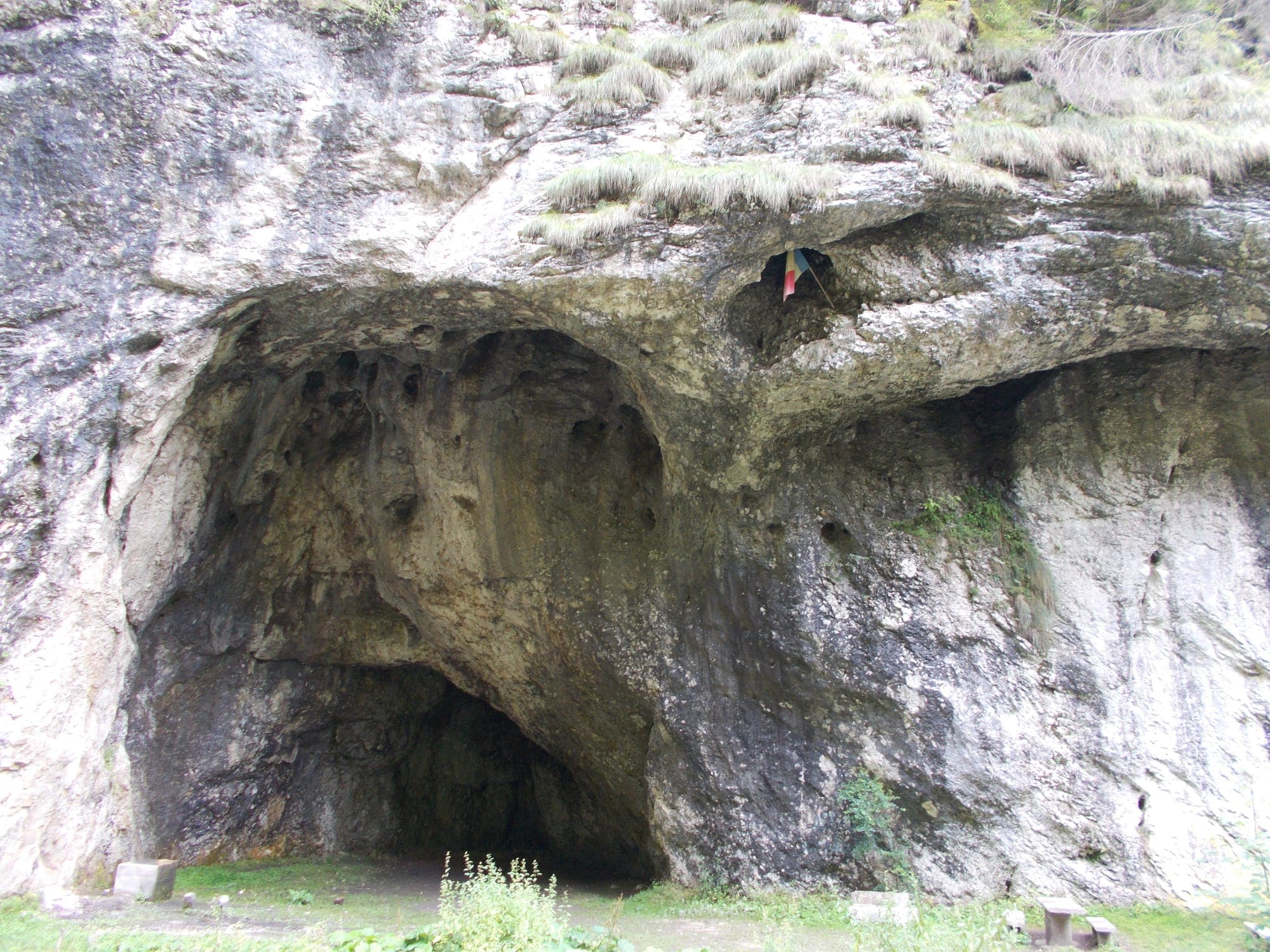
What is the largest underground glacier in Romania
The Scărișoara glacier. Apuseni Natural Park calls it the cave with the largest block of underground ice in the world, and the researchers who drilled it describe it as the oldest known underground glacier. Within the country, the park ranks Avenul Borțig, on the Padiș Plateau, second by volume and the Focul Viu glacier third, with about 25,000 m³. Avenul Borțig has no page on this site.
Caves longer or deeper than Scărișoara are a different ranking: see the largest cave in Romania.
Is the Scărișoara glacier melting?
Yes, and faster than ever since it has been studied. Aurel Perșoiu, of the ‘Emil Racoviță’ Institute of Speleology in Cluj-Napoca, said in April 2023 that in a single year the ice surface can lose 20–25 cm, compared with an average of 2–3 cm a year over the last 20 years. In February 2026, the institute's researchers described the current rate as the highest in the last 100 years of research in the cave.
The explanation given by the researchers and the park: milder winters leave an ever thinner new layer of ice, while hot summers and rain melt more than has formed. The glacier will not vanish from one year to the next, but it is losing thickness. For visitors, the consequence is just one: you see the ice from the walkway and you may not step down onto it, because the block is a natural monument and is measured continuously.
The Focul Viu glacier, near Padiș
Focul Viu Ice Cave is in the Galbena Valley, at the edge of the Padiș Plateau, also at 1,165 m. The chamber is almost 50 m high and has a wide opening in the ceiling. Around midday, light comes in through it and falls on the ice; this is where the name ‘focul viu’ (‘living fire’) comes from.
Apuseni Natural Park describes it as the third underground glacier in the country by volume, with about 25,000 m³. The glacier, however, has been losing ice for years: in 2024, hikers reported that only a white patch was left. No recent official measurement exists.
The visit is free and open, but only as far as the metal gate at the entrance, from a wooden platform from which you see the chamber. You get there on foot from Poiana Glăvoi, on the Galbena Valley circuit marked with a yellow dot (~1 hour one way). In winter the circuit is closed.

Vârtop Cave
Vârtop Cave lies above the hamlet of Casa de Piatră, at ~1,170 m, ~12 km from Gârda de Sus, plus a 30–45 minute climb on a forest path. The ice is only in the first chamber, before the metal gate: ice blocks and icicles among boulders, which shrink a lot in summer. The rest of the cave, ~340 m long, is known for its white formations and for the Neanderthal footprint found here in 1974.
The cave has no lighting. Visits are only with the guide, in groups of 5–10 people, with your own torch and clothes for ~4 °C; children under 6 are not allowed. The ticket is 15 lei, according to Apuseni Natural Park. Watch out for the name: the Vârtop resort and pass on the DN 75 are elsewhere; the cave is reached from Gârda de Sus. Near Casa de Piatră is also the portal of Coiba Mare Cave, without ice.


The Ice Cave at Borsec
The Ice Cave (Peștera de Gheață) at Borsec (in Hungarian Jégbarlang) lies in the Scaunul Rotund reserve, a travertine hill 2–3 km from the resort park, on the path that passes the old travertine quarry. On the same route are Poiana Zânelor and Grota Urșilor.
It is not a true glacier like Scărișoara: the cold air circulating through the cave keeps the ice for only part of the year. In winter and early spring ice stalactites and stalagmites form, lasting until late spring. The cave is only a few tens of metres long and has no lighting.
Entry is free and open. Bring a torch and shoes with a good grip: in winter and spring the path and steps can be icy. Scaunul Rotund is a protected area, so do not take travertine or pick plants.

Is there an Ice Cave at Predeal?
People search for the ‘Predeal Ice Cave’ (Peștera de Gheață Predeal), but the cave is not in the town of Predeal: it is in the Piatra Mare Mountains, on the slope facing the Timiș valley, between Brașov and Predeal. It is a small, undeveloped cavity: the entrance is a crack between rocks, with no stairs, lighting, administrator, opening hours or ticket. At the back, according to hikers' reports, ice or snow survives from one year to the next.
It can only be reached on mountain trails, on the marked routes from the Dâmbul Morii area, the same starting area as for Seven Ladders Canyon. No institution publishes an official route to the cave or its condition, so it has no page on this site. If you want a developed ice cave, the closest to Brașov among those above is the one at Borsec, and the only one with stairs and a walkway is Scărișoara.
How ice forms in a cave
Underground glaciers are not mountain glaciers that have slipped underground. They form in caves that work as a cold-air trap: the entrance is high up, usually a shaft or a wide mouth, and the chamber lies lower. In winter the cold, heavy air sinks into the chamber and stays there; in summer the warm, lighter air has no way of pushing it out. Water from melting snow and rain that reaches the chamber freezes layer upon layer, and over time a block builds up. At Scărișoara, snow lies at the bottom of the shaft almost all year, and at Focul Viu, under the opening in the ceiling, a mound of snow and fallen wood has piled up.
At Borsec the mechanism is the same but weaker: the cold air keeps the ice for a few months, not from one year to the next. How the caves themselves form, in limestone, is another story: see stalactites and stalagmites: how a cave forms.
When there is most ice in the caves
In spring, usually. Winter builds up the cold, and the meltwater dripping into the cave in spring freezes: that is when the ice stalagmites grow in the Church area at Scărișoara, and at Borsec the ice stalactites and stalagmites last until late spring. In summer the ice melts at the surface: at Vârtop the blocks in the first chamber shrink a lot.
The visiting calendar, however, does not match the ice calendar. Scărișoara is open all year, but in winter the stairs are icy and the road to Ghețari may be snowed in. Vârtop has daily opening only between 15 June and 1 September. At Focul Viu the circuit is closed in winter. In short: at Scărișoara the new ice can be seen in spring, while in summer the road and the stairs are free of snow; at Borsec go at the end of winter or in spring.
Visiting an ice cave: cold, stairs, gear
- The cold. At Scărișoara it is around 0 °C even in summer, at Vârtop ~4 °C. Bring warm clothes even in July, plus gloves if you stay long on the walkway.
- The stairs. At Scărișoara you go down into the shaft on steep stairs, wet or icy in the cold season; the route is not accessible with a pushchair or a wheelchair. Hold the handrail and do not step off the walkway onto the ice.
- Footwear. Grippy soles everywhere; at Vârtop the park requires hiking boots and your own torch lasting at least 30 minutes.
- Getting to the cave. Scărișoara: a few minutes' walk from the car park. Vârtop: 30–45 minutes on a path. Focul Viu: ~1 hour one way through the forest. Borsec: 2–3 km on a path from the resort. Piatra Mare: a mountain trail.
The rest of the cave tips (with children, what to wear, what to bring) are in the guide to the caves of Romania.
Frequently asked questions
- What is the largest ice cave in Romania?
- Scărișoara Ice Cave, in the Apuseni Mountains (Alba). Apuseni Natural Park describes it as the cave with the largest block of underground ice in the world, with over 130,000 m³ in recent studies.
- How old is the Scărișoara glacier?
- At least 10,500 years at the base, according to the drilling published in 2017 by researchers at the ‘Emil Racoviță’ Institute of Speleology and their partners. Preliminary data cited in 2023 suggest it could be up to 13,000 years old.
- Is the Scărișoara glacier melting?
- Yes. In a single year the ice surface can lose 20–25 cm, compared with an average of 2–3 cm a year over the previous two decades, and in February 2026 researchers said the rate is the highest in the last 100 years.
- Where is the Borsec Ice Cave?
- In the Scaunul Rotund reserve, 2–3 km from the park of the Borsec resort (Harghita), on the path that passes the old travertine quarry. Entry is free, the cave has no lighting, and the ice can be seen in winter and spring.
- Is there an Ice Cave at Predeal?
- There is a small, undeveloped cave with this name in the Piatra Mare Mountains, between Brașov and Predeal, reached only on mountain trails. It has no administrator, opening hours, ticket or lighting.
- When is there most ice in the cave?
- In spring, after the meltwater freezes inside the cave; in summer the ice melts at the surface. Scărișoara is open all year, but in winter the stairs are icy; at Borsec the ice can be seen in winter and spring.
- Can you visit the Focul Viu Ice Cave?
- Only as far as the metal gate at the entrance, from a wooden platform, free of charge. You get there on foot from Poiana Glăvoi in ~1 hour, and in winter the Galbena Valley circuit is closed.
- What is the temperature in Scărișoara Ice Cave?
- Around 0 °C in summer and below zero in winter. Bring warm clothes and shoes with grippy soles even in midsummer.
Sources
- Apuseni Natural Park: Scărișoara Ice Cave
- Apuseni Natural Park: the park's 10 caves
- Apuseni Natural Park: Focul Viu glacier
- Apuseni Natural Park: Vârtop glacier
- ScienceDaily, April 2017: drilling in the Scărișoara glacier, ice at least 10,500 years old (Scientific Reports)
- Alba24, July 2016: ground-penetrating radar survey of the Scărișoara ice block
- Alba24, April 2023: Aurel Perșoiu (Institute of Speleology) on the melting of the glacier
- Alba24, February 2026: the melting rate, the highest in the last 100 years
- Digi24, August 2024: mild winters and hot summers are melting the glacier
- Borsec resort: attractions
- Showcaves.com: Seven Ladders Canyon and the Ice Cave in Piatra Mare
All guides
- Ski slopes in Romania: the ski resorts and ski areas by region, with a map
- When the ski slopes open and where the snow comes first: the ski season in Romania
- Sledging, alpine coasters and tubing in Romania: where to go with a sledge
- The longest ski slope in Romania and the other records: the largest ski area, the highest, the hardest
- The nearest ski slopes to Bucharest, Cluj, Brașov, Sibiu, Iași, Timișoara and Oradea: distances for a day of skiing
- Beginner and kids' ski slopes in Romania: where to learn to ski, ski schools and slope colours
- Caves in Romania: the ones you can visit, by area, with a map
- Apuseni caves: a 2–3 day route through Bihor and Alba
- The largest cave in Romania and the other records: the longest, the deepest, the oldest show cave
- The nearest cave to Bucharest, Brașov, Cluj, Sibiu, Oradea and Timișoara: distances for a day trip
- Famous caves in Romania you cannot visit: Movile, Topolnița, Vântului, Coliboaia, Peștera cu Oase (and what to see instead)
- Stalactites and stalagmites: what they are, how a cave forms and where to see them in Romania
- The Danube Delta: map, what it is, the villages and what to see
- Danube Delta trip: one, two or three days, where to start and how to get to Sulina and Sfântu Gheorghe
- Things to do in Tulcea: what to see in the city and around it
- Birds and wildlife of the Danube Delta: pelicans, where and when to see them
- Visiting the Danube Delta for the first time: the access permit, mosquitoes and when to go
- Fishing in the Danube Delta: the fishing permit, the 2026 closed season and where you may fish
- Sulina or Sfântu Gheorghe? The beaches of the Danube Delta (and Gura Portiței)
- Deltas near Bucharest: Văcărești, Comana (the Neajlov Delta) and Balta Mică a Brăilei
- The Romanian Black Sea coast: the resorts in order, north to south, with a map
- The best beaches in Romania (and the Blue Flag ones)
- The Black Sea season in Romania: when it opens, how long it lasts and when the water is warmest
- Wild beaches on the Romanian coast: Corbu, Vadu, Tuzla and the south
- Which Romanian seaside resort to choose: for young people, families, quiet, budget
- The Romanian seaside with kids: resorts, shallow beaches and what to do off the beach
- Things to do in Constanța: what to see in the city, on the seafront and nearby
- Jellyfish, sharks and lifeguard flags in the Black Sea
- Salt mines in Romania: the complete guide to the salt mines you can visit
- The largest, the deepest and the oldest salt mine in Romania
- The nearest salt mine to Bucharest, Cluj, Brașov, Sibiu, Iași, Timișoara, Oradea, Constanța and other cities
- Salt mines with children and babies: from what age, which one suits, what to bring
- Turda or Slănic Prahova? Which salt mine to choose
- Visiting a salt mine for the first time: temperature, clothing, how long, lift or bus, dogs
- Salt lakes and salt baths in Romania: where to swim, season and prices
- Salt mine therapy in Romania: what the operators say, how long to stay, which mines have a treatment base