Roman Fort of Călugăreni
Călugăreni, MS · 141 km from Sibiu
An auxiliary Roman fort on the eastern limes of Dacia, in the Niraj valley, now a modernised archaeological park (Limesparc) with exhibition pavilions and a viewpoint.
351 results
An auxiliary Roman fort on the eastern limes of Dacia, in the Niraj valley, now a modernised archaeological park (Limesparc) with exhibition pavilions and a viewpoint.

The Saxons' Gothic church in the centre of Sebeș, with a tall 14th-century choir and the largest winged altarpiece of any Lutheran church in Romania.

A passage 1.1–1.35 m wide in Brașov's old town, recorded in the 17th century and counted among the narrowest streets in Europe; closed for repairs since November 2025.

A thermal waterfall that never freezes, spilling over a moss-covered travertine wall, a quarter of an hour's walk from the centre of the Geoagiu-Băi spa resort.

A 14th-century Gothic church built by the noble Apafi family, with the largest ensemble of Gothic frescoes in Transylvania and a polyptych altarpiece that has stood in place for more than five centuries.

Romania's longest and highest limestone ridge, 25 km long, with La Om Peak at 2,238 m, the Zărnești Gorge, Curmătura Chalet and trails for every level.
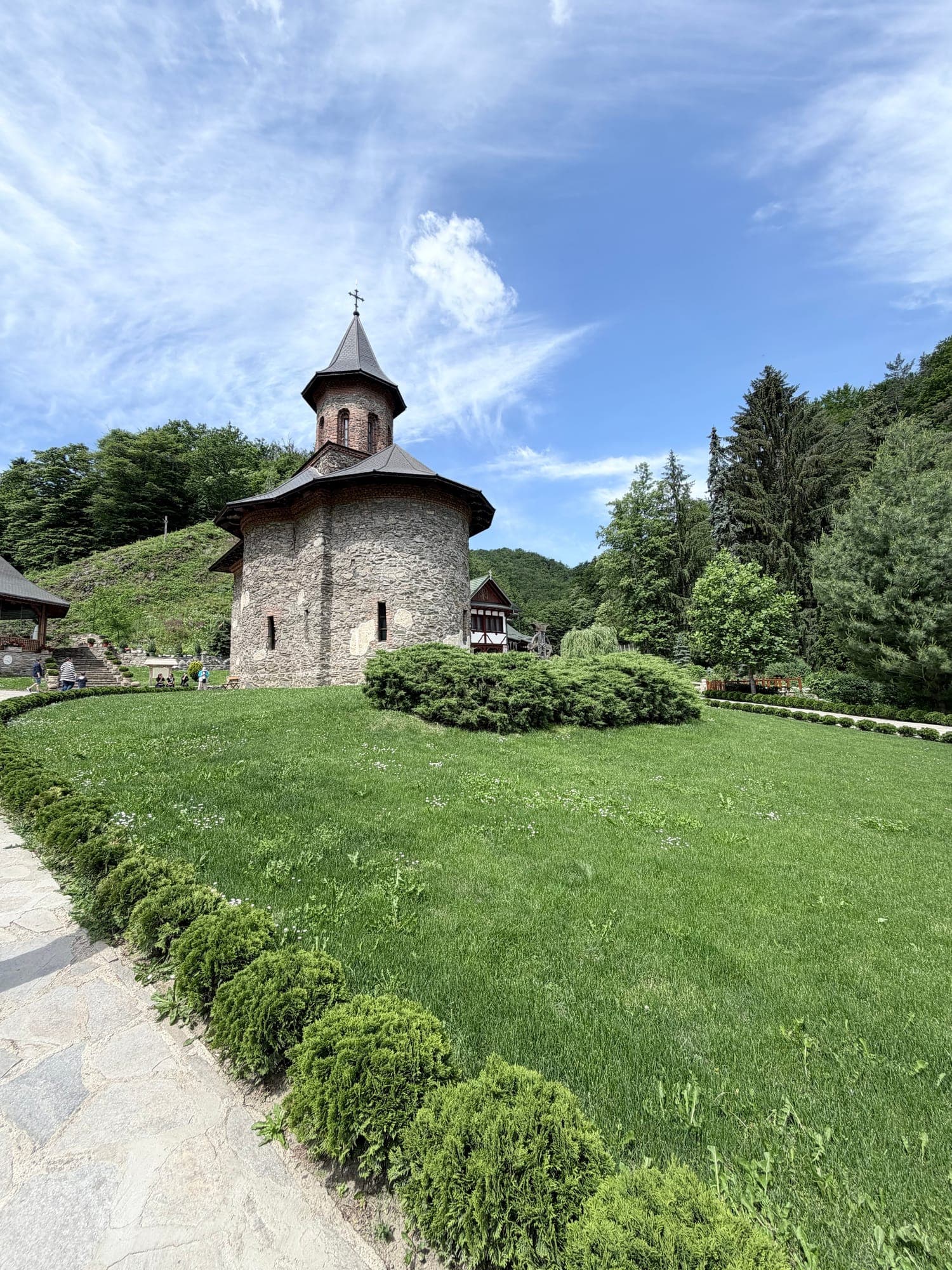
A convent in the Hațeg Country, with a stone church rebuilt in 1564 and the grave of St Arsenie of Prislop (Father Arsenie Boca), one of the largest pilgrimage sites in Romania.

An auxiliary Roman fort on Urieșilor Hill above the Mureș, near Geoagiu, with foundations, a headquarters building with an underground treasury unique in Dacia, and wide views over the valley.

The second square of old Sibiu, with guild houses arcaded at street level, the Arts House and the Bridge of Lies, the 1859 cast-iron footbridge over Ocnei street.

The best-preserved bastion of Brașov's city walls, built by the weavers' guild in the 15th and 16th centuries, with timber galleries on four levels and a model of the medieval town.

A Baroque manor house of the second half of the 18th century in the centre of Beclean, with a vaulted gate and a coat of arms dated 1768; today it houses the Agricultural Technological High School.

The pass where the DN1A crosses from the Teleajen valley into the Bârsa region at 1,263 m, below the Ciucaș Mountains: a mountain road between Cheia and Săcele and the trailhead for Ciucaș Peak.

A Romanesque basilica of the 13th century, strengthened in 1494 with an 8-metre enclosure wall, in the easternmost Saxon village on the Royal Land; its west portal is among the finest stone carving in Transylvania.

The Gothic church of the Sibiu Saxons, with a 73-metre tower you can climb, the 1914 Sauer organ, the 1445 Crucifixion fresco and the gravestones of the ferula.

The land of dwarf dinosaurs around Hațeg, Romania's first geopark: small museums with reconstructions and fossils, themed trails through villages, palaeontological sites and traces of 70-million-year-old volcanoes.