
Dracula's Castle: where it is and which one is the real one (Bran, Poenari, Sighișoara, Tihuța)

“Dracula's Castle” is in fact four places: Bran Castle, in Brașov County, is the castle that tourism calls by that name, Poenari Citadel, on the Transfăgărășan, is the fortress with the strongest link to Vlad the Impaler, Sighișoara is the town where tradition says he was born, and at the Tihuța Pass, the “Borgo Pass” of Bram Stoker's novel, stands the hotel built near the spot in the book. Count Dracula's castle in the novel does not exist: it is imaginary, and Stoker never went to Romania.
Below you will find what links each place to Vlad the Impaler or to the novel and what you can visit, then Vlad's other places (Târgoviște, Snagov, Comana, the Curtea Veche in Bucharest) and the most common mix-ups. Opening hours and prices are on each attraction's page.
In short
- Bran Castle, ~30 km from Brașov, is called “Dracula's Castle” because of Bram Stoker's novel, even though the castle's own website says Vlad the Impaler does not seem to have played an important role in its history.
- Poenari Citadel, above the Argeș Gorge on the Transfăgărășan, is the fortress with the strongest link to Vlad the Impaler: the chronicles say he built it, and excavations attribute its 15th-century extension to him.
- In Sighișoara, Vlad Dracul, Vlad the Impaler's father, lived between 1431 and 1436, and tradition says the son was born in the house on the Citadel Square now called the Vlad Dracul House.
- The Tihuța Pass is the “Borgo Pass” of the novel “Dracula” (1897), where the count's carriage waits for Jonathan Harker; the Hotel Castel Dracula at Piatra Fântânele was built between 1976 and 1983 and is not a medieval castle.
- Count Dracula is a character in a novel; his name comes from Vlad the Impaler's nickname, linked to the Order of the Dragon, to which his father, Vlad Dracul, belonged.
- Tradition places Vlad the Impaler's grave at Snagov Monastery, but excavations found nothing conclusive, and some historians look for it at Comana Monastery, which he founded in 1461.
Where is Dracula's Castle: the four places
A search for “Dracula's Castle” mixes up two things: Vlad the Impaler (Vlad Țepeș), the 15th-century prince of Wallachia, and Count Dracula, the vampire of Bram Stoker's novel, published in 1897. No single place brings the two together. Bran has the fame, Poenari has the history, Sighișoara has the birth tradition and the Tihuța Pass has the reference in the novel. The table puts them side by side, together with the two places searched for as “Vlad the Impaler's castle” that are not castles.
| Place | What it is | Link with Vlad the Impaler | Link with the novel | County | Can you visit? |
|---|---|---|---|---|---|
| Bran Castle | fortress from 1377–1388, later Queen Marie's residence | weak: he passed through the Bran Pass | its fame as “Dracula's Castle” | Brașov | yes, all year, with a ticket |
| Poenari Citadel | ruins of a mountain fortress, 1,480 steps | the strongest: the chronicles and the excavations | none | Argeș | yes, with a ticket; climb in groups only |
| Sighișoara (Vlad Dracul House) | inhabited citadel town, UNESCO | his father lived here; his birth, according to tradition | none | Mureș | yes, the citadel is free |
| Tihuța Pass (Hotel Castel Dracula) | pass on the DN17; hotel from 1976–1983 | none | the “Borgo Pass” of the novel | Bistrița-Năsăud | the pass, yes; the hotel is accommodation |
| Târgoviște Princely Court | ruins of the princely residence, Chindia Tower | his residence; the tower, from his time | none | Dâmbovița | yes, with a ticket; closed on Mondays |
| Snagov Monastery | monastery on an island in the lake | his grave, according to tradition | none | Ilfov | yes; hours not published |
From the attraction pages and the official websites (bran-castle.com, muzeul-judetean-arges.ro, primariasighisoara.ro, muzee-dambovitene.ro), checked on 25 November 2026.


Bran Castle: Dracula's Castle for tourists
Bran Castle is the place almost everyone thinks of when they search for “Dracula's Castle” or “Dracula Castle Brasov”. It was built by the people of Brașov in 1377–1388 as a border fortress and customs post at the entrance to the Bran Pass, and in 1920 it became Queen Marie's summer residence.
The link with Vlad the Impaler is thin, and the castle's administration says so itself: the official website states that the prince does not seem to have played an important role in the fortress's history and that the connection was made much later. What can be verified are his passages through the Bran Pass, towards Brașov and back: in 1459, when his army attacked Brașov, then in 1460, 1462 and 1476. It is not known whether he ever took the castle; the website also mentions the hypothesis, introduced with an “apparently”, that he may have been held prisoner here for two months in the autumn of 1462.
The fame comes from the novel. The castle explains it by saying that Bran would be the only castle in Transylvania that fits Stoker's description, and assumes that the writer was inspired by an illustration of Bran in an English travel book. Inside you see the rooms of the royal family, not the count's. The full description is on the castle's page.
Poenari Citadel: Vlad the Impaler's real fortress
If the question is “which is Vlad the Impaler's real castle?”, the answer is Poenari Citadel, on Mount Cetățuia above the Argeș Gorge, ~25 km from Curtea de Argeș on the Transfăgărășan road (Arefu commune). It is also searched for as “Poenari Castle” or “Dracula's Castle on the Transfăgărășan”, but it is a fortress, not a castle.
The link has two sources. The chronicles: the Cantacuzino Chronicle writes that “Prince Vlad Țepeș, he built the fortress at Poenari”, and the chroniclers tell how the prince brought the punished townspeople of Târgoviște here on Easter Day and made them work on the walls until their clothes were in tatters. The excavations: the core, a square tower built directly on the rock, is older, from the time of the first Basarab princes, but the 15th-century extension, an enclosure of almost 60 m with three semicircular towers, is attributed to Vlad the Impaler. In the 19th–20th centuries the ruins were even known as “the Fortress of Prince Țepeș”.
A legend recorded in 1747 also comes from here: besieged by the Turks, the prince is said to have fled towards Transylvania with his horses shod backwards. The climb has 1,480 steps, and because of bears you can only go up in a group, formed at the foot of the steps. The other fortresses of Wallachia are in the guide to fortresses.

Sighișoara and Dracula's house
“Dracula's house” and “Dracula Castle Sighișoara” lead to Sighișoara Citadel, a medieval citadel town in Mureș County, still inhabited and on the UNESCO World Heritage List since 1999. There is no castle here. The link with Vlad is a family one: Vlad Dracul, Vlad the Impaler's father and a member of the Order of the Dragon, lived in the citadel between 1431 and 1436, as the town hall also states. Tradition says his son was born in the house on the Citadel Square (Piața Cetății), now called the Vlad Dracul House; it is a tradition, not a proven fact.
You enter the citadel under the Clock Tower, and the house is further up, on the Citadel Square, on the way to the Church on the Hill; walking around the citadel is free. What else to see in Sighișoara, from the Clock Tower to the covered staircase, is in the town guide.
Castel Dracula at the Tihuța Pass (Borgo Pass)
Searches for “Castel Dracula Tihuța”, “Dracula Castle Bistrița” and “Dracula Castle Vatra Dornei” all lead to the Tihuța Pass, the 1,201 m pass through which the DN17 links Bistrița with Vatra Dornei. Foreigners know it as the “Borgo Pass”, the name of Bârgău on old maps. Bram Stoker, who never went to Romania, used the name in “Dracula”: this is where the count's carriage waits for Jonathan Harker. The castle it takes him to, however, is pure fiction, and the place has no link at all with Vlad the Impaler.
The building searched for as “Castel Dracula” is the Hotel Castel Dracula at Piatra Fântânele, ~45 km from Bistrița on the DN17. It was built between 1976 and 1983 under the name Hotel Tihuța and took its current name after 1989. It is a hotel, not a monument. The pass itself, with the pastures around it and the cross by the Piatra Fântânele Monastery, is described on the Tihuța Pass page.
Târgoviște: the Princely Court and the Chindia Tower
“Vlad the Impaler's castle in Târgoviște” means the Târgoviște Princely Court (Curtea Domnească din Târgoviște), ~80 km from Bucharest. It was the residence of the princes of Wallachia for almost three centuries, and the Bran Castle website even calls it “the residence of Vlad the Impaler”. In the 15th century, under Vlad Dracul and Vlad the Impaler, the court was given strong fortifications.
Its symbol, the Chindia Tower, 27 m high, was most probably built in the second half of the 15th century, in Vlad the Impaler's time, according to the museum that runs it; in the 16th–17th centuries it was also used as a prison. Its present form is the result of later rebuilding. You climb a spiral staircase to the terrace at the top. According to the chronicles, the townspeople punished with work at Poenari also came from Târgoviște.

Snagov or Comana: where is Vlad the Impaler's grave
Snagov Monastery, on an island in Lake Snagov, ~40 km from Bucharest, is the place that tradition gives as Vlad the Impaler's grave: the slab in front of the altar. It is not a certainty. The 1933–1934 excavations by the archaeologist Dinu Rosetti found nothing conclusive under it. Vlad is said to have built walls, a bridge to the shore and a prison at Snagov, and the Cantacuzino Chronicle even credits him with the monastery; today's church, however, is the one built by Neagoe Basarab in 1521. You reach the island on a footbridge from Siliștea Snagovului.
Other historians look for the grave at Comana Monastery, ~35 km south of Bucharest, which Vlad the Impaler founded in 1461. The historian Constantin Rezachevici, in a text published on the website of the Diocese of Giurgiu, considers the most likely hypothesis to be that the prince, killed on the road between Bucharest and Giurgiu, was buried here, in a grave that disappeared when his wooden church was demolished in 1588. This version is not proven either.


Other places linked to Vlad the Impaler
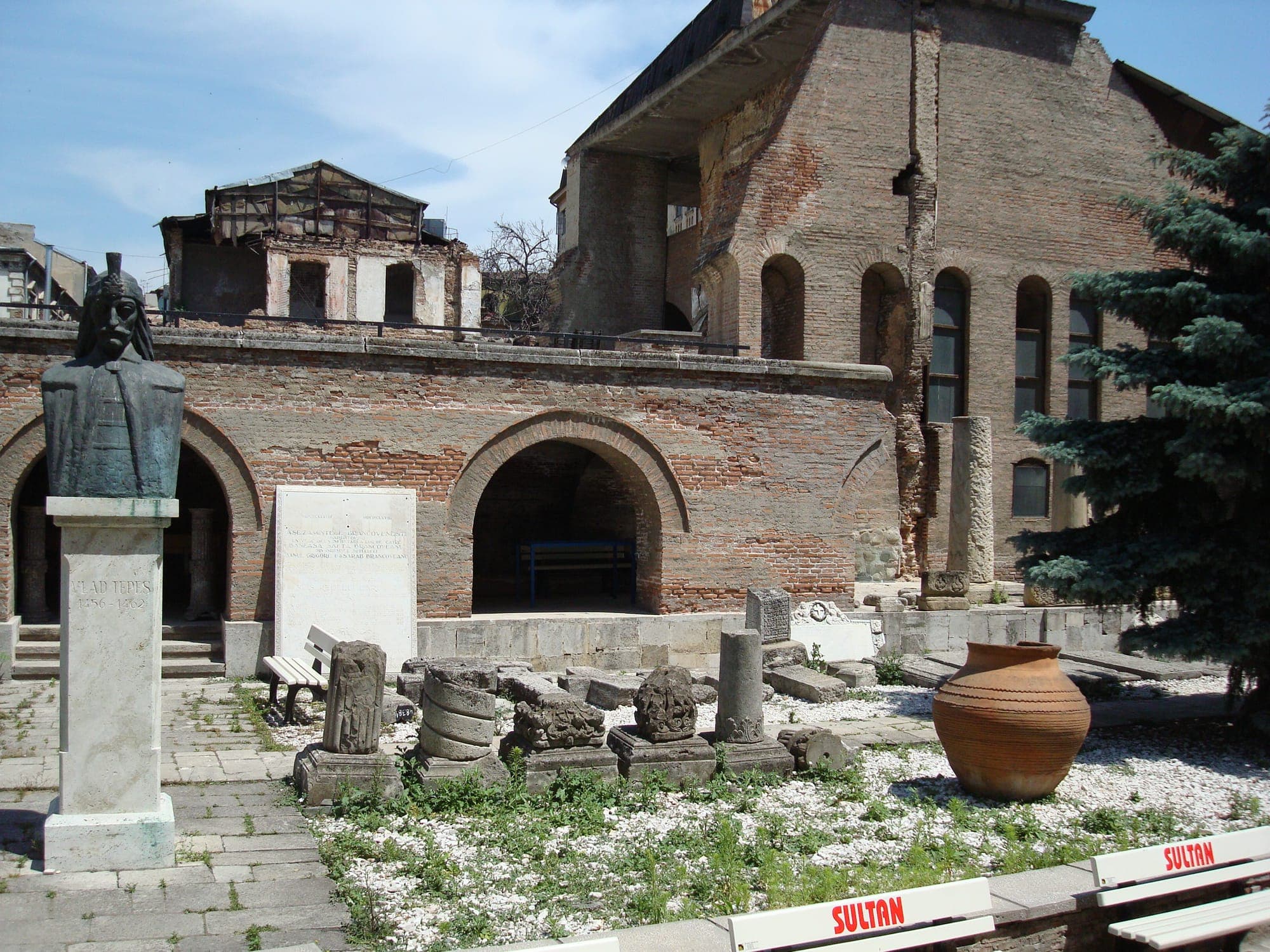
- Curtea Veche Princely Palace, in Bucharest's Old Town, is the answer to “Vlad the Impaler's castle in Bucharest”. A 1459 document of Vlad the Impaler mentions the fortress of Bucharest as a princely residence, and the museum preserves fragments of walls from his reign. The museum has been closed since November 2015 for consolidation: the ruins and the bust of Vlad the Impaler can only be seen from the street, through the fence.
- Feldioara Fortress, near Brașov, a peasant fortress that Vlad the Impaler damaged in 1457; the locals rebuilt it the same year.
- The Transfăgărășan climbs from the south up the Argeș valley right past Poenari, which is why it turns up in searches as “Dracula's Castle Transfăgărășan”.
For the difference between a fortress and a castle, which explains why Poenari and Sighișoara are not castles, see the guide to fortresses.

Vlad the Impaler and Dracula: common mix-ups
Vlad the Impaler is not Count Dracula. The count is a character in a novel: a Transylvanian vampire who lives in a ruined castle in the Carpathians. His name comes from Vlad the Impaler's nickname, and the nickname from the Order of the Dragon, to which his father, Vlad Dracul, belonged. The Bran Castle website notes that Stoker avoided turning the character into a real historical figure.
Bran is not Vlad the Impaler's castle. It was the castle of the people of Brașov and, later, of Queen Marie; Vlad only passed through the pass below it. A “Dracula interior” at Bran Castle does not exist: the rooms are furnished as in the royal family's time.
“Castel Dracula” is also the name of a hotel. When you search for “Castel Dracula Tihuța” or “Hotel Castel Dracula”, the results are about the Hotel Castel Dracula at Piatra Fântânele, built in the 1970s–80s, not about a monument.
“Poenari Castle” and “Sighișoara Castle” are fortresses. One is a ruin on a mountain, the other a fortified town. The country's actual castles are in the guide to castles in Romania.
Route: how to link Dracula's places
The four places are in different corners of the country, so you cannot see them in one day. From Bran it is about 2 h 30 by car both to Poenari and to Sighișoara, while the Tihuța Pass is much further north, between Bistrița and Vatra Dornei. The table gives the distances and what to know off-season for each stop.
| From | To | Distance | Good to know |
|---|---|---|---|
| Brașov | Bran Castle | ~30 km, ~35 min | November–December 2026: standard adult tour 100 lei |
| Bran Castle | Poenari Citadel | ~120 km, ~2 h 35 | November 2026: 09:00–16:00, last climb at 15:00 |
| Bran Castle | Sighișoara | ~145 km, ~2 h 25 | the citadel is free to visit |
| Sighișoara | Tihuța Pass | ~190 km, ~3 h 45 | in winter, blizzards in the pass |
| Bucharest | Târgoviște / Snagov / Poenari | ~80 km / ~40 km / ~175 km | Snagov has no published hours |
The Brașov–Bran distance and those from Bucharest come from the attraction pages; Bran–Poenari, Bran–Sighișoara and Sighișoara–Tihuța Pass are calculated with OSRM on OpenStreetMap on 25 November 2026, rounded. Bran's rate (bran-castle.com) and the Poenari hours (muzeul-judetean-arges.ro) were checked on 25 November 2026.
Frequently asked questions
- Where is Dracula's castle?
- The castle called “Dracula's” is Bran Castle, in Brașov County, ~30 km from Brașov. The fortress truly linked to Vlad the Impaler is Poenari, in Argeș County, on the Transfăgărășan. The count's castle in Bram Stoker's novel is imaginary.
- What is Vlad the Impaler's real castle?
- Poenari Citadel, above the Argeș Gorge: the Cantacuzino Chronicle says Vlad the Impaler built it, and archaeologists attribute its 15th-century extension to him. His residence as prince was the Princely Court in Târgoviște.
- Did Bran Castle belong to Vlad the Impaler?
- No. The castle was built by the people of Brașov in 1377–1388, and its official website says Vlad the Impaler does not seem to have played an important role in the fortress's history; his army passed through the Bran Pass, for example in 1459.
- What is Castel Dracula at the Tihuța Pass?
- It is the Hotel Castel Dracula at Piatra Fântânele, built between 1976 and 1983 as the Hotel Tihuța and renamed after 1989. It stands next to the Tihuța Pass, the “Borgo Pass” of Bram Stoker's novel, ~45 km from Bistrița.
- Where is Dracula's house in Sighișoara?
- The Vlad Dracul House is on the Citadel Square, in Sighișoara's citadel, close to the Clock Tower. Vlad Dracul, Vlad the Impaler's father, lived in the citadel between 1431 and 1436, and tradition says his son was born in this house.
- Where is Vlad the Impaler buried?
- It is not known for certain. Tradition places him at Snagov Monastery, under the slab in front of the altar, but the 1933–1934 excavations found nothing conclusive; the historian Constantin Rezachevici considers Comana Monastery, which Vlad founded in 1461, more likely.
- Is Vlad the Impaler Dracula?
- No. Count Dracula is the character of Bram Stoker's novel, published in 1897; his name comes from Vlad the Impaler's nickname, which in turn comes from the Order of the Dragon, to which the prince's father, Vlad Dracul, belonged.
- Can you visit Dracula's castle?
- Yes. Bran Castle is open all year; in November–December 2026 the standard tour costs 100 lei for adults. Poenari Citadel is open in November 2026 every day 09:00–16:00, with the last climb at 15:00, in groups only.
Tickets and tours
- Buy ticket· from €32.90
Bran Castle entry ticket

- Buy ticket· from €62.60
Ticket bundle: Bran Castle + Peleș Castle
- Buy ticket· from €58.71
Bran Castle + Pelișor Castle, with a guided tour
- Buy ticket· from €33.35
Guided tour of the citadel, with the Clock Tower Museum
- Buy ticket
Day trip from Bucharest: Bran, Peleș and Brașov

- Buy ticket
Guided tour of Bran Castle from Brașov
- Buy ticket
Day trip from Bucharest in Vlad the Impaler's footsteps: Târgoviște, Curtea de Argeș, Poenari

Sources
- Bran Castle: Count Dracula and Vlad the Impaler
- Bran Castle: the history of the Bran fortress
- Bran Castle: opening hours and prices, November–December 2026
- Argeș County Museum: Poienari Citadel
- “Curtea Domnească” National Museum Complex, Târgoviște: chronology of the Chindia Tower
- “Curtea Domnească” National Museum Complex, Târgoviște: the Princely Court monument ensemble
- Sighișoara Town Hall: tourism
- Diocese of Giurgiu: Comana Monastery
- Bucharest Municipal Museum: Curtea Veche Princely Palace
- OpenStreetMap / OSRM: distances between the places
Attractions by area and category
Related guides
- Castles in Romania: the most important ones, which you can visit inside and where they are
- Palaces to visit in and around Bucharest: Parliament, Cotroceni, Royal Palace, Mogoșoaia, Potlogi
- Castles in Transylvania: the noble castles you can visit, by county
- Fortresses in Romania: the most important ones, by type and region, with a map
- Things to do in Sibiu: what to see in 1–2 days, in the city and nearby