
Things to do in Oradea: what to see in 1–2 days, in the city and nearby

Nearly all the sights of Oradea can be seen on foot, in the centre, on both sides of the Crișul Repede river: Piața Unirii (Union Square), with the Black Eagle Palace, the Moon Church and the tower of the Oradea City Hall Palace, the Art Nouveau buildings on the riverbank, the Oradea Fortress, ~1 km to the east, and, ~1.5 km to the north, the Roman Catholic Basilica of Oradea and the Baroque Palace of Oradea. 8 km to the south is Băile Felix, with thermal outdoor pools open all year.
Below are the sights by area, how to combine them in a day or a weekend, what is open in winter and on Mondays, what to do with children or when it rains and what to see around the city, from the thermal baths to the caves of the Pădurea Craiului and Bihor mountains. The current opening hours and prices are on the page of each attraction; all the places are on the Bihor county page and on the map.
In short
- Most of the sights in Oradea are in the centre, on foot: Union Square with the Black Eagle Palace, the Moon Church and the City Hall Palace, Sion Synagogue and Darvas-La Roche House on the bank of the Crișul Repede, and the Oradea Fortress, ~1 km away.
- The courtyards of the Oradea Fortress can be visited freely, without a ticket; the City Museum in the princely palace costs 20 lei and in winter is open Tuesday–Sunday 9:00–17:00.
- The City Hall tower, reopened on 18 July 2026, can be climbed Tuesday–Sunday 10:00–18:00, with a 15 lei ticket; its clock plays Iancu's March on the hour.
- On Mondays the City Museum in the fortress, the Țării Crișurilor Museum, Darvas-La Roche House, Sion Synagogue and the City Hall tower are closed; the Baroque Palace is closed on Sundays.
- Băile Felix is 8 km from Oradea, with thermal pools open all year; Vadu Crișului Cave is ~55 km away, Meziad Cave ~80 km and Bears' Cave ~90 km.
Oradea attractions: what to see, in one table
The table brings together the sights in the city, with the winter opening hours and the adult price from their pages. The centre, the fortress and the riverbank can be done on foot in a day; the zoo and Băile Felix need a car or the bus.
| Attraction | Where | What it is | Visit length | Hours and price |
|---|---|---|---|---|
| Union Square | centre | the central square, pedestrianised | ~45 min | always open, free |
| Black Eagle Palace | Union Square | Secession building, passage with stained glass | ~30 min | public passage, free |
| Moon Church | Union Square | church from 1784–1790, moon globe | ~30 min | daily, free |
| City Hall tower | Union Square | ~50 m tower, views | ~30 min | Tuesday–Sunday 10–18, 15 lei |
| Sion Synagogue | riverbank | synagogue from 1877–1878, Moorish interior | ~30 min | Tuesday–Sunday 10–18, 15 lei |
| Darvas-La Roche House | riverbank | Art Nouveau museum | ~1 h | Tuesday–Sunday 10–18, 20 lei |
| Regina Maria Theatre | Ferdinand Square | theatre from 1900, Fellner & Helmer | one performance | tickets from 25 lei |
| Oradea Fortress | ~1 km east | pentagonal fortress, City Museum | ~2 h 30 | courtyards free; museum 20 lei |
| Roman Catholic Basilica | ~1.5 km north | the largest Baroque church in the country | ~30 min | daily 7–19, free |
| Baroque Palace | next to the basilica | episcopal palace from 1762–1777 | ~1 h 30 | Monday–Saturday 9–17, 25 lei |
| Țării Crișurilor Museum | ~1 km from the centre | the county museum, vivarium | ~2 h | Tuesday–Sunday 9–17, 15 lei |
| Oradea Zoo | south-west | zoo on 7.5 ha | ~2 h | daily 9–17, 32 lei |
Winter hours (November–March) and adult prices from the attraction pages, checked on the official websites in 2026. At the Țării Crișurilor Museum, 15 lei is the price of one permanent exhibition; at the Fortress, the courtyards are free and only the museum is paid.
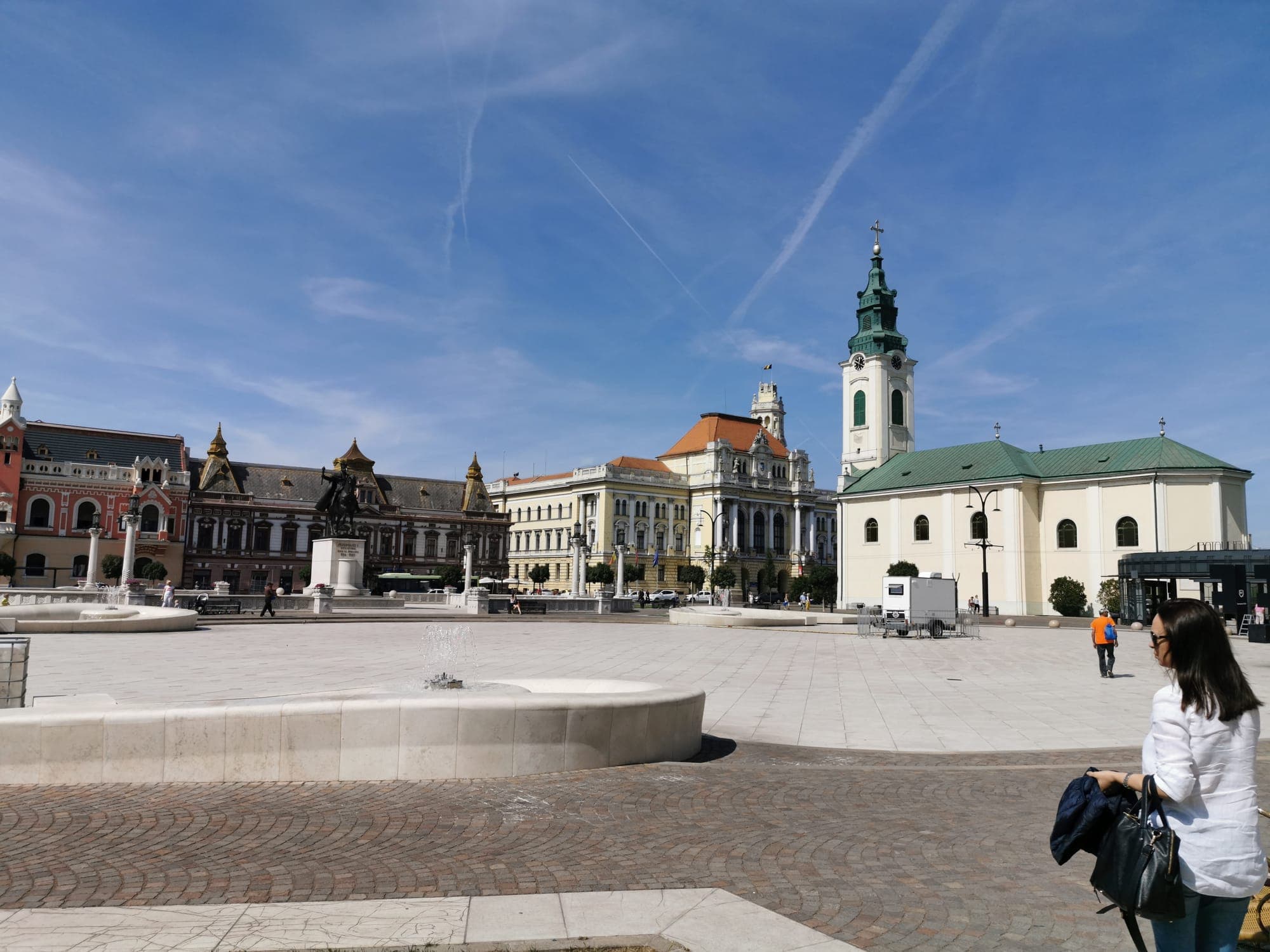

Union Square: Black Eagle, Moon Church, City Hall
Piața Unirii (Union Square) is the heart of Oradea: pedestrianised, with the equestrian statue of King Ferdinand I in the middle and palaces from around 1900. On the north side, the Black Eagle Palace, from 1907–1908, has a glass-roofed passage that you can enter freely, and the black eagle stained glass from 1909, from which it takes its name.
In the south-east corner is the Moon Church, from 1784–1790: in its 55 m tower, a globe of ~1 m, half black and half gold, shows the phases of the Moon, in a mechanism from 1793. Entry is free; climbing the tower is only possible with the parish's permission.
Towards the river, the square ends with the Oradea City Hall Palace, from 1902–1903. Its tower, almost 50 m tall, reopened on 18 July 2026: you can climb it Tuesday–Sunday 10:00–18:00, with a 15 lei ticket, and five people fit at the top at a time. The clock plays Iancu's March on the hour, between 8 and 20.


Art Nouveau Oradea: Sion Synagogue, Darvas House, theatre
On the bank of the Crișul Repede, ~300 m from Union Square, the Sion Neolog Synagogue, from 1877–1878, has a wide dome and an interior painted in Moorish style; restored in 2015, it is now a cultural venue, open Tuesday–Sunday 10:00–18:00 (15 lei).
A few minutes away, on Strada Iosif Vulcan, Darvas-La Roche House is the Secession villa of an industrialist, designed by the Vágó brothers in 1909–1912. It houses the first Art Nouveau museum in Romania, with period interiors, stained glass and a garden facing the Criș; it is open Tuesday–Sunday 10:00–18:00, and a ticket costs 20 lei, free for children under 7.
Across the river, on Ferdinand Square, the Regina Maria Theatre, opened in 1900 to plans by the Viennese firm Fellner & Helmer, has an auditorium with boxes and a balcony seating 567. The building has no visiting hours: you see its interior at a performance, with tickets from 25 lei, or on the open-door days announced by the theatre.


Oradea Fortress: free courtyards and the City Museum
The Oradea Fortress, ~1 km east of Union Square, is a bastion fortress in the shape of a pentagon, with five bastions and a princely palace in the middle, built in the 16th–17th centuries. The courtyards, the paths around the walls and the moat can be walked freely, without a ticket, at any time.
In the palace is the Oradea City Museum, with the Griffins' Hall and the permanent exhibition: 20 lei for adults, 10 lei for children over 4, pupils and pensioners. Between 1 November and 31 March it is open Tuesday–Sunday 9:00–17:00, with the last entry one hour earlier. The Crăișorul Bastion, the oldest, reopened in September 2026, after being dug out from under some 10,500 tonnes of earth. For a full visit, with the museum and a walk round the walls, allow ~2 hours 30 minutes.
The Basilica, Baroque Palace and Țării Crișurilor Museum
Across the Crișul Repede, in the Olosig district, on Șirul Canonicilor, stands the Baroque ensemble of the Roman Catholic bishopric. The Roman Catholic Basilica of Oradea, from 1752–1780, is the largest Baroque church in Romania, with a Carrara marble altar and the organ donated by Maria Theresa; entry is free, daily 7:00–19:00, outside services.
Next to it, the Baroque Palace of Oradea, from 1762–1777, is the largest Baroque palace in the country. The church art exhibition on the first floor costs 25 lei, and the ticket for all exhibitions 50 lei; the interior is open Monday–Saturday 9:00–17:00, closed on Sundays. The surrounding garden is open daily 6:00–22:00.
The Țării Crișurilor Museum, the county museum, moved from the palace to the former Royal Cadet School from 1898, on Strada Armatei Române, ~1 km from Union Square. It has archaeology, history, art, ethnography, natural sciences and a vivarium, with a separate ticket for each exhibition (15 lei); in winter it is open Tuesday–Sunday 9:00–17:00.


What to do in Oradea in one day or in 2 days
One day is enough for the centre. In the morning: Union Square, the Black Eagle passage, the Moon Church and the climb up the City Hall tower. Then the riverbank: Sion Synagogue and Darvas-La Roche House. In the afternoon: the Fortress, with the City Museum, which closes at 17:00 in winter. In the evening, the square and the Black Eagle have their façades lit. Choose a day from Tuesday to Saturday: on Mondays the museums, the synagogue and the tower are closed, and on Sundays the Baroque Palace.
On the second day you have two options. Either the Basilica and the Baroque Palace in the morning, the Țării Crișurilor Museum and the zoo in the afternoon, or a day at the pools in Băile Felix, 8 km away. With a car, a third half-day goes to a cave from the section on the surroundings.
Oradea in winter, during the Christmas market
In winter, Piața Unirii (Union Square) and Ferdinand Square host the Christmas market, with a Ferris wheel and an ice rink; the dates and what you find at the market are in the Oradea section of the Christmas markets guide. What changes in the city in the cold months:
- The City Museum in the fortress and the Țării Crișurilor Museum have winter hours, Tuesday–Sunday 9:00–17:00; the Țării Crișurilor Museum is closed on 25–26 December and 1–2 January.
- The Oradea Zoo is open 9:00–17:00, with the ticket office until 16:00.
- Sion Synagogue had short hours on 24 and 31 December (10:00–14:00) in the winter of 2025–2026 and was closed on 25–26 December and 1–2 January.
- Băile Felix: the Apollo-Felix Complex stays open, but from 21 December the wave pool and the water slides close; the outdoor thermal pool at Felixarium operates on 28–30 November and 24 December – 10 January.
- Unguru Mare Cave is closed between 1 November and 31 March, for the hibernating bats.

What to do in Oradea with children
- Oradea Zoo, on 7.5 ha, with tigers, wolves, bears and zebras: 32 lei for adults, 16 lei for children aged 3–14, free under 3; a pony ride costs 25 lei for 10 minutes.
- The Țării Crișurilor Museum, with the vivarium (10 lei for children over 4) and interactive rooms.
- The Fortress: wide courtyards, no cars, and the exhibition “Medieval Inventions. Leonardo da Vinci” (10 lei).
- Union Square, pedestrianised, with the singing clock and the moon globe; in winter, the market's ice rink.
- Băile Felix and Băile 1 Mai, with children's pools and slides.
The City Hall tower has stairs, and only five people fit at the top; with small children, go up in turns.

What to do in Oradea when it rains
When it rains, choose the museums: the Țării Crișurilor Museum (an hour per exhibition), the City Museum in the fortress, the Darvas-La Roche House and the Baroque Palace, plus the Sion Synagogue and the Basilica. The Black Eagle passage is covered. On Mondays, when the museums are closed, the churches, the Baroque Palace and the indoor pools of Băile Felix stay open.
Oradea and surroundings: attractions 8–90 km away
- Băile Felix, 8 km to the south, on DN 76: the largest permanent spa resort in Romania, with springs of up to 49 °C and pools open all year.
- Băile 1 Mai, also ~8 km away, 4 km from Felix: a small resort with a wave pool from 1896 and the old park; the pools operate in summer.
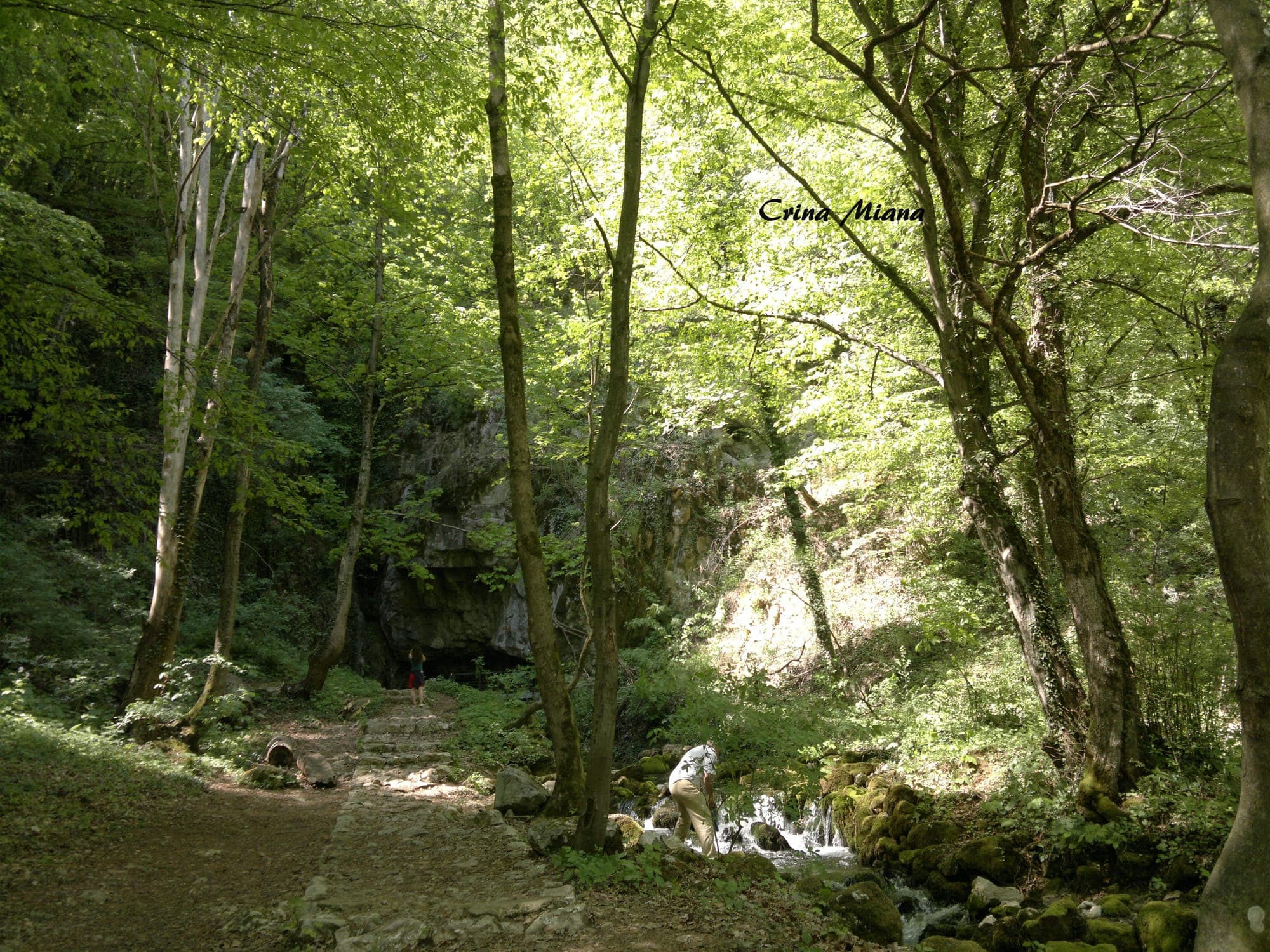
- Vadu Crișului Cave, ~55 km along the E60 towards Cluj: a guided route of 680 m, with a stream that comes out through a waterfall; in winter Tuesday–Sunday 10:00–16:00, booked by phone 24 hours ahead, 20 lei. You reach it on foot from the car park, in ~30 minutes.
- Meziad Cave, ~80 km via Beiuș: a 16 m portal and halls on two levels; in December–February entries are between 11:00 and 15:00 (40 lei).
- Bears' Cave, ~90 km via Beiuș (~1 hour 40 minutes): the most visited cave in Romania, with the bones of about 140 cave bears; open all year, with a guide, 40 lei.
Unguru Mare Cave, ~60 km away, is temporarily closed for works; call ahead. For more caves in the area, see the guide to the caves of the Apuseni Mountains.


Getting around Oradea: parking, railway station, airport
The centre is largely pedestrianised or has restricted traffic: you leave the car on the surrounding streets, in the paid zones, or in a car park in the centre and continue on foot. The OTL trams and buses go through Union Square and link the centre to the railway station.
Oradea railway station is ~2.5–3 km from Union Square, and the airport ~6–7 km to the west. By car, Oradea is ~150 km from Cluj-Napoca, ~120 km from Arad and ~15 km from the Borș border crossing, towards Hungary. For Băile Felix you leave on DN 76 towards Beiuș.
Frequently asked questions
- What are the main attractions in Oradea?
- In the centre: Union Square with the Black Eagle Palace, the Moon Church and the City Hall tower, Sion Synagogue, Darvas-La Roche House and the Regina Maria Theatre; the Oradea Fortress, ~1 km away; the Roman Catholic Basilica, the Baroque Palace and the Țării Crișurilor Museum, plus the zoo.
- What to see in Oradea in one day?
- Union Square, the Black Eagle passage, the Moon Church and the City Hall tower, then Sion Synagogue and Darvas-La Roche House on the riverbank and, in the afternoon, the Oradea Fortress with the City Museum. Everything is on foot; avoid Monday, when the museums are closed.
- How much is the entrance to Oradea Fortress?
- The courtyards and paths of the fortress are free. The City Museum in the princely palace costs 20 lei for adults and 10 lei for children over 4, pupils and pensioners; in winter it is open Tuesday–Sunday 9:00–17:00.
- Can you climb the City Hall tower in Oradea?
- Yes. The tower reopened on 18 July 2026 and can be climbed Tuesday–Sunday 10:00–18:00, with a 15 lei ticket (10 lei reduced); five people fit at the top at a time.
- What to do in Oradea with kids?
- The zoo (32 lei for adults, 16 lei for children aged 3–14), the vivarium at the Țării Crișurilor Museum, the courtyards of the Fortress, Union Square with the winter ice rink and the pools at Băile Felix, 8 km away.
- What to do in Oradea in winter?
- The Christmas market in Union Square, the museums (the City Museum and the Țării Crișurilor Museum, Tuesday–Sunday 9:00–17:00) and a day at Băile Felix, where the thermal pools are open all year.
- What are the attractions near Oradea?
- Băile Felix and Băile 1 Mai, 8 km away; Vadu Crișului Cave, ~55 km away; Meziad Cave, ~80 km away, and Bears' Cave, ~90 km away, via Beiuș.
- How far is Băile Felix from Oradea?
- Băile Felix is 8 km south of Oradea, on DN 76 towards Beiuș, about 15 minutes by car; the large car park is at the entrance to the resort.
Sources
All guides
- Things to do in Brașov: what to see in 1–2 days, in the city and nearby
- Things to do in Cluj-Napoca: what to see in 1–2 days, in the city and nearby
- Things to do in Bucharest: what to see in 1–2 days, in the city and nearby
- Things to do in Timișoara: what to see in 1–2 days, in the city and nearby
- Things to do in Iași: what to see in 1–2 days, in the city and nearby
- Things to do in Craiova: what to see in one day, in the centre and in the parks
- Things to do in Sibiu: what to see in 1–2 days, in the city and nearby
- Thermal baths in Romania: the resorts with thermal and mineral waters by region, with a map
- Thermal baths open in winter in Romania: where to bathe outdoors in warm water and what is indoors
- Spa resorts in Romania: the list, by type of mineral water and by the conditions they are recommended for
- The nearest thermal baths to Bucharest, Cluj, Brașov, Oradea, Timișoara, Sibiu and Arad: distances and what is open
- Thermal pools and water parks in Romania: where to go in summer, with children, for warm water and slides
- Mofettes in Romania: what a mofette is, how a session works and where to find them, from Covasna to Tușnad
- Christmas markets in Romania 2026: the list by city, dates and what you will find
- Craiova Christmas Market: opening hours, dates and what to find in 2026
- Sibiu Christmas Market 2026: opening hours, dates and what you will find in the Grand Square
- Christmas markets in Bucharest 2026: which ones, where and when
- Christmas in Romania: where to go, cities and regions to visit in December
- Ski slopes in Romania: the ski resorts and ski areas by region, with a map
- When the ski slopes open and where the snow comes first: the ski season in Romania
- Sledging, alpine coasters and tubing in Romania: where to go with a sledge
- The longest ski slope in Romania and the other records: the largest ski area, the highest, the hardest
- The nearest ski slopes to Bucharest, Cluj, Brașov, Sibiu, Iași, Timișoara and Oradea: distances for a day of skiing
- Beginner and kids' ski slopes in Romania: where to learn to ski, ski schools and slope colours
- Caves in Romania: the ones you can visit, by area, with a map
- Ice caves and underground glaciers in Romania: Scărișoara, Focul Viu, Vârtop, Borsec
- Apuseni caves: a 2–3 day route through Bihor and Alba
- The largest cave in Romania and the other records: the longest, the deepest, the oldest show cave
- The nearest cave to Bucharest, Brașov, Cluj, Sibiu, Oradea and Timișoara: distances for a day trip
- Famous caves in Romania you cannot visit: Movile, Topolnița, Vântului, Coliboaia, Peștera cu Oase (and what to see instead)
- Stalactites and stalagmites: what they are, how a cave forms and where to see them in Romania
- The Danube Delta: map, what it is, the villages and what to see
- Danube Delta trip: one, two or three days, where to start and how to get to Sulina and Sfântu Gheorghe
- Things to do in Tulcea: what to see in the city and around it
- Birds and wildlife of the Danube Delta: pelicans, where and when to see them
- Visiting the Danube Delta for the first time: the access permit, mosquitoes and when to go
- Fishing in the Danube Delta: the fishing permit, the 2026 closed season and where you may fish
- Sulina or Sfântu Gheorghe? The beaches of the Danube Delta (and Gura Portiței)
- Deltas near Bucharest: Văcărești, Comana (the Neajlov Delta) and Balta Mică a Brăilei
- The Romanian Black Sea coast: the resorts in order, north to south, with a map
- The best beaches in Romania (and the Blue Flag ones)
- The Black Sea season in Romania: when it opens, how long it lasts and when the water is warmest
- Wild beaches on the Romanian coast: Corbu, Vadu, Tuzla and the south
- Which Romanian seaside resort to choose: for young people, families, quiet, budget
- The Romanian seaside with kids: resorts, shallow beaches and what to do off the beach
- Things to do in Constanța: what to see in the city, on the seafront and nearby
- Jellyfish, sharks and lifeguard flags in the Black Sea
- Salt mines in Romania: the complete guide to the salt mines you can visit
- The largest, the deepest and the oldest salt mine in Romania
- The nearest salt mine to Bucharest, Cluj, Brașov, Sibiu, Iași, Timișoara, Oradea, Constanța and other cities
- Salt mines with children and babies: from what age, which one suits, what to bring
- Turda or Slănic Prahova? Which salt mine to choose
- Visiting a salt mine for the first time: temperature, clothing, how long, lift or bus, dogs
- Salt lakes and salt baths in Romania: where to swim, season and prices
- Salt mine therapy in Romania: what the operators say, how long to stay, which mines have a treatment base