
Things to do in Timișoara: what to see in 1–2 days, in the city and nearby

The sights of Timișoara are nearly all in the Cetate, the historic centre, 10 minutes' walk from one another: Union Square (Piața Unirii), the Baroque square with the Roman Catholic Dome of St George, the Serbian Orthodox Cathedral of the Ascension of the Lord and the National Museum of Art Timișoara, then Victory Square (Piața Victoriei), between the Timișoara National Theatre and Opera and the Metropolitan Cathedral of the Three Holy Hierarchs, and the Maria Theresia Bastion. Towards the Bega are the parks, and on the edge of the city, by the Pădurea Verde forest, the Banat Village Museum. Huniade Castle, the oldest building in the city, is closed for restoration and can only be seen from the outside.
Below are the sights by area, how to combine them in a day or a weekend, what is open in winter and on Mondays, what to do with children or when it rains and what to see around the city, 25–70 km away. The current opening hours and prices are on the page of each attraction; all the places are on the Timiș county page and on the map.
In short
- Most of the sights in Timișoara are in the Cetate, on foot: Union Square with the Roman Catholic Dome and the Serbian Cathedral, Victory Square with the Opera and the Metropolitan Cathedral, the Maria Theresia Bastion and the Cetate synagogue.
- On Mondays and Tuesdays the National Museum of Art, the museum in the Maria Theresia Bastion and the Banat Village Museum are closed; the Revolution Memorial is open every day of the week.
- The single ticket of 33 lei covers the National Museum of Banat (the Bastion), the National Museum of Art and the Banat Village Museum.
- Huniade Castle is closed for restoration; Timiș County Council announces a partial opening in 2027 and a full one in 2028.
- Traian Square in the Fabric district has been an urban regeneration worksite since March 2026, due to be finished in spring 2028.
Timișoara attractions: what to see, in one table
The table brings together the sights in the city, with their opening hours at the beginning of November 2026 and the adult price from their pages. The Cetate and the parks are done on foot; the Banat Village Museum is ~5 km away, by tram 1.
| Attraction | Where | What it is | Visit length | Hours and price |
|---|---|---|---|---|
| Union Square | Cetate | Baroque square, ~150 × 110 m | ~1 h | always open, free |
| Roman Catholic Dome | Union Square | Baroque cathedral from 1736–1774 | ~30 min | outside services |
| Serbian Cathedral | Union Square | Baroque church from 1744–1748 | ~30 min | outside services, free |
| National Museum of Art | Union Square | Baroque Palace, Baba collection | ~1 h 30 | Wednesday–Sunday 10–18 |
| Victory Square | Cetate | esplanade between the Opera and the Cathedral | ~45 min | always open, free |
| Metropolitan Cathedral | Victory Square | cathedral from 1936–1946, spire of ~83 m | ~30 min | daily, free |
| Opera and National Theatre | Victory Square | building from 1875 | one performance | Opera tour 20 lei |
| Maria Theresia Bastion | Cetate | bastion from the 1730s, museum | ~1 h 30 | museum Wednesday–Sunday 10–18, 40 lei |
| Revolution Memorial | ~1 km from Victory Square | museum of the 1989 Revolution | ~1 h 30 | daily, 20 lei |
| Huniade Castle | Cetate | the oldest building in the city | ~20 min | closed, outside only |
| Roses Park | bank of the Bega | rose garden from 1929–1934 | ~1 h | free |
| Banat Village Museum | Pădurea Verde, ~5 km | open-air museum, ~17 ha | ~2 h | from 16 November, Wednesday–Sunday, 20 lei |
Opening hours and adult prices from the attraction pages, checked on the official websites in 2026. The National Museum of Art does not publish its price on its information page; children and pupils get in free. The single ticket of 33 lei covers the Bastion, the Museum of Art and the Village Museum.


Union Square: the Dome, the Serbian Cathedral, the Museum
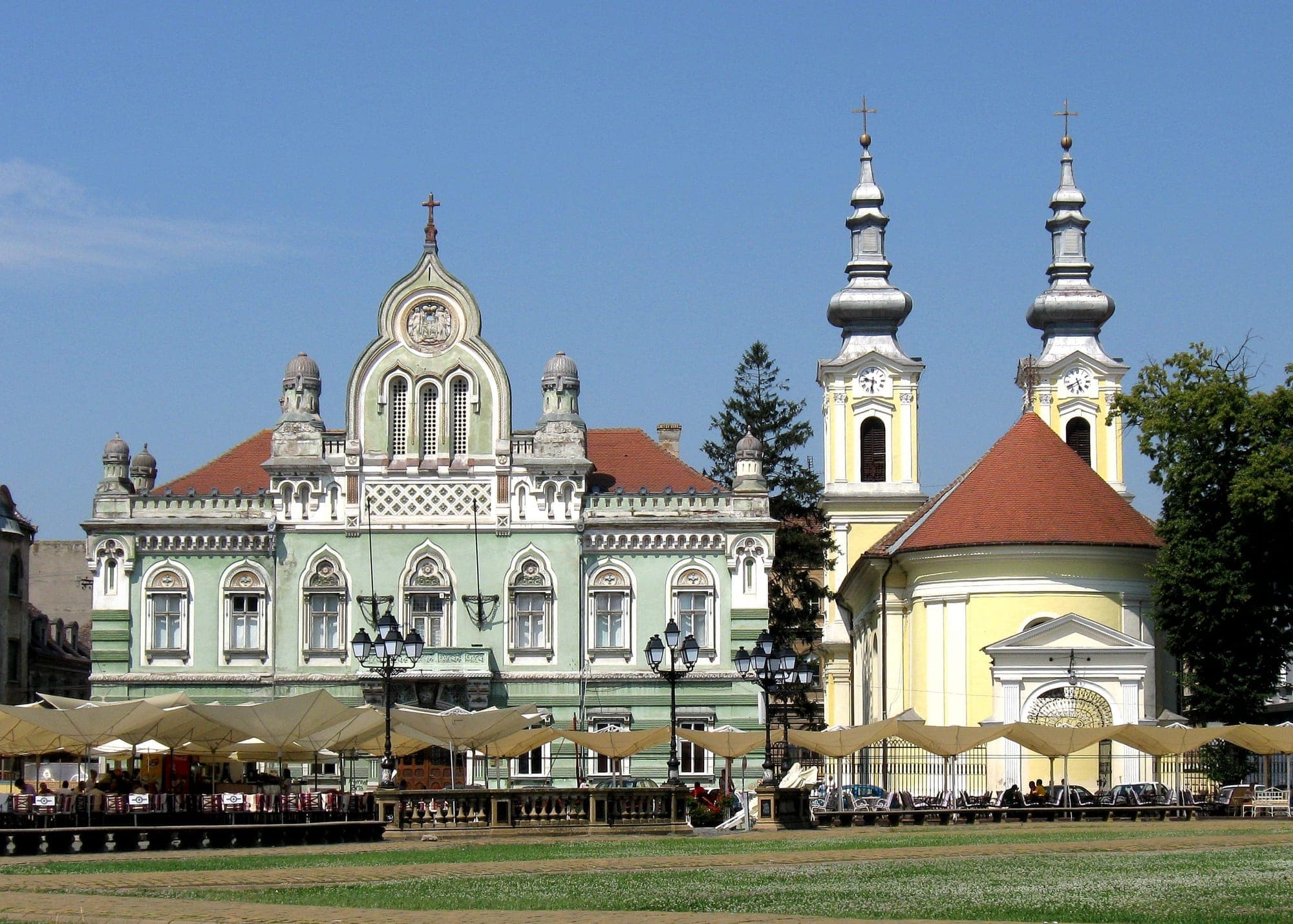
Union Square (Piața Unirii) is the oldest square in Timișoara, a Baroque rectangle of ~150 by 110 metres in the middle of the Cetate, with coloured houses from the 18th–20th centuries. In the middle stand the Plague Column, raised in memory of the epidemic of 1731–1738, and a fountain from 1894, above a 412 m borehole.
On the east side is the Roman Catholic Dome of St George, from 1736–1774, restored and reopened in April 2023; the altar painting, with Saint George, is from 1754. The visiting hours are not published, and the bishops' crypt can only be seen on request. On the west side, the Serbian Orthodox Cathedral of the Ascension of the Lord, from 1744–1748, has two clock towers and a gilded iconostasis from 1833–1836; entry is free, outside services.
On the south side, in the Baroque Palace begun in 1754, is the National Museum of Art Timișoara: old European painting, Banat art and the Corneliu Baba collection. In winter, from 1 October to 31 May, it is open Wednesday–Sunday 10:00–18:00. A few hundred metres away, on Strada Mărășești, the Cetate Synagogue, from 1863–1865, opens only for services and concerts.


Victory Square: the Opera, the Cathedral, the Revolution
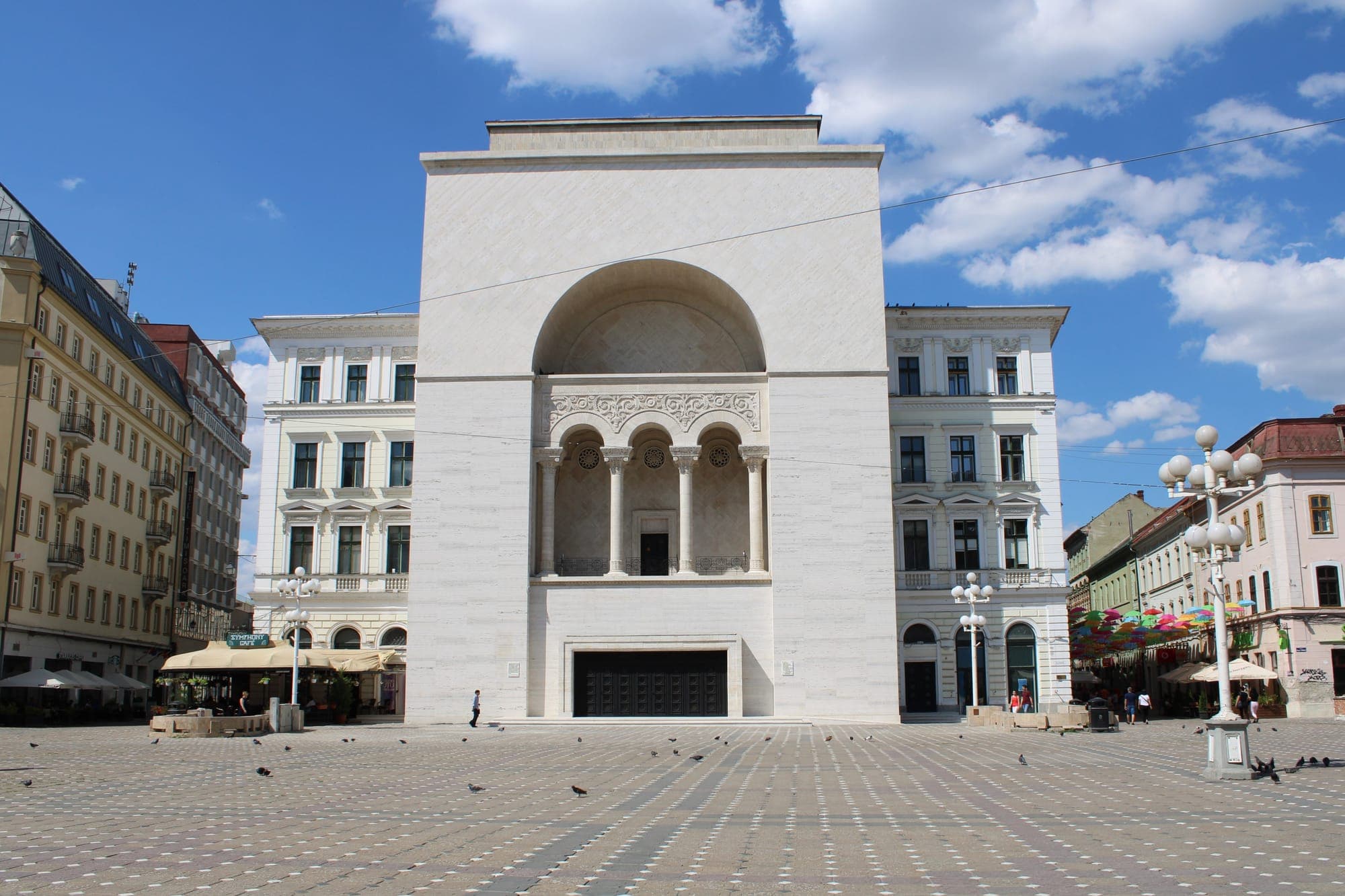
Victory Square (Piața Victoriei), 10 minutes from Union Square, is a pedestrian esplanade of ~300 m. At the north end is the Palace of Culture, with the Timișoara National Theatre and Opera: from the Opera's balcony, Timișoara was declared free of communism on 20 December 1989. You enter the building for performances or for the guided tour of the Opera (20 lei), on the days announced on ort.ro.
At the southern end is the Metropolitan Cathedral of the Three Holy Hierarchs, from 1936–1946, with a main spire of about 83 m and glazed-tile roofs; it is open daily for services, with free entry. Next to it, the Anton Scudier Central Park (Parcul Central „Anton Scudier”) has the Alley of Personalities, with bronze busts.
~1 km away, on Strada Oituz, the Memorial of the December 1989 Revolution keeps the clothes and flags of the days of December 1989 and the only section of the Berlin Wall in Romania. It is open Monday–Friday 8:00–17:00 and at weekends 10:00–18:00; the standard ticket costs 20 lei.


The Maria Theresia Bastion and Huniade Castle
The Maria Theresia Bastion is the largest surviving piece of the Austrian fortress built in the 1730s, between Strada Martin Luther and Bulevardul Revoluției din 1989. The courtyard, arcades and walls can be seen for free; inside the bastion is the National Museum of Banat, open Wednesday–Sunday 10:00–18:00. The full ticket costs 40 lei, a separate exhibition 12 lei.
Huniade Castle, the oldest building in the city, built in 1308–1315 by King Charles Robert of Anjou and rebuilt in the Romantic style in 1856, is closed for restoration: it can only be seen from the outside. On Țepeș Vodă Square, the Dicasterial Palace, from 1855–1860, houses the courts and can likewise only be seen from the street.

Parks in Timișoara, on the banks of the Bega
Timișoara calls itself “the city of flowers”, and the parks are 10–20 minutes from the centre, all with free entry:
- Roses Park (Parcul Rozelor), laid out in 1929–1934 on the bank of the Bega, with rose beds, 12 white pergolas and the Summer Theatre, where the Opera and Operetta Festival is held in August. The roses bloom in May–June and in September.
- Anton Scudier Central Park (Parcul Central „Anton Scudier”), next to the Metropolitan Cathedral, with wide alleys, a fountain and pergolas.
- Botanical Park (Parcul Botanic), over 8 ha in the north of the Cetate, with a Japanese garden from 2008 and a fragment of the fortress wall.


The Fabric district and the Banat Village Museum
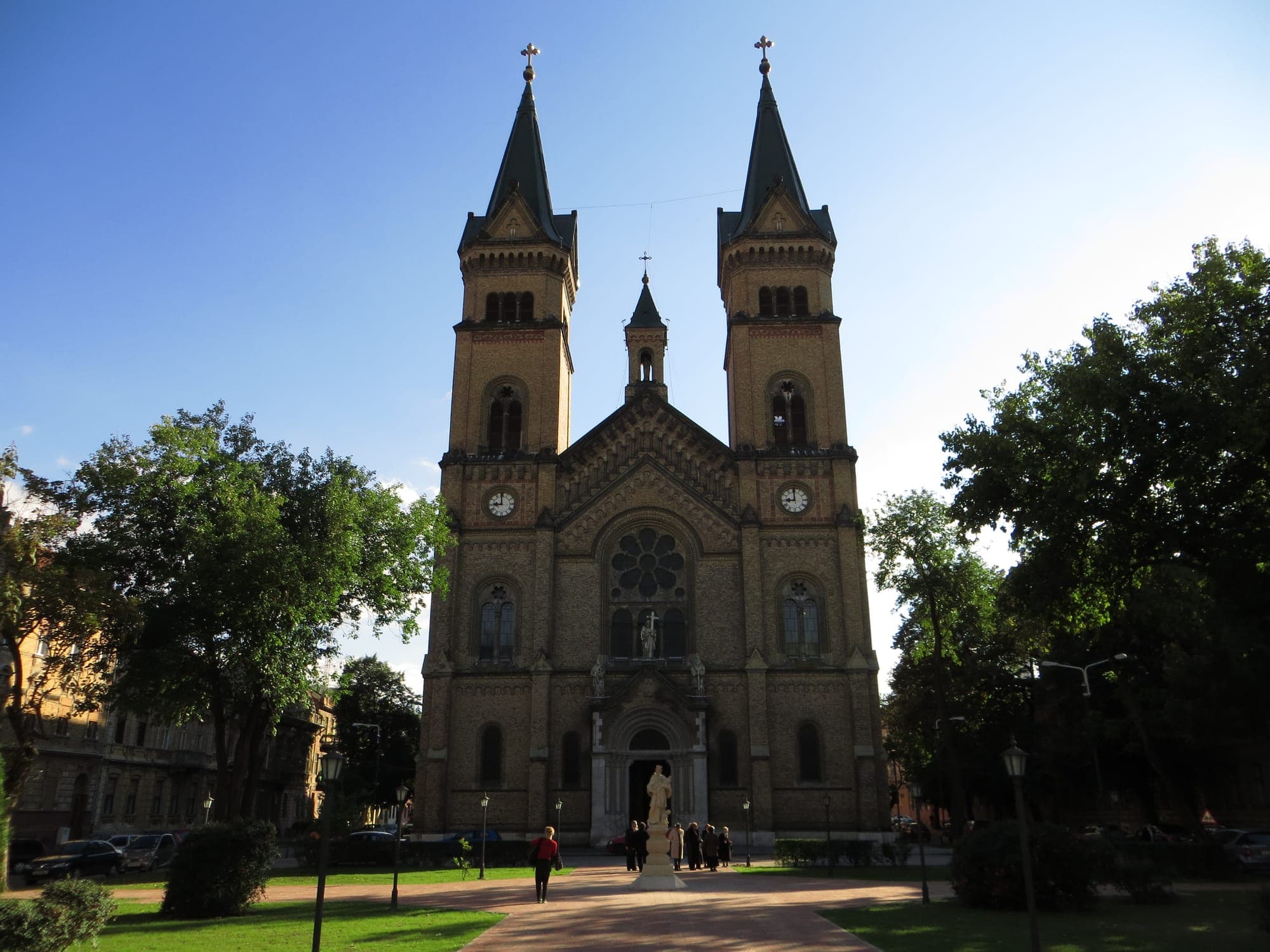
~2 km from Union Square, the Fabric district has the Millennium Roman Catholic Church, from 1896–1901, with two towers of 65.7 m, and the Fabric Synagogue, from 1899, which can only be seen from the street. Traian Square (Piața Traian), the centre of the district, is a worksite from March 2026 until spring 2028, with restricted access.
In the north-east of the city, ~5 km away, by the Pădurea Verde forest, the Banat Village Museum gathers houses, mills and a wooden church from 1746 on ~17 ha, plus the Alley of Ethnic Groups. You get there by tram 1 from Gara de Nord to the Meteo stop. Between 16 November and 15 March it is open Wednesday–Saturday 9:00–17:00 and Sunday 10:00–18:00; the ticket costs 20 lei, and pupils and preschoolers get in free.

What to do in Timișoara in one day or in 2 days
One day is enough for the Cetate. Morning: Union Square, the Dome and the Serbian Cathedral, then the Museum of Art at opening time. Midday: the Maria Theresia Bastion, the courtyard and the museum. Afternoon: Victory Square, the Metropolitan Cathedral and the Central Park, then Roses Park on the bank of the Bega. In the evening, a performance at the Opera or at the National Theatre. Choose a day from Wednesday to Sunday: on Mondays and Tuesdays the museums in the centre are closed.
The second day: the Revolution Memorial in the morning, then Fabric, with the Millennium Church, and in the afternoon the Banat Village Museum, by tram 1. By car, a third half-day goes to Domeniile Murani or to Buziaș.
Timișoara in winter, during the Christmas market
In winter, Victory Square (Piața Victoriei), Liberty Square and the Central Park host the Christmas market; the dates and the stalls' opening hours are in the Timișoara section of the Christmas markets guide. Here is what changes in the city in the cold months:
- The Banat Village Museum moves to its winter schedule on 16 November: Wednesday–Saturday 9:00–17:00, Sunday 10:00–18:00.
- The National Museum of Art is on its winter schedule, Wednesday–Sunday 10:00–18:00, until 31 May.
- The Revolution Memorial has changed hours over the holidays: in 2025–2026 it was closed on 24–26 and 31 December and on 1–2 January. In December, the city commemorates the days of the Revolution, 15–22 December 1989.
- The parks stay open, without flowers; Roses Park has its roses only from May.
What to do in Timișoara with kids
- The Banat Village Museum: wide alleys, houses you can go into, workshops; pupils and preschoolers get in free.
- The Maria Theresia Bastion: a cannon, uniforms and the exhibition about the “Plague Doctor”; children get in free.
- The National Museum of Art: children and pupils do not pay for a ticket.
- Union Square and Victory Square, pedestrian, with no traffic; in winter, the market's stalls and carousels.
- The parks: Roses, Central and Botanical, with alleys and lawns.
- Domeniile Murani, ~25 km away: a farm with animals, playgrounds and activities, with booking at weekends.
The Revolution Memorial is suitable from school age.
What to do in Timișoara when it rains
When it rains, stay in the Cetate: the Museum of Art and the Bastion, with the single ticket of 33 lei, the Dome and the Serbian Cathedral on Union Square, the Metropolitan Cathedral and the Revolution Memorial. In the evening, the Opera and the National Theatre. On Mondays and Tuesdays, when the museums are closed, the Revolution Memorial and the churches remain. The Village Museum and the parks are outdoors: keep them for a day with good weather.
Things to see around Timișoara, 25–70 km away
- Domeniile Murani, ~25 km away (~35 minutes): a family park with centuries-old trees, a farm and playgrounds, on an estate with a manor house under restoration; entry costs 10 lei, activities are paid separately.
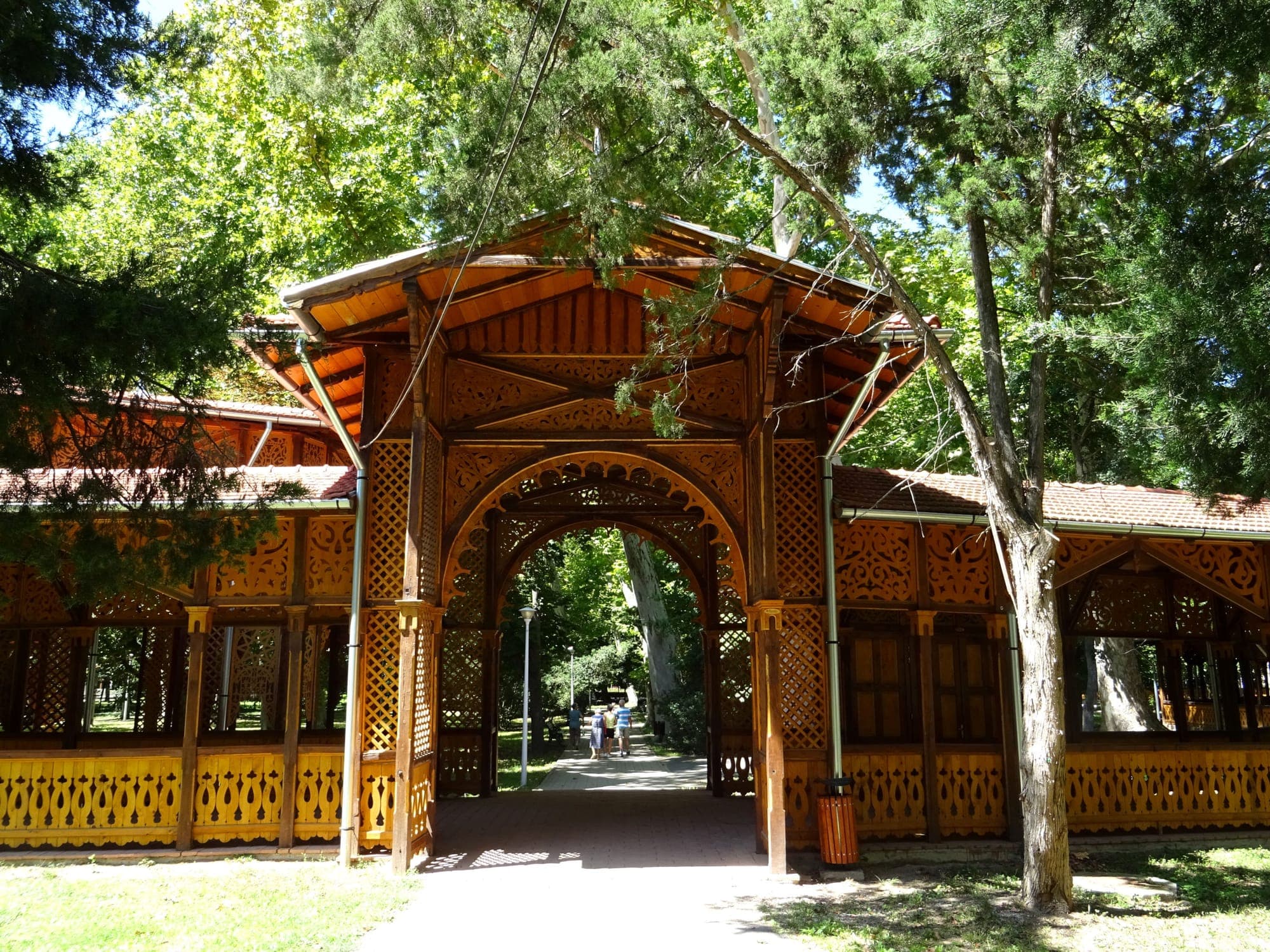
- Buziaș Spa Resort, ~36 km away (~45 minutes): carbonated mineral water springs, a park of over 20 ha and a wooden colonnade ~500 m long, open at any time.
- Nakó Castle in Sânnicolau Mare, ~65 km away on the DN6: a neoclassical castle begun in 1864, with the “Béla Bartók” Memorial Exhibition, which can be visited by appointment.
- Church of the Dormition of the Mother of God in Lugoj (the Two-Tower Church), ~69 km away on the A1: a Baroque church from 1759–1766, with towers of 57 m.
Getting around Timișoara: parking, station, airport
The historic centre has restricted traffic and pedestrian zones: you park in a nearby car park or on the paid streets of the TimPark system and continue on foot. Trams and trolleybuses link the station with the centre.
Gara de Nord is ~1.8 km from Victory Square (~25 minutes on foot) and ~2 km from Union Square. Traian Vuia Airport is ~12 km from the centre, by bus or taxi. By car, Timișoara is ~55 km from Arad on the A1 and ~320 km from Cluj-Napoca.
Frequently asked questions
- What are the main attractions in Timișoara?
- In the Cetate: Union Square with the Dome and the Serbian Cathedral, the National Museum of Art, Victory Square with the Opera and the Metropolitan Cathedral, the Maria Theresia Bastion and Huniade Castle (outside only). Further out: the Revolution Memorial, Roses Park, the Fabric district and the Banat Village Museum.
- What to see in Timișoara in one day?
- Union Square with the Dome and the Museum of Art, the Maria Theresia Bastion, Victory Square with the Metropolitan Cathedral and Roses Park, all on foot; in the evening, a performance at the Opera. Choose a day from Wednesday to Sunday, when the museums are open.
- How much does it cost to enter the Maria Theresia Bastion?
- The courtyard, arcades and walls are free. The full ticket for the museum in the bastion costs 40 lei, a separate exhibition 12 lei, and the single ticket for the museums of Timișoara 33 lei; children get in free.
- Can you visit Huniade Castle?
- Not inside: the castle is closed for restoration and can only be seen from the outside. Timiș County Council announces a partial opening of some spaces in 2027 and of the whole castle in 2028.
- What to do in Timișoara with kids?
- The Banat Village Museum and the Museum of Art (free for children and pupils), the Maria Theresia Bastion, the pedestrian squares, Roses Park and, ~25 km away, Domeniile Murani, with a farm and playgrounds.
- What to do in Timișoara in winter?
- The Christmas market in Victory Square, Liberty Square and the Central Park, the museums of the Cetate (Wednesday–Sunday), the Revolution Memorial and a performance at the Opera. The Banat Village Museum is on its winter schedule from 16 November.
- What are the best day trips from Timișoara?
- Domeniile Murani (~25 km), the Buziaș resort (~36 km), Nakó Castle in Sânnicolau Mare (~65 km) and the Two-Tower Church in Lugoj (~69 km).
Sources
All guides
- Things to do in Brașov: what to see in 1–2 days, in the city and nearby
- Things to do in Cluj-Napoca: what to see in 1–2 days, in the city and nearby
- Things to do in Bucharest: what to see in 1–2 days, in the city and nearby
- Things to do in Oradea: what to see in 1–2 days, in the city and nearby
- Things to do in Iași: what to see in 1–2 days, in the city and nearby
- Things to do in Craiova: what to see in one day, in the centre and in the parks
- Things to do in Sibiu: what to see in 1–2 days, in the city and nearby
- Thermal baths in Romania: the resorts with thermal and mineral waters by region, with a map
- Thermal baths open in winter in Romania: where to bathe outdoors in warm water and what is indoors
- Spa resorts in Romania: the list, by type of mineral water and by the conditions they are recommended for
- The nearest thermal baths to Bucharest, Cluj, Brașov, Oradea, Timișoara, Sibiu and Arad: distances and what is open
- Thermal pools and water parks in Romania: where to go in summer, with children, for warm water and slides
- Mofettes in Romania: what a mofette is, how a session works and where to find them, from Covasna to Tușnad
- Christmas markets in Romania 2026: the list by city, dates and what you will find
- Craiova Christmas Market: opening hours, dates and what to find in 2026
- Sibiu Christmas Market 2026: opening hours, dates and what you will find in the Grand Square
- Christmas markets in Bucharest 2026: which ones, where and when
- Christmas in Romania: where to go, cities and regions to visit in December
- Ski slopes in Romania: the ski resorts and ski areas by region, with a map
- When the ski slopes open and where the snow comes first: the ski season in Romania
- Sledging, alpine coasters and tubing in Romania: where to go with a sledge
- The longest ski slope in Romania and the other records: the largest ski area, the highest, the hardest
- The nearest ski slopes to Bucharest, Cluj, Brașov, Sibiu, Iași, Timișoara and Oradea: distances for a day of skiing
- Beginner and kids' ski slopes in Romania: where to learn to ski, ski schools and slope colours
- Caves in Romania: the ones you can visit, by area, with a map
- Ice caves and underground glaciers in Romania: Scărișoara, Focul Viu, Vârtop, Borsec
- Apuseni caves: a 2–3 day route through Bihor and Alba
- The largest cave in Romania and the other records: the longest, the deepest, the oldest show cave
- The nearest cave to Bucharest, Brașov, Cluj, Sibiu, Oradea and Timișoara: distances for a day trip
- Famous caves in Romania you cannot visit: Movile, Topolnița, Vântului, Coliboaia, Peștera cu Oase (and what to see instead)
- Stalactites and stalagmites: what they are, how a cave forms and where to see them in Romania
- The Danube Delta: map, what it is, the villages and what to see
- Danube Delta trip: one, two or three days, where to start and how to get to Sulina and Sfântu Gheorghe
- Things to do in Tulcea: what to see in the city and around it
- Birds and wildlife of the Danube Delta: pelicans, where and when to see them
- Visiting the Danube Delta for the first time: the access permit, mosquitoes and when to go
- Fishing in the Danube Delta: the fishing permit, the 2026 closed season and where you may fish
- Sulina or Sfântu Gheorghe? The beaches of the Danube Delta (and Gura Portiței)
- Deltas near Bucharest: Văcărești, Comana (the Neajlov Delta) and Balta Mică a Brăilei
- The Romanian Black Sea coast: the resorts in order, north to south, with a map
- The best beaches in Romania (and the Blue Flag ones)
- The Black Sea season in Romania: when it opens, how long it lasts and when the water is warmest
- Wild beaches on the Romanian coast: Corbu, Vadu, Tuzla and the south
- Which Romanian seaside resort to choose: for young people, families, quiet, budget
- The Romanian seaside with kids: resorts, shallow beaches and what to do off the beach
- Things to do in Constanța: what to see in the city, on the seafront and nearby
- Jellyfish, sharks and lifeguard flags in the Black Sea
- Salt mines in Romania: the complete guide to the salt mines you can visit
- The largest, the deepest and the oldest salt mine in Romania
- The nearest salt mine to Bucharest, Cluj, Brașov, Sibiu, Iași, Timișoara, Oradea, Constanța and other cities
- Salt mines with children and babies: from what age, which one suits, what to bring
- Turda or Slănic Prahova? Which salt mine to choose
- Visiting a salt mine for the first time: temperature, clothing, how long, lift or bus, dogs
- Salt lakes and salt baths in Romania: where to swim, season and prices
- Salt mine therapy in Romania: what the operators say, how long to stay, which mines have a treatment base