
Fortified churches in Transylvania: the 7 UNESCO villages, the peasant fortresses and a route through the Saxon villages

A fortified church is a village church turned into a fortress: curtain walls with towers, a wall walk and storerooms where the villagers kept their grain and took shelter during sieges. Transylvania has more than 160 of them, built mostly by the Saxons, and seven villages make up the UNESCO site “Villages with Fortified Churches in Transylvania”: Biertan, Prejmer, Viscri, Saschiz, Valea Viilor, Dârjiu and Câlnic. Where the church was not fortified, communities built peasant fortresses of refuge on the hills instead, as at Râșnov, Rupea or Saschiz.
Below are the ten most-searched fortified churches in a table, followed by the villages grouped around Brașov, around Sibiu and Mediaș, around Sighișoara and Rupea and in the Székely Land, then the peasant fortresses and the one-day route Rupea – Viscri – Saschiz – Sighișoara, with distances. Royal and noble castles, bastion fortresses and Dacian fortresses are covered in the guide to Romania's fortresses.
In short
- A fortified church is a village church surrounded by walls, towers and food storerooms, where the community took refuge during sieges; Transylvania has more than 160, according to the Fortified Churches Foundation.
- The UNESCO site “Villages with Fortified Churches in Transylvania” has 7 components: Biertan (inscribed in 1993), Prejmer, Viscri, Saschiz, Valea Viilor, Dârjiu and Câlnic (added in 1999).
- Six of them were built by the Saxons, who were Lutheran; Dârjiu is the only Székely and Unitarian church on the site, and Câlnic is the 13th-century residence of a count (greav) that became a peasant fortress.
- “The 7 Saxon citadels” are not the 7 UNESCO churches: the phrase comes from Transylvania's German name, Siebenbürgen, which is put down to seven towns founded by the Saxons (Sibiu, Brașov, Sighișoara, Mediaș, Bistrița, Sebeș, Cluj-Napoca).
- The Rupea – Viscri – Saschiz – Sighișoara route involves about 60 km of driving and can be done in a day (calculated on OpenStreetMap, November 2026).
- In November 2026 the interior of the church in Viscri and its main tower are closed for restoration (probably until 2027), Dârjiu is closed until 31 March, and Roadeș cannot be visited while the works last.
Top 10 fortified churches in Transylvania
The table brings together the seven components of the UNESCO site and the three fortified churches most searched for after them: Hărman, Cisnădioara and St Margaret's Church, Mediaș. Each has its full opening hours and directions on its own page; here you will find only what sets it apart and what admission costs.
All of them are on the map of fortresses and fortifications, alongside the other fortified churches on the site.
| Church | Village, county | What sets it apart | Adult ticket | Status (November 2026) |
|---|---|---|---|---|
| Biertan Fortified Church | Biertan, Sibiu | three rings of walls, the polyptych altarpiece from 1483–1513, the door with 19 locks; UNESCO since 1993 | not published | open; in winter Tuesday–Sunday 11:00–15:00 |
| Prejmer Fortified Church | Prejmer, Brașov | oval wall 10–12 m high with more than 270 refuge storerooms; UNESCO | 30 lei | open; in winter 09:00–16:00 (Sunday from 11:00) |
| Viscri Fortified Church | Viscri, Brașov | 12th-century chapel, grain galleries, village museum; UNESCO | 20 lei (reduced) | interior and main tower closed for restoration since 14 September 2026 |
| Saschiz Fortified Church | Saschiz, Mureș | tower from 1677 copied from the Clock Tower in Sighișoara; UNESCO | 10 lei | closed on Tuesdays and Wednesdays |
| Valea Viilor Fortified Church | Valea Viilor, Sibiu | choir raised as a tower with four defensive levels, portcullis from 1525; UNESCO | 8 lei | opened by the custodian; phone ahead in winter |
| Dârjiu Fortified Church | Dârjiu, Harghita | Székely Unitarian church, frescoes from 1419, bacon kept in the towers; UNESCO | 10 lei | closed 1 November – 31 March |
| Câlnic Fortress | Câlnic, Alba | residential tower of a count (greav), from around 1270, that became a peasant fortress; UNESCO | not published | phone ahead; hours not published |
| Hărman Fortified Church | Hărman, Brașov | 12 m wall with seven towers, chapel with 15th-century frescoes | 20 lei | open; in winter daily 10:00–16:00 |
| Cisnădioara Fortified Church | Cisnădioara, Sibiu | Romanesque basilica on a rocky spur, a 10–15 minute walk uphill | 10 lei | winter hours not published; phone ahead |
| St Margaret's Church, Mediaș | Mediaș, Sibiu | church enclosed within the town's citadel, leaning tower almost 70 m high | 15 lei | November–December: Tuesday–Saturday 11:00–15:00, Sunday 11:15–15:00 |
Tickets and opening hours from the attraction pages, checked on 20 November 2026. Biertan and Câlnic do not publish their prices online. Winter hours are reduced almost everywhere; in villages with no posted hours, the key is held by the custodian or the parish.
What is a fortified church and how did it work
Villages on the armies' routes had no castle and no money for a fortress, so they turned their church into a refuge. Defensive storeys with firing holes were added above the nave and the choir, as at Saschiz and Dârjiu, and walls with towers and a wall walk were raised around it. Along the inner face of the wall each family had its storeroom: at Prejmer there are more than 270, on three or four levels of wooden galleries, including two classrooms so that school did not stop during sieges. Valea Viilor still has its portcullis, the wood and iron grille that was lowered over the entrance.
The storeroom tradition has survived in some villages: in Dârjiu families still keep their bacon in the fortress towers today, and in Viscri the eastern bastion is called the “bacon tower”.
Most are Saxon and Lutheran, but not all: in the Székely Land and in Alba there are Unitarian, Roman Catholic and Reformed fortified churches, and at Câlnic the starting point was not a church but the residence of a count (greav), bought by the villagers in 1430.
UNESCO fortified churches: the 7 villages on the site
The site “Villages with Fortified Churches in Transylvania” was inscribed on the World Heritage List in 1993 with Biertan and extended in 1999 with six more villages. Between 1572 and 1867 Biertan was the seat of the Saxons' Lutheran bishops, and its church is defended by three enclosures.
- Prejmer, about 18 km from Brașov: a church built on the plan of a Greek cross, rare in Transylvania, with a triptych altarpiece from around 1450–1460.
- Viscri: a 12th-century chapel that grew into a fortified church, in a Saxon village preserved almost intact.
- Saschiz: a hall church from 1493–1525, with a defensive storey resting on 22 buttresses, right on the DN13.
- Valea Viilor, near Mediaș: a defensive system preserved almost in full, with an oval wall 6–7 m high.
- Dârjiu, near Odorheiu Secuiesc: the only church built by the Székelys, with the legend of Saint Ladislaus painted in 1419.
- Câlnic, near Sebeș: the only component that is a fortress rather than a church, with the “Siegfried” keep, more than 20 m high.
Câlnic and Dârjiu are far from the others, the first west of Sibiu and the second in Harghita, so a circuit taking in all seven needs at least two days.


Fortified churches near Brașov, in the Burzenland
Around Brașov the fortified churches lie 10–30 km from the city, on national roads, and can easily be combined in half a day.
- Prejmer and Hărman, about 8 km apart, to the east. Hărman has the tallest bell tower in the region, 56 m high, and a chapel with a Last Judgement painted in the 15th century.
- Sânpetru, on the edge of Brașov, with a chapel with frescoes from around 1400; visits are arranged with the parish.
- Cristian and Ghimbav, to the west, on the road to Râșnov and Făgăraș; Cristian has a double enclosure with eight towers.
- Codlea, with a coffered ceiling from 1702 made up of 252 painted panels.
- Măieruș, on the bank of the Olt, and Bod, near the DN13; in Bod only the bell tower remains of the old fortification.
Prejmer and Hărman have daily opening hours and tickets; for the others, visits are arranged with the parish. What else to see in the city is in the Brașov guide.


Fortified churches near Sibiu and Mediaș
Near Sibiu there are two churches a quarter of an hour from the centre: Cisnădioara, the Romanesque basilica on the rocky spur that locals call “the fortress”, and Cisnădie, with a clock tower from 1425 and double walls. About 15 km from Sibiu, Ocna Sibiului has a fortified Reformed church, and on the DN14 towards Mediaș, Axente Sever has one with a museum in its former storerooms.
Most of the villages lie along the Târnava Mare, between Mediaș and Sighișoara:
- Biertan, with Richiș (the Green Man carved in stone) about 6 km away and Copșa Mare 10 km away, with a last stretch of road described as poor.
- Valea Viilor, Moșna (a corner of the wall collapsed in June 2026) and Alma Vii, with micro-museums in its towers, south of Mediaș.
- Mălâncrav, with the largest ensemble of Gothic frescoes in Transylvania, and Ighișu Nou.
In Mediaș, St Margaret's Church, Mediaș stands inside the town's citadel, with its walls and school preserved. Towards Agnita are Hosman, in the Hârtibaciu valley, and Agnita, with four guild towers. For the city of Sibiu, see the Sibiu guide.


Sighișoara to Rupea: Viscri, Saschiz and nearby villages
On the DN13, the road between Sighișoara and Brașov, the fortified churches are a few kilometres off the main road. Saschiz can be seen from the road itself; Viscri is about 7 km from the DN13, on a local road that starts at Dacia.
Around them, the lesser-known villages have locked churches, whose key you ask for in the village or at the Lutheran parish in Rupea:
- Bunești, with its grain storerooms built against the wall, and Criț, 4 km from Bunești, on a hill in the middle of the village;
- Meșendorf, at the end of a local road off the DN13;
- Homorod, about 5 km from Rupea, with an eight-storey keep, and Drăușeni, with a carved stone west portal;
- Apold, about 16 km from Sighișoara, with walls and towers preserved almost intact.
Roadeș, about 3 km off the DN13 near Bunești, cannot be visited: the church tower partly collapsed in 2016 and restoration is under way. The oval enclosure, with three surviving towers, can be seen from the village.


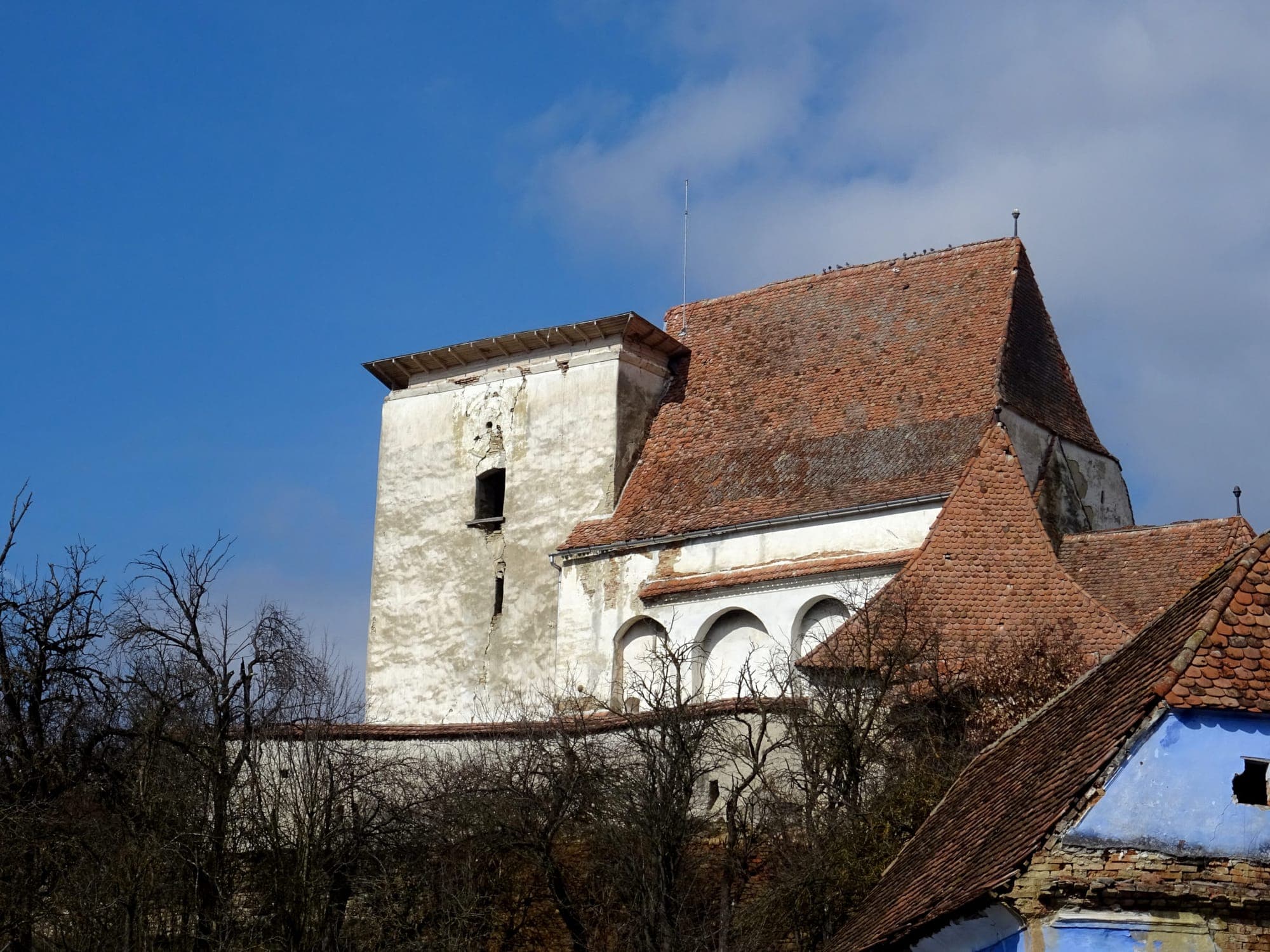
Székely and Hungarian fortified churches
Apart from Dârjiu, the Székely Land has Roman Catholic fortified churches in the Ciuc basin: Cârța, on a rocky hill, Mihăileni, with 15th-century frescoes, and Ciucsângeorgiu, with a crenellated wall and a gate tower. In Covasna, Ghidfalău has a Reformed church enclosed by a wall with a gate tower, on the terrace above the Olt.
Near Alba Iulia there are three Reformed churches with enclosures: Cricău, Romanesque, with a keep tower, Șard and Ighiu, where only remains of the enclosure survive. None has published opening hours: they are churches in use, and to see the interior you ask at the parish.


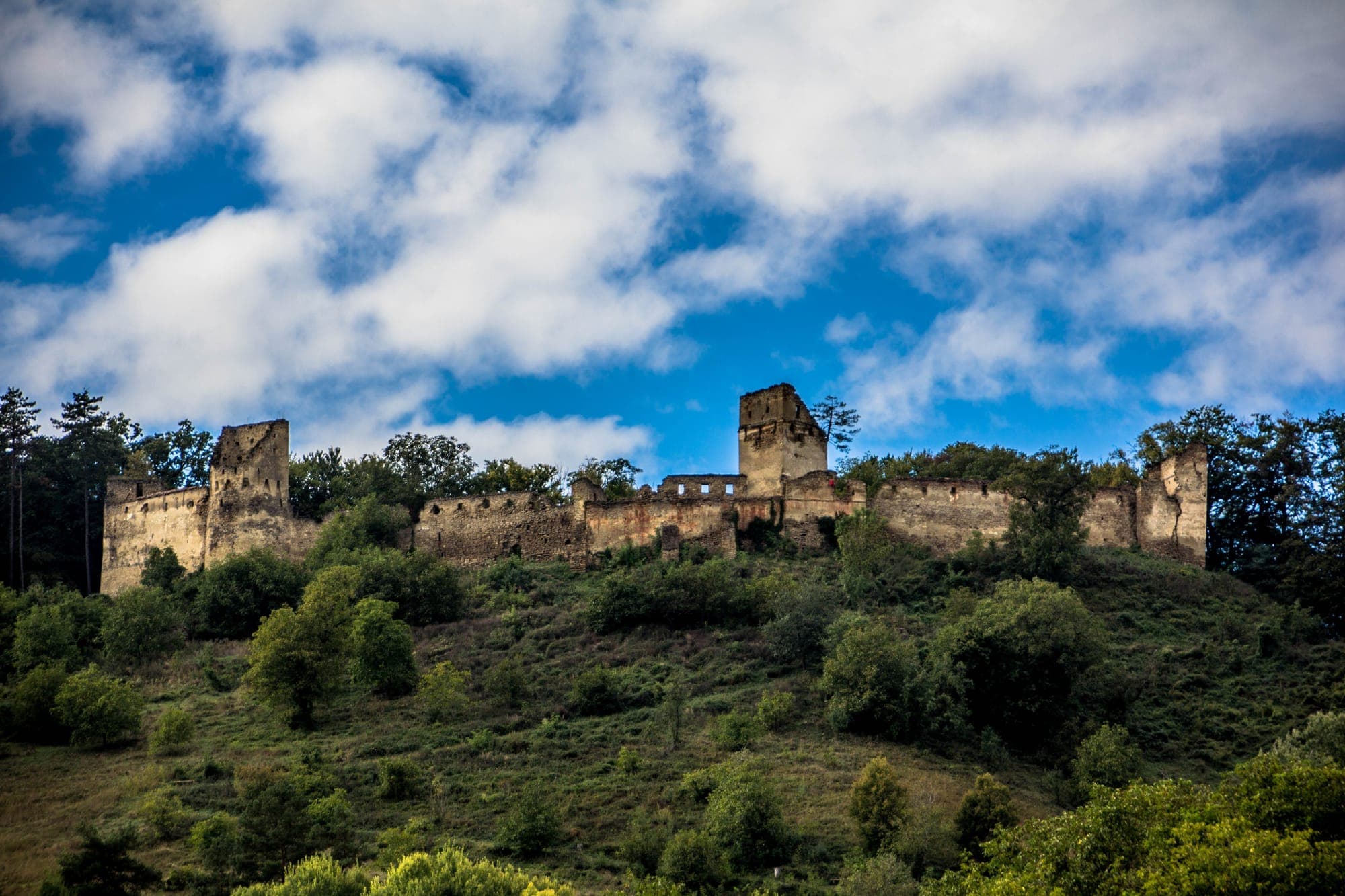
Peasant fortresses: Râșnov, Rupea, Saschiz, Slimnic, Câlnic
A peasant fortress is a refuge built by the community on a hill, not a nobleman's residence: in times of danger, people climbed up there with their provisions and animals.
- Râșnov Fortress sheltered the people of Râșnov, Cristian and Ghimbav; its 146 m well was dug into the rock in 1623–1640. The upper enclosure is closed for restoration, with reopening expected from 2028; the fortress garden and the Báthory Tower can be visited.
- Rupea Fortress, first recorded in 1324, rises in enclosures one above the other on a basalt hill; it was restored in 2010–2013.
- Saschiz Peasants' Fortress, also known as the Peasant Fortress, stands on the hill above the village, about 2 km on foot from the centre; tradition links its construction to seven Saxon villages.
- Slimnic Fortress, about 18 km from Sibiu, is a brick ruin with a hall church that was never finished.
- Câlnic Fortress, the UNESCO component, and Feldioara Fortress, built on the site of the Teutonic Knights' fortification and rebuilt in 2013–2017.
Jimbor Fortress, near Rupea, is an undeveloped ruin that you view from outside. On the road between Sebeș and Câlnic, in Gârbova, the Counts' Fortress (Cetatea Greavilor) is a fortified noble residence whose former keep became a clock tower.




One-day route: Rupea – Viscri – Saschiz – Sighișoara
The classic route through the Saxon villages follows the DN13 from Rupea towards Sighișoara and involves about 60 km of driving, including the detour to Viscri. Coming from Brașov, add the roughly 65 km to Rupea.
- Rupea Fortress in the morning, open daily from 9:00.
- Viscri, about 15 km away: the enclosure, the museum and the south bastion can be visited while the church is being restored. Leave the car in the car park at the entrance to the village.
- Optionally, Bunești and Criț, 4 km apart, if you have phoned ahead for the key.
- Saschiz: the church (closed on Tuesdays and Wednesdays) and, if it is open, the Saschiz Peasants' Fortress on the hill.
- Sighișoara, about 20 km away, where the day ends in the Sighișoara Citadel.
From Brașov, Prejmer and Hărman can be fitted in before the route only on a long summer day; otherwise they make a separate half day.
| From – to | Distance | Driving time |
|---|---|---|
| Brașov – Prejmer | ~18 km | ~25 min |
| Prejmer – Hărman | ~8 km | ~10 min |
| Brașov – Feldioara | ~23 km | ~30 min |
| Brașov – Rupea | ~65 km | ~1 h |
| Rupea – Viscri | ~15 km | ~15 min |
| Viscri – Bunești | ~9 km | ~10 min |
| Bunești – Criț | ~4 km | ~5 min |
| Viscri – Saschiz | ~23 km | ~25 min |
| Saschiz – Sighișoara | ~20 km | ~20–30 min |
| Rupea – Sighișoara, direct on the DN13 | ~50 km | ~50 min |
| Saschiz – Dârjiu | ~26 km | ~35 min |
Calculated on OpenStreetMap (OSRM) between the attractions' coordinates, 20 November 2026, rounded; Brașov – Prejmer, Brașov – Rupea, Saschiz – Sighișoara and Rupea – Sighișoara are taken from the attraction pages.
A 2–3 day circuit between Brașov, Sighișoara and Sibiu
Two days cover five of the seven UNESCO components, from east to west.
- Day 1, Brașov – Sighișoara: Prejmer in the morning, then along the DN13 through Feldioara, Rupea, Viscri and Saschiz. Spend the night in Sighișoara.
- Day 2, Sighișoara – Sibiu: Biertan (~30 km), with Richiș 6 km away, then Mediaș (~25 km from Biertan), with St Margaret's Church, Mediaș, and Valea Viilor (~15 km from Mediaș). From there, Sibiu is about 50 km away.
A third day adds one of the remote components: Dârjiu, about 38 km from Sighișoara (only between April and October), or Câlnic, about 50 km from Sibiu. Cisnădioara, 14 km from Sibiu, fits into any day spent there.
Without a car, the yellow line of the UNESCO Bus minibuses stops in Biertan four times a week between May and October, and the blue line stops in Valea Viilor all year round, with online booking.
Opening hours, keys and winter visits
- Opening hours: only a few churches have daily hours and a ticket office (Prejmer, Hărman, Biertan, Viscri, Mediaș, Cisnădioara, Saschiz). At the others, the key is held by a custodian in the village, whose number is posted on the gate, or by the Lutheran parish; for the villages around Rupea, the Fortified Churches Foundation refers visitors to the parish in Rupea. Phone a day ahead.
- Winter: hours are reduced and some churches close: Dârjiu is closed between 1 November and 31 March, Biertan is closed on Mondays, Mediaș is open only at weekends in January–February, and the peasant fortress in Saschiz is open Friday–Sunday, weather permitting.
- Services: these are churches in use; on Sunday mornings visits may be stopped (in Viscri, usually on the second or third Sunday of the month, 11:00–12:00).
- Works (November 2026): in Viscri the church interior and main tower are closed, Roadeș cannot be visited, in Râșnov only the fortress garden can be seen, and in Moșna it is worth asking whether you can go in after the wall collapse.
- Payment: in Râșnov tickets can be paid by card only, and in Hărman card payment is not guaranteed.
On wooden stairs and galleries, such as those in Prejmer and Biertan, you need comfortable shoes and should keep a close eye on small children.
Frequently asked questions
- What is a fortified church?
- A village church turned into a fortress: with defensive storeys above the nave, a curtain wall with towers and a wall walk, and storerooms where each family kept its provisions and took shelter during sieges. Transylvania has more than 160, according to the Fortified Churches Foundation.
- Which fortified churches in Transylvania are UNESCO World Heritage sites?
- Seven components of the site “Villages with Fortified Churches in Transylvania”: Biertan (inscribed in 1993), Prejmer, Viscri, Saschiz, Valea Viilor, Dârjiu and Câlnic (added in 1999). Câlnic is a peasant fortress, not a church.
- What are the seven Saxon citadels of Transylvania?
- The phrase comes from Transylvania's German name, Siebenbürgen, which tourism sources explain by seven walled towns founded by the Saxons: Sibiu, Brașov, Sighișoara, Mediaș, Bistrița, Sebeș and Cluj-Napoca. They are not the 7 villages with fortified churches on the UNESCO site.
- What is the largest fortified church in Transylvania?
- The attraction pages do not give a comparable ranking. Prejmer is one of the largest, with an oval wall 10–12 m high and more than 270 storerooms; Biertan has three rings of walls, and Hărman covers almost one and a half hectares.
- How far is Viscri from Rupea Fortress?
- About 15 km, roughly 15 minutes by car, along the DN13 to Dacia and then on the local road to Viscri (calculated on OpenStreetMap, November 2026).
- Is Viscri fortified church open?
- Partly: since 14 September 2026 the church interior and the main tower have been closed for restoration, probably until 2027. The museum, the gate tower and the south bastion can be visited, with a reduced ticket of 20 lei (November 2026).
- Can you visit the fortified churches in winter?
- Yes, with reduced hours: Prejmer, Hărman, Biertan, Viscri and Mediaș stay open, and in the small villages visits are arranged with the custodian or the parish. Dârjiu is closed between 1 November and 31 March.
- What is a peasant fortress?
- A refuge built by a village community on a hill, not a nobleman's residence, where people withdrew with their provisions in times of danger. The best known in Transylvania are Râșnov, Rupea, Saschiz and Slimnic.
- Is there a map of the fortified churches in Transylvania?
- On the site's interactive map, under the “Fortresses and fortifications” category, every fortified church on the site has a pin, and their pages give the coordinates and directions.
- Are there fortified churches outside Transylvania?
- Yes, but only a few: in Galați, the Sfânta Precista Fortified Church, consecrated in 1647, has walls up to 1.8 m thick and a fortified attic with 28 embrasures.
Tickets and tours
- Buy ticket
Day trip from Bucharest: Sighișoara and Biertan

- Buy ticket
From Sibiu: two UNESCO sites, Sighișoara and Biertan
- Buy ticket
Day trip: Sighișoara and Viscri
- Buy ticket
From Brașov: Sighișoara, Viscri and pálinka tasting
- Buy ticket
Day trip from Brașov: Peleș, Bran and Râșnov Fortress
- Buy ticket
From Brașov: bear sanctuary, Bran Castle and Râșnov Fortress
- Buy ticket
Brașov city tour, Râșnov Fortress and Valea Cetății Cave
Sources
Attractions by area and category
Related guides
- Fortresses in Romania: the most important ones, by type and region, with a map
- Dacian fortresses in Romania: the 6 UNESCO fortresses of the Orăștie Mountains, map and how to get there
- Fortresses in Dobruja: Histria, Enisala, Capidava and the other Greek, Roman and medieval fortresses, with a map
- Things to do in Sibiu: what to see in 1–2 days, in the city and nearby
- Caves in Romania: the ones you can visit, by area, with a map